Meditating on the Sri Yantra
Patanjali’s Yoga Sutra II.48, tatah dvandaha anabhighataha is translated by B.K.S. Iyengar as “from then on [after the yogi through steady practice has absorbed him/herself in the practice of yoga), the sadhaka (practitioner) is undisturbed by dualities.” This sutra follows the only two in all of Patanjali’s Yoga Sutras that specifically discuss asana, which Patanjali describes as a controlled and perfect ease and steadiness of mind and body.
I was thinking about the freedom from the “pairs of opposites” — pleasure and pain, etc. — when I read an article in the Washington Post yesterday dividing everyone who was impacted by the blizzard as a winner or a loser. Children off from school were winners, frustrated parents, travelers who were grounded from flying, and politicians sure to be blamed for not having planned in a Southern city to have the snow removal equipment, personnel, and budget of a city like Buffalo, NY, were losers. I am fairly certain (based on the harangues on the blogs) that the author was not alone in seeing everything as winning or losing. To me, though, it feels like one of the “afflictions” described by Patanjali. I was a grounded flyer. I was much looking forward to a trip to San Francisco to see a dear friend from college and then to attend the weekend workshop with John Friend. It would have been great fun to be there. I was disappointed. But it never would have occurred to me to label myself a loser. Do so so would just had me hold onto unhappiness.
Yoga teaches us to look for the good, to accept what we cannot change, and to seek to respond in the highest. In essence, we are changing what we can change, which is how we react. If my only reaction to the storm was pain and sadness from having the pleasure of my planned trip taken away from me, then I would in fact be a loser. If I just accept that no one can anticipate when record-breaking winter storms are going to arrive and then have the best day I can under the unavoidable circumstances, then I am a winner. I am not a winner in a game where someone else is a loser. I am not a winner in that I did not let Mother Nature win. Rather, I have learned that the steady practice of yoga makes life more easeful and delightful even in challenges and disappointments. I am motivated to practice more. The lessons learned from being confined a blizzard when I was warm, well fed, and surrounded by friends are a hopeful prelude for how the yoga will serve when I really face a challenge.
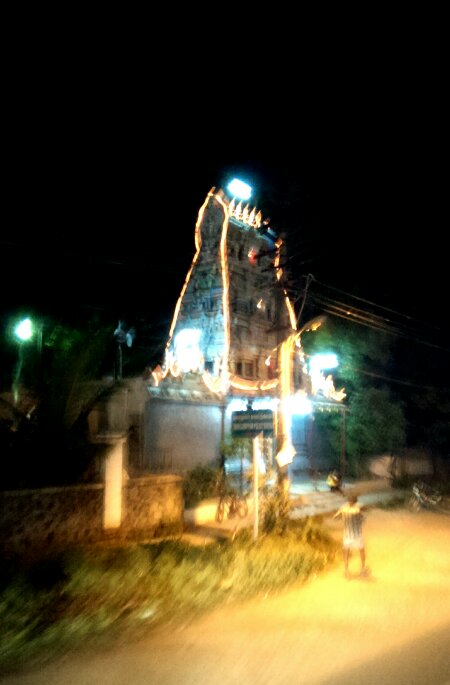
There are thousands of little temples — some hardly more than altars — scattered throughout both the countryside and cities here. I marvel at the artistry of some and the garishness of others.
I think, on witnessing this effulgence of creativity, of what helps me remember the everyday sacred. Mostly, I am inclined to look inward.
Needing a brightly decorated space that tells a story is so different from my Quaker upbringing.
On the walk home from Union Station after teaching the Friday evening gentle/therapeutic class at Willow Street Takoma Park. Come join us some time. It is a fine way to spend Friday after work “happy hour [and a half].”

Peace and light, E — Posted with WordPress for BlackBerry.
 vv
vv