| | | |

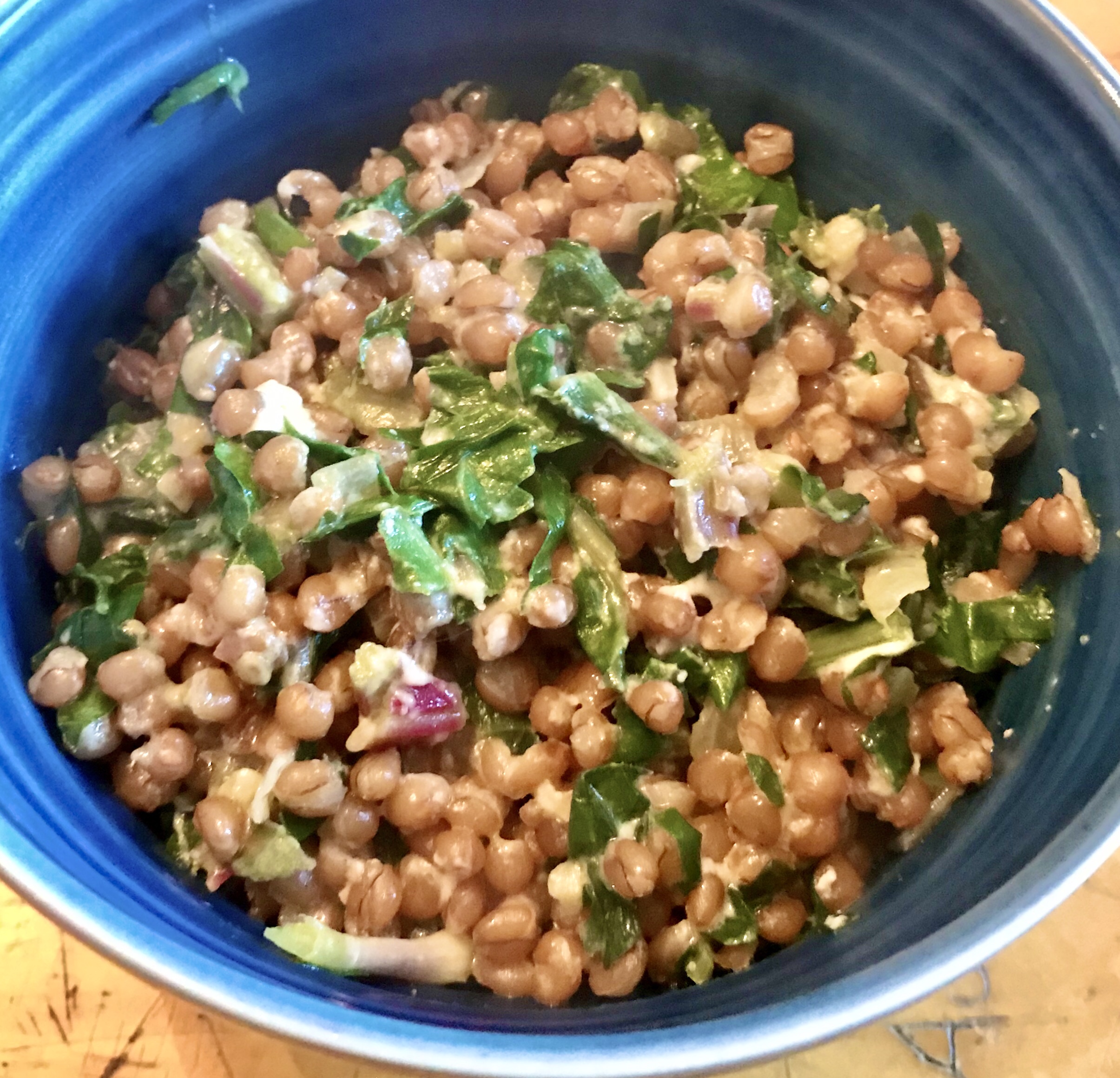
Wheat Berries with Beet Greens, Garlic Chives, and Feta Cheese

Pantry items, long storage organic cheese, greens from the garden.

As I eat these simple, inexpensive, nutritious meals, I ask myself:

How much do I need?

What kind of economy do I want to support for when we can go out again?

What kind of businesses, of food delivery systems, of community support and interaction?

I have reorganized my budget–not having eaten out or bought anything in weeks and thinking about how little I miss it except as a treat, and having already come within range of this as these dark times have been progressing, I have now dedicated a full bi-weekly paycheck to monthly giving. I am blessed to still have a steady paycheck, health insurance, and the knowledge to live well on a budget.

Similar Posts

  • | |

    A Slow Metro Ride, A Missed Yoga Class, and Meditations on the Costs of War

    Yesterday I wrote to my DC elected officials and to the budget office to let them know how important it is to me that local municipalities fully fund public transportation, as the budget year comes to a close.  Metro officials are threatening to close down many bus lines entirely, which will mean that far too many people will be unable to get to work, especially for low-paying jobs.  Hundreds of workers are scheduled to  be laid off, which means (as an icy cold budgetary matter — the budget after all being a moral document) that they will need services and no longer will be paying taxes.  Disrepair, injuries, and accidents will become even more prevalent, and service will be slowed at already overtaxed and overcrowded times.  Our air quality will go from yellow/orange to orange/red from the increase in gridlocked traffic.  I discussed the issue and the urgency of making our voices heard with several co-workers today.

    I left the office at 5:40 pm this evening to go to take Suzie Hurley’s 6:15pm class at Willow Street, Takoma, Park.  I was standing on a metro train at 5:46pm.  The ride is supposed to take 13 minutes from Judiciary Square metro.  We reached Takoma Park at 6:27pm.  I went over to the studio when I arrived.  If the door was open, I would have looked in and caught Suzie’s eye and quietly seen whether I could slip in.  The door was closed, and I could hear that the class had already started doing standing poses.  Under circumstances where being late is clearly not my fault (and I try to avoid those by being willing to be early if it turns out the travel has been optimally sequenced), I will join the class just after centering and before the asanas begin.  As much as I would have liked to have taken a yoga class after the slow metro ride, I felt that I shouldn’t risk disturbing the other students by coming so late.  I instead will be doing a long, deep, slow, inward-moving practice when I am finished writing, corresponding, getting ready for practice and sleep, and doing some preparations for tomorrow’s work day.

    In my growing acceptance that I would be arriving too late to Takoma to take class, I thought about the email I had received earlier in the day about the Friends Committee on National Legislation’s “Our Nation’s Checkbook” campaign.  The email reminded me that a third of my tax dollars are being spent on war.  “What about investing in green jobs, preventing more home foreclosures, and funding diplomacy to prevent wars?” I was asked.  “What about public transportation,” I thought, as I sat on the stationary train between stations.  “How many trains could be operated efficiently and safely for each fighter aircraft?”

    How do I want to live?  What are my priorities?  When does short-sightedness or immediate personal satisfaction impact my long-term health and happiness and peaceful co-existence on a crowded planet?  For what purposes do I practice?  How would I like to invite others to live?

    The ride home, of course, had nary a problem.  A train arrived in under five minutes.  The ride back to Union Station was exactly 11 minutes.  Everyone had a seat, and the car was nearly full,  so it was at perfect capacity.  It was still light, and lots of people were out because of the balmy night and the beauteous blossoms, and I felt safe strolling home instead of taking the bus.  What a beautiful night!

  • | | |

    State of the Garden

    One of the key teachings about yoga sadhana (practice) is that results best or sometimes only can possibly come with steady commitment for a long period of time.

    The red maple in my front garden (really more of a giant tree box) was barely the height of the porch roof when I bought my house.  Now, almost 25 years later, it is as tall as the house.  And even more stunningly, blazingly, Kali-like red every fall.

    red maple

  • | |

    Yoga for Householders

    Paul Muller-Ortega, who teaches philosophy and meditation from similar roots to those that inform Anusara yoga, spoke yesterday of the differences between the path of the renunciate and the path of the householder.  He strongly stated that neither path was better.  What he suggested, though, was that a householder will better flourish practicing yoga designed for the householder rather than attempting to practice renunciate techniques, while still staying in the householder path.

    What does this mean?  I think it means that we become unhappy and conflicted if we try attempt the practices of the path of complete non-attachment and transcendence of body and mind while we are still very much staying in society and responsible for family, work, and citizenship.  The tantric, householder path, including that of the Shaivite tradition of Kashmir and Abhinavagupta, offers practices that enable one to live liberated in society, instead of suggesting that the only way to true liberation is to reject and transcend work, family, and community.  In yoga terms, the householder path is one that realizes moksha (liberation), through ardha (physical and material well-being), kama (love/relationship), and dharma (right work/path) rather than by transcending them.

    Taking the householder path does not mean just indulging.  It still requires sensitivity, dedication, discrimination, and alignment.  I think it may be even harder than renunciation.  I know it is easier for me to just stay alone and practice, for example, than to bring yoga off my mat to how I work, consume, relate to others, and participate in society.  The householder path, though, is the one for me.

Leave a Reply

Your email address will not be published. Required fields are marked *

This site uses Akismet to reduce spam. Learn how your comment data is processed.