|

Did You Do Anything Fun for the Labor Day Weekend?

When I go back to work tomorrow, people will ask me whether I did anything “fun” over the Labor Day Weekend, just as before the weekend I was asked it I had anything “fun” planned.  At recent gatherings where I have bumped into people I haven’t seen in a while, all the questions have been about whether I did anything exciting this summer.  I have been pondering these questions and what they say about how we structure our lives.  For me, the seasons change based on what I cook and eat, how I dress, and to some degree, when I sleep (more at night when it is cold and dark; more afternoon naps when it is overly hot and bright), but I both work and take breaks throughout the year, so summer did not bring anything more or less exciting than usual.

I am acutely aware that part of the reason I have the luxury to live in accordance with the seasons is that I am not on a school schedule, and I have a job that allows me a little flexibility in terms on when to take breaks and when I come and go on any given day.  I also realize that I have blurred the difference between work and “fun.”  I have had a most enjoyable Labor Day weekend, but some would think much of it has been work:  I taught two classes; I gardened; I cooked; I’ve done some housecleaning; I am writing this blog entry, etc.  As I took pleasure in all of these activities, I think of it as having had fun, even though everything I did was something someone could have been doing as “work.”  I think that when we take pleasure in our work, we are less in need of grasping at “fun” and can find more joy in the leisure activities that are more usually labeled as “fun.”

I hope whatever you have been doing, whether working or playing, you are enjoying the day, and can take a few moments to reflect on those who fought long and hard for ordinary workers to be able to have the time to play in between working.
Similar Posts

  • | | | | |

    Whether It Is Good Weather

    When I was out doing an errand at lunchtime, I bumped into a neighbor I haven’t seen in a long time. We did not spend much time talking; I needed to get back home to my work within the short allotted time, and she was meeting someone. “Did I just hear thunder,” she asked. The sky was thick and white with heat and “Code Orange” air. “You might have heard thunder, but there isn’t any rain with it” I replied. We talked about how much we need some good rain. The trees are really struggling. (Note: forget about cleaning any outside things with water. Forget non-edible annuals. Water established trees and perennials very deeply once a week instead of less watering more frequently. Shallow watering in drought conditions promotes growth of fungus and other pesky things.)

    As gardeners, my neighbor and I notice how much rain we are getting in any given season and week. We think about whether the rainfall is what the farmers and the trees and birds and wild animals need, in addition to whether it will interfere with a child’s soccer game or a planned outing. We were at the point that we would far rather get caught out in a deluge than miss out on any chance of rain. On the other hand, those in flooded parts of the north are praying for a few warm (but not blazing hot) dry days in a row. Today’s storm is welcome and needed, though one storm does not end a drought. We need some more good ones for days on end.

    I think the approach of various classes and intensity levels of asana practice can feel like a whether a thunderstorm is welcome weather. Sometimes an outrageously intense and fierce practice is what will bring me to my fullest possibility of growth and expansion. At other times, I need to step back and rest my body. Restorative and other gently therapeutic practices are what nurtures best. Sometimes, I have long, steady periods of moderate practice.

    The more sensitive, aware, and knowledgeable I get about the weather outside and how it impacts life around me, the better able I am to take care of my garden. The more I am sensitive and open to the weather inside and the more knowledgeable both from study and experience of how my practice best aligns with inner and outer weather, the better able I am to live out the yoga principles I seek ever better to follow–the most important being to see the highest first and to be of service.

    Peace and light, E — Posted with WordPress for BlackBerry.

  • | |

    What Does It Mean to Study War?

    Martin Luther King, Jr. said:   “A true revolution of values will lay hand on the world order and say of war, “This way of settling differences is not just. …A nation that continues year after year to spend more money on military defense than on programs of social uplift is approaching spiritual death.” Still, the Pentagon suggests that Martin Luther King “might” have supported the war in Afghanistan.  Not sure on what basis.

    Last night at the Willow Street Book Club, where we were reading Ram Dass’s Paths to God–Living the Bhagavad Gita, one of my fellows raised the question of how we could read as a spiritual guide a book whose context is war.  Another asked a similar question from the perspective of a feminist.  It was a fabulous, engaged, lively discussion, and I hope to see more next month.

    It would be an injustice to the text and the historical context to read entirely out of the Bhagavad Gita the duty of a warrior to kill, a wife to practice suttee, and persons born into each caste to accept their lot in life in a society structured on the caste system.   There is much richness in the text, though, that can provide guidance for a feminist, pacifist, who believes that “all men are created equal.”

    We have reread “men” in the Declaration of Independence to include women and those of all races (though we cannot manage to rewrite the Constitution to explicitly state that women are equal, but that’s a thought for another day).  Similarly, without doing injustice to the text, we can see that the ultimate teachings about living in accordance with duty (svadharma), love, devotion, and sacrifice in the Gita, like the concepts of “life, liberty, and the pursuit of happiness,” provide guidance and force for social action and spiritual devotion beyond a historical context that oppressed and bound on the worldly plane the very persons who are now seeking the deeper meanings in the text.  In fact, I believe that we can use the essential intent of the text to teach and transform the oppressors, to use the very text to show why the violence and oppression of the historical context is injust and needs to be changed so that the spiritual intent can be expanded and spread beyond the privileged.

  • | |

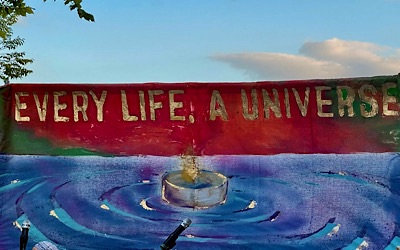
    Every Life a Universe

    This evening I attended a gathering at Meridian Hill Park with several hundred Jewish people and a some allies and a few dozen police (not sure whether the police were there intentionally to be threatening or to be of supposed protection).

    The gathering was to mourn the 1200 killed on October 7, the 250 taken hostage, and the tens of thousands killed and millions displaced since then. Whether the speakers were Jewish or Palestinian or Christian or Hindu, they were unified in their belief (relying on the texts and teachings that informed their faith), that no lives are more precious than others. The rabbis were emphatic that continuing to bomb and displace Palestinians and now, Lebanese, makes no one safer.

    We must stop the relentless funding of war, the destruction of life and communities and the ecosystem if we and our companion species (flora and fauna) are ever to thrive.

    Om shanti, shanti, shanti.

    Shalom.

  • | | |

    How Do You React? (and Dharma)

    How do you react when you see signs of neglect, disinterest, disregard for the health and well-being of the earth and other beings?  Do you get stuck in a sense of helplessness or rage? Do you think we’re all screwed anyway and decide no effort to make things better is worth it?  Are you moved to political action?  Are you moved to take better care of self, family, and friends, even if you think you cannot make much of a greater impact beyond your intimate circle? Can you remain engaged and still find joy, whatever the apparent immediate results and how hard the battle seems to be?

    The Bhagavad Gita, says that to live a life of yoga, we must do the last of these.  The first teaching from the Bhagavad Gita on this point is that we must live in accordance with our  dharma (duty).  The second teaching, and more important for having peace of mind in a life of duty, is that of “actionless action.”  The true yoga is to live a life of action in accordance with dharma, but without attachment to the outcome (i.e., live in an orderly way, accepting the tendency of the universe to be chaotic). 

    Dharma in the Bhagavad Gita, of course, contemplated rigid roles in terms of livelihood and place in society.  In the paradigm of citizenship in a democracy that does not so narrowly circumscribe one’s livelihood or place in society, I wcould argue that it is all of our dharma to participate as a citizen, voting, speaking out for our beliefs, and otherwise using the freedom we have to live a life that best supports the twins of individual and common good, including not just human good, but the whole ecology in which we exist.  The actionless action part is to keep seeking (without despairing) to make things more in alignment even if the forces against healing, nurture, and alignment seem to conspire against positive results that we will see or actualize ourselves.

    Are you registered to vote?  Have you watered your trees?  Casey Trees reminds us that this week in DC is dry; trees need about 25 gallons of water or 1 1/2 inches.

Leave a Reply

Your email address will not be published. Required fields are marked *

This site uses Akismet to reduce spam. Learn how your comment data is processed.