Asana, Pranayama, and Yoga Practice | Food for the Mind (Yoga Philosophy, etc) | Meditation | Photos
Signs Around Town (Excerpt)
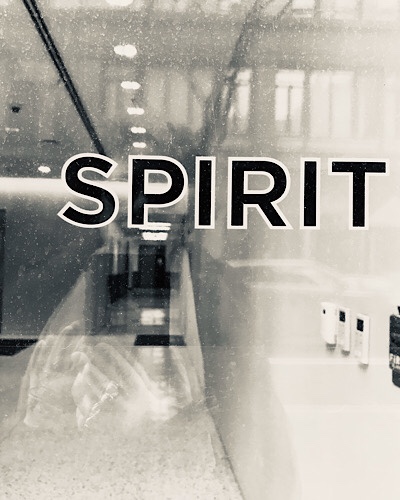
Last week Orie suggested that as I have a “Yoga for Gardeners” workshop, I should also do a “Yoga of Housekeeping” workshop. A blog post isn’t a workshop, but here are a few preliminary thoughts on yoga and housekeeping.
From an alignment perspective, I have found that the Anusara principles of alignment make safe everything I do off the mat, as well as on. Overwhelmed by all that needs to be done? Doing heavy lifting? Bending and stooping? Reaching for something way up high?
First, soften (open to grace). Appreciate that you have a home and things to clean. Honor each item in the house. Things have energy, too., and they like to be touched and cleaned. If you have anything that you do not appreciate or does not fit in the house, give it a new life in a new home (freecycledc is a great way to pass things forward).
Use muscular energy, drawing the muscles to the bone, hugging into the mid-line, and drawing energy into the focal point (for most housecleaning activities, this will be the pelvis). Using muscle energy will definitely help to keep you from tweaking a muscle or straining the low back or shoulders. When you are reaching, keep the arm bones integrated by hugging the shoulder blades onto the back and then reach from the waist, though each rib to extend the length of your torso (organic energy).
Especially for bending and lifting, after you bend your knees, hug your shins in (muscular energy), take your inner thighs back and apart (inner spiral) and then tuck your tailbone (outer spiral). If you just bend from the knees but hunch your back, your low back will still be vulnerable.
Switch sides for activities like sweeping, vaccuuming, and scrubbing. Yes, it can be difficult and awkward, but it’s worth it to shift sides. Imagine doing all of your yoga practice only on one side. How much imbalance would you be encouraging?
The first niyama of Patanjali’s Yoga Sutras is sauca, which means cleanliness or purity. It is easier to think and live and be hospitable in a clean home.
The first yama is ahimsa, or non-harming. Do your best to use safe, biodegradable cleaning products. Your skin and respiratory system will be grateful. So will the earth. Try to make cleaning your own space and act of honoring your self, your home, and the greater home of the earth.
Fully absorb yourself in the task of cleaning. Make it a meditation. Integrate fully the act of cleaning, the item being cleaned, and you as the cleaner.
Finally, be playful.
Desiree Rumbaugh, in the afternoon break-out session on hip openers yesterday, referenced the earlier teachings at the gathering on love, and said with a giggle that her class was “hip openers for peace.”
She shared a story of a teacher having his students create pictures representing peace. He picked two images that best depicted peace. The first was a serene picture of a mirror lake in the mountains (not unlike the tantric yoga principle of using our practice to find in ourselves the mirror of divine spirit). The second was of a barren and craggy landscape with a stormy sky. In a corner of the painting, though, was a nest with a small bird singing. Amidst challenge and chaos, one being living peacefully and joyously. This is why we do yoga, suggested Desiree, to find our own place of peace amidst whatever chaos is life. Noting how challenging hip openers can be for body and mind, especially if our bodies feel tight, she said that the practice can be like the second picture. We want to learn how to feel calm and centered even when we are deeply challenging ourselves on the mat, so we can tap into that place when life gets harder than we think we can bear.
The technology she offered for finding peace in hip openers was not tricks for stretching, but rather to strengthen the core muscles so that the outer hips and the hamstrings do not need to clench to protect themselves. When the core is powerful (as John Friend would say, “adamantine”) then the outside can soften and be open to what comes. This principle, in my experience and as given by my teachers, holds equally true for facing life and the most challenging of yoga poses.
Peace and light, E — Posted with WordPress for BlackBerry.
One of the most profound and essential teachings of the great yogis is to “watch the gap.” We are given the practice of watching the gap, the space, the pause, the turning point between the in breath and the out breath, the out breath and the in breath. In the gap, we are able to witness perfect fullness (purna) and perfect emptiness (sunyata). In minding the gap, we can experience perfect stillness and serenity. It is an extraordinary practice in its simplicity and in its gift of peace and repose.
Whether you have never heard of this practice, learned it at some point but have mostly forgotten about it, or just did it with your own practice, I invite you to take a few minutes on reading this: make your seat steady and as comfortable as possible, close your eyes, invite an intention of finding a still spaciousness in your heart. Draw your attention to the breath and start to notice the space (maybe almost instantaneous and unobservable, maybe a real pause) between the in and out breaths.
If you are moved, comment on your experience to share with each other. There is no one right reaction nor a wrong one. If it was challenging to sit still and focus, just be gentle and soften to how enjoyable it can be to do nothing other than watch the breath, like the sweet and easy restfulness of watching the movement of waves at the beach.

Peace and light, E — Posted with WordPress for BlackBerry.
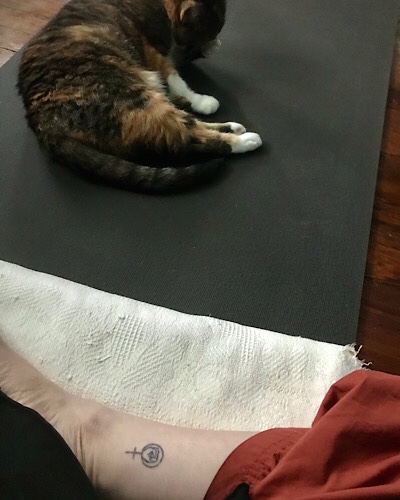
Tattoo circa the Kavanaugh hearings. I have strategically placed reminders to keep me engaged.