Found Exhortation
Good boundaries are critical.

Good boundaries are critical.

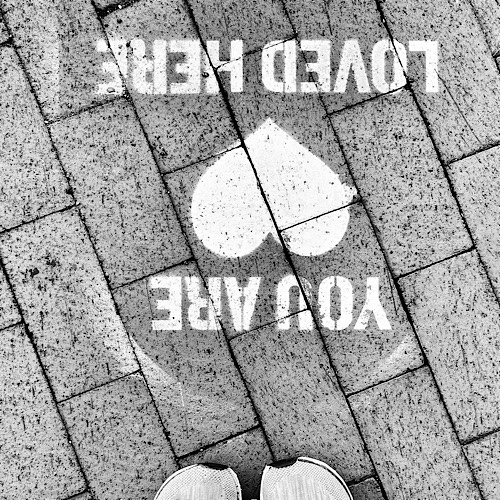
I wonder sometimes about signs that say every one is welcome. We might wish for that. We might believe it. But when someone shows up who scares us or who is radically different or is somehow distasteful, is the welcome really as full as the words?
A completely open welcome is a worthy goal, but I know that as much as I try to make more room in my heart for a wider range of beings, I have my limits. This wide open, embracing, honest welcome–a true recognition of the spirit in every being–is one of the most challenging of practices.
Peace and light, E — Posted with WordPress for BlackBerry.
On Friday night, Professor Douglas Brooks offered a satsang that was hosted by District Kula. One of the attendees, who said that she did no yoga, but taught Argentinian tango, wanted to know about what she had heard of yoga talking about the dance of masculine and feminine because that’s what tango is all about.
Douglas gave a quick overview of the idea of the tattvas as a foundation for an answer to the tango dancer’s question. As part of this background, he discussed the numerological aspect of the tattvas, saying that Shiva and Shakti relate like this: one is two becomes three becomes five. The two must separate, and the space between them makes three and teaches us the one. Because of the spaces between, we do not have one to two to four, but two (one because inseparable) to three to five. We know the one only when we know two, and the one is therefore part of three. (“Lovely dance of numbers; that makes perfect sense,” I thought, having a happy geekfest in my own mind. “I’ll enjoy pondering how that might be an explanation for there being five top tattvas and not six or four and wondering whether I had even begun finding an understanding, even though what Douglas was talking about is something I have been contemplating for years in various ways and contexts.)
Douglas then led into a description of the inseparable, inextricably intertwined nature of Shiva and Shakti. “It is like that in tango,” the dancer interjected at multiple points. “The better the leader, the more he is listening to the follower, thus allowing the follower to be the leader.” Each time Douglas refined his response, the dancer offered something else about her experience with tango. “Right, when they are dancing well, the man takes on some of the characteristics of the feminine, and the woman that of the man. The difference between them starts to dissolve into the dance itself.” Her eyes lit up, and she bubbled up with speech, in her excitement at finding in the tantric philosophy what appeared to be an explanation of what she experiences in the tango.
The tango dancer and the yoga texts assign specific roles and attributes to the masculine and the feminine, and we tend to fall into that tradition when we discuss the tantric philosophy. As much as the traditional tantrika or tango dancer might say that the masculine and feminine (when embodied) take on/have characteristics of each other, they have assigned masculine/feminine roles to play, and they are still stuck in a paradigm that keeps real humans in assigned roles. These assigned roles impact how male and female are permitted to act in society, regardless of any recognition that who is actually, rather than technically, in charge may be in flux on different levels.
The paradigm of tango dancing kept Friday night’s discussion within the context of typical and rigid roles for male and female, but I do not think that is a required way for us to think of how to bring the tantric yoga philosophy into our lives. When we think of the tattvas as abstract principles, we do not have to privilege in our lives or own thinking the traditional divide between male and female roles as the basis for understanding the play of opposites (though to be true to the text in its historical context we do).
I believe that the dance of shiva and shakti is as much about the dance between the universal and multiplicitous individuality as it is about the specific play between masculine and feminine in assigned roles. The one is two. The two (one) separates into three; when the two separate we discover the one (two), and after that the three becomes five. I remember a friend saying in our college days, “There are three of us in it: there is me, there is my loved one, and then there is our relationship.” To be in the world and relate fully, the tattvas (and dances with partners of either sex) teach us that two are inseparable by being in relationship. By recognizing the appearance of separation, the dance of Shiva and Shakti tattvas shows us the relationship — the oneness. Thus, all consciousness is one, but two, and then three, and yet still one.
How this informs me, other than enjoyable thoughts in my head, is that when we try to be spaciously and openly aware in all of our relationships of this elemental play of individual identity, separability, and indivisible unity, we see the other in ourselves and ourselves in the other. This helps much to inspire friendliness, understanding, and compassion. It also helps bring understanding of the leader when we are following, which it makes it easier to follow with discrimination, but without judgment. When it is our turn to lead, it helps us know that for those who might choose to or be required to follow us for some particular project, that to lead well we must listen to the followers. As the the Grateful Dead taught me decades ago, “you who choose to lead must follow.”
Last night, we were talking about the parameters of cultivating a steady and fruitful meditation practice, and Paul Muller-Ortega suggested that it was about the balance of stability and flexibility. He had learned the principle from a different source, but I have contemplated and explored the principle in depth from teachings I have received from John Friend.
A critical aspect of the Anusara alignment principles is to find the perfect balance of stability and freedom. We need stability to stay fully and safely in each pose. We need freedom to achieve the fullest and most delightful expression of the pose.
We find the stability both by making certain that we have established our foundation (which is an aspect of the first principle of opening to grace). By then using the three aspects of muscular energy–hugging the muscles to the bone, drawing into the midline, and drawing energy from the periphery to the focal point, we make possible an expansion of our edge, whatever that might be. Having a solid, aligned foundation and affirming our very core with these actions, gives us security and balance. We also want to reach out, to be playful, to expand to our fullest, which we do using the expansive, outreaching organic energy — from focal point to the periphery, from the midline to our outer edges, from the very marrow of our bones through bone, muscle, skin, and beyond.
If we over-emphasize (including natural inclination) stability, then we can get stuck. If we just let ourselves be free, then we end up all over the place. When these elements are perfectly balanced, we can safely find our deepest freedom of expression.
When I teach this principle as the focus of a class, I always invite my students to think of how important the balance of stability and freedom is for every aspect of our lives.
The discussion last night put this principle in the context of the regularity and steadiness of our practice, with the recognition that to stick with our practice, we will sometimes need to vary the time or amount of our practice, or what elements are included in the practice.
To get the fullest benefits of a practice (this applies to any practice and not just to meditation), we need to show up consistently and to practice in accordance with how we have been taught. To stay steady, though, we need to give ourselves the permission or freedom not to show up, or within appropriate parameters, to modify the practice when life gets in the way of what we think would be the ideal practice. If we think we have to do things at the exact time and place every day in a perfectly precise way, we become rigid. On the other hand, if we are loosey-goosey about it, then we do not have much of a practice and will not realize the benefits that we could get.
Where in your practice or life would more stability and steadiness give a field for greater freedom and happiness? Where could you give yourself a little more flexibility so that you feel that steadiness brings the possibility of joy, rather than tying you down?
Peace and light, E — Posted with WordPress for BlackBerry.
Never underestimate the power of ritual.

It is a good thing, I think, to do what one can to prepare for eventualities, to take reasonable precautions. It is not optimal, though, to allow fear and anxiety prevent us from living fully each day. I choose to continue to face fear and discomfort in my asana practice, as well as just doing the poses for which I have an innate affinity. I practice poses that bring up fear, dislike, discomfort, and general aversion. I do not ignore my fears and discomforts. I learn why I have them; I practice more assiduously the preparatory strengthening or stretching poses that will give me more support in the deeper poses, so that I can be in a place where I know when my fears are appropriate cautions and when they are unnecessary anxiety.
By practicing the poses that are scary and uncomfortable and learning how to stay grounded, present, and even joyous while doing so, I have learned a lot about how to live in away that optimizes my health (physical, emotional, spiritual, and financial) and the health of those around me, without letting fear, worry or discomfort about dangers, limitations, and pitfalls limit my ability to live fully and generously with a care for the suffering and joys around me. Yes, I took extra care to wash my hands last night right before I started teaching a pre-natal class, but I cannot stop going out and enjoying the spring days or getting my work done for fear of swine flu; I am currently healthy. I am not going to stop supporting local businesses because there is a recession; I still have a steady job and have no reason to curtail my spending, and I have always lived within my income.