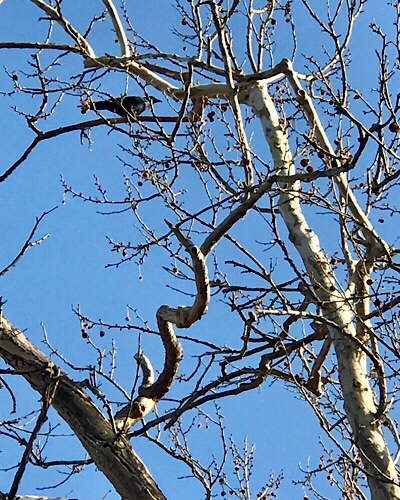
Found Exhortation (and the Tillai Forest?)

But perhaps find your Self? Wondrous and scary and unsettling things happen in the forest when we muster the courage to leave settled notions behind and explore.
But perhaps find your Self? Wondrous and scary and unsettling things happen in the forest when we muster the courage to leave settled notions behind and explore.
I meant to go somewhere else. When I got outside, I found my feet taking me to the river.

Having grown up in the New York metropolitan area without much in the way of traditions of any kind, I was not familiar with Hoppin’ John. I am fairly certain that the first time I heard of it was from a college friend whose family has been in South Carolina since before the Revolution. As it is not part of my tradition, I do not feel bound to any particular recipe (I am sure it is sacrilege in some circles to leave out the ham/bacon) or to eating it at any particular time of day (e.g., immediately after the clock strikes 12 midnight). It would not be Hoppin’ John, though, if I did not know its tradition and know where I was deviating from tradition. (Though this would entail a much longer blog than is within my time frame today, this balance of freedom from tradition and needing to know and honor tradition is very much an issue for the Western yoga practitioner.)
1. Soak a cup of dried black-eyed peas for at least several hours or overnight.
2. Dice one small onion or 1/2 large onion (about a cup), a few celery stalks, including the leaves, and mince a couple of cloves of garlic.
3. Heat a few tablespoons of a flavorless oil (peanut, corn, or safflower) in a pressure cooker (my preferred method for saving energy and time) or a stock/stew pot.
4. Saute seasoning vegetables along with a few hot peppers until onion is translucent. I used the last habanero from my harvest and so left it whole. You can use fresh or dried chilis in an amount to your taste/tolerance for spiciness.
5. Stir in a cup of brown rice until rice is coated with oil.
6. Pour in 1/4-1/2 cup of white wine and stir until absorbed (as if making risotto). [You could use stock instead. If you are using white rice, skip this step, which serves to partially cook the brown rice, so that it will take the same amount of time as the black-eyed peas.]
7. Crumble in some dried thyme (preferably from your own garden) and a bay leaf or two.
8. Drain and rinse the soaked black-eyed peas and stir into the cooking pot until all ingredients are combined.
9. Add one 28 ounce can of diced tomatoes and 2 1/2 – 3 cups of vegetable stock or water. How much liquid depends on (a) whether you want a soupy consistency or one more like pilaf or risotto; (b) how liquid are the tomatoes; (c) whether you are using a pressure cooker (less liquid needed) or cooking in a pot.
10. If using a pressure cooker, cover and bring to full pressure, then lower heat and cook at full pressure for 28 minutes. Allow natural pressure release (about 15-20 minutes additional). If cooking in a regular pot, bring to a boil, stir, then lower heat and cook for an hour or more until rice and peas are tender, stirring occasionally.
11. While rice and peas are cooking, mince a few cloves of garlic.
12. Rinse and chop several handfuls of greens (collard or curly kale are best; don’t use spinach or chard, they are too tender). Heat oil and garlic together. When garlic start sizzle, add damp greens and saute until greens are wilted and dry.
13. When rice and peas have finished cooking, stir in sauteed greens and bring back up to full heat. Adjust seasonings, adding more salt and your favorite hot sauce to taste (or allow guests to add their own hot sauce at the table).
I don’t know whether having eaten this will bring me luck and prosperity, but I’ve started the year with lots of vitamins, minerals, fiber, flavor, and cooking, which for me means health, love, technique, tradition, flexibility, and joy! Try this, make your own, read all about Hoppin’ John, or call a friend from the South who must eat Hoppin’ John on the New Year and learn about the tradition and what it means.