Nothing is Free
For those of us moving in time and space, I’m pretty sure the only thing that is free to take is, indeed, nothing.
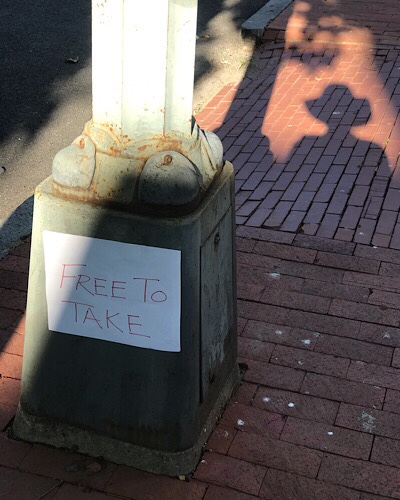
For those of us moving in time and space, I’m pretty sure the only thing that is free to take is, indeed, nothing.
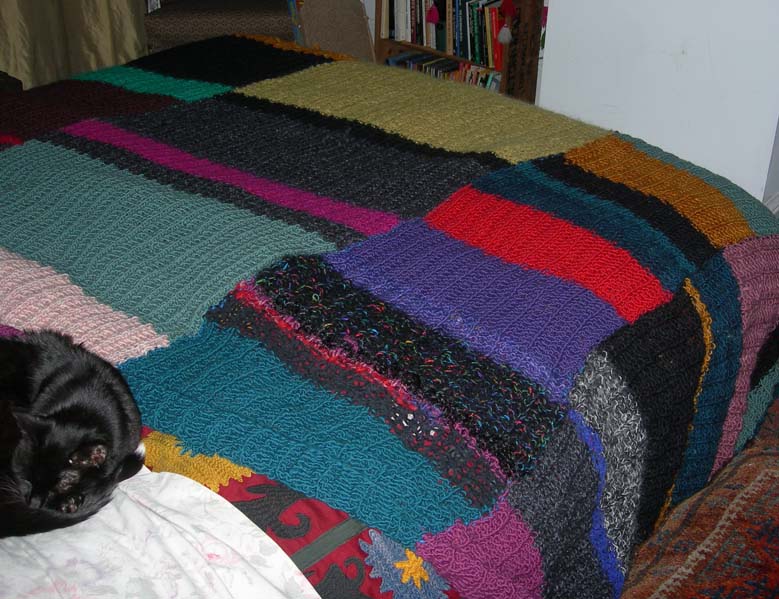
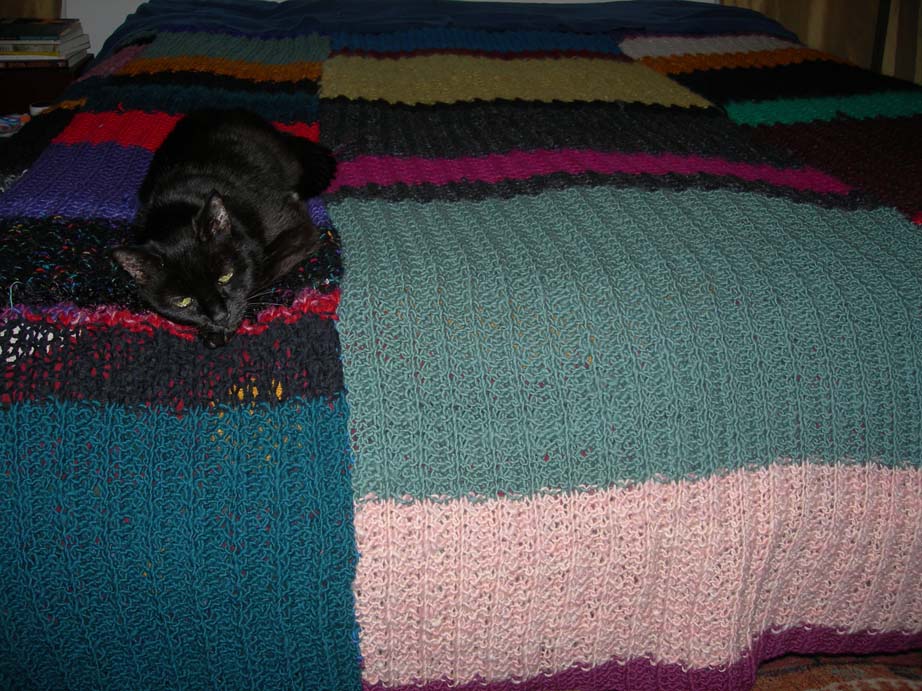
There are lots of ways to clean out a closet. Partly, it depends on what is in the closet. Per my earlier post about freecycle, I think that part of the practice of sauca or cleanliness, is making sure that the hidden parts of our homes are not overfilled with stuff we do not use. Cleaning out the closet, does not mean throwing everything out. It can mean creatively rethinking where things should be and how we should use them. It also means for every artist, cook, crafts person, periodically making use of all those things you picked up or saved because they would be of use in something.
I was raised to save things that possibly could be used later, and to try and make every scrap usable. I was taught this because my father was born in 1929 and my mother in 1936 of Jewish peasant immigrants. Now, we are re-learning how to maximize the use of objects and minimize waste for ecological, rather than financial reasons, though the two are inextricably intertwined. As the recession progresses, it will be interesting to see whether financial constriction will foster more environmentally conscious living.
About four years ago, when I was engaged in a periodic review of what was in the hall closet, I came upon my big box of leftover yarn. In the late eighties and early nineties, I traveled extensively for business, and spent many hours in airports and evenings in hotels. I found it comforting to have a lapful of mohair, homespun, or other delicious to touch yarn. Airport security was less invasive, and it was possible to knit in the airport and take knitting needles on board the airplane. As I love working with multiple colors, that resulted in a leftover skeins from each project. Over a 10-15 year period, even with only a couple of aborted projects and no yarn bought for imagined future projects (unlike a really serious knitter), I ended up with enough yarn for a queen-sized blanket (shocking, really). As you can see, I designed it like a crazy quilt. It took an educated sense of color and line — imagine this as a painting or pastel and you can see the influence of the Washington Color School, but it did not require much in the way of knitting skills (the whole blanket knit in panels of “mistake rib” — (k2, p2), end k2, p1 — about 50,000 times). The patch of fire engine red and the grape juice purple next to it, came from my friend Sara, who is a fabulously talented knitter. I felt the need for those colors, so we swapped for some of the teal and green that I had.
The blanket took almost four years to knit because I only did it in fits and starts. Finally, last year, I decided that I needed to finish it in time for Becky be able to curl up on it. As you can see, she thinks it is great. Now my closet is not stuffed with a big box of yarn, I have an extra warm blanket that helps me keep the house just a little cooler, I made a thing of beauty where I might have been tempted to go out and buy something new, and Becky has a new happy spot.
How to think of this as an exhortation is a grammatical puzzle.
Peace and light, E — Posted with WordPress for BlackBerry.
Yoga clothes–check
Meditation shawl– check
Hiking boots–check
Head lamp–check
Bathing suit–check
Insect repellent– check
Will be on retreat. Not to escape, but to reinvigorate and reconnect so that I can be more fully present and available for work and community and seeking to change what is possible on my return.
No cell phone service until Monday. Will have stories, I’m sure, when I get back.


Peace and light, E — Posted with WordPress for BlackBerry.
When I was eight or nine, a teacher asked everyone in my class to say what they wanted to be when they grew up. The other children named the various jobs or professions that appealed to them at the time. I responded that I wanted to be independently wealthy. At that age, I was expressing something I already knew from family issues. Though I did not have the words for it or a clear understanding, what I was saying was not just false precocity. I knew at a basic level what is taught in yoga: I would need enough material support (ardha) to follow my heart in love (kama) and work (dharma); then my life could be free (moksha).
When I was 22 and visiting my friend Dan, he asked me what I really wanted to do with my life. We had just graduated from college. Dan was working for a sculptor who was a professor in the art department; I had just moved back to New York, had just gotten over a failed attempt to serve as an office manager for an off-off Broadway theater, was in a place of deep emotional and financial struggle, and was trying to determine what work and corresponding further education I wanted. “I want to be content,” I said. “That’s too passive,” he replied. “No, that’s not what I mean,” I tried to explain. “For me being content being satisfied and engaged with my work and life, but still working hard and having goals. It’s not just hanging out.” I had all sorts of things that I found interesting and possibilities for a life path, but I didn’t have one specific career or life plan that I was certain would be more fulfilling than any of the others. They just would have satisfied me in different ways. Because of the dilemma of too many choices, I wanted to be able happy with whatever choice I made, even if it seemed like a compromise. I was conscious that once I picked, because of the inherent limitations of time and space, that I would either have to be content with my choice or be unhappy. I have since learned to think of contentment (samtosha), which is one of the niyamas of the path of yoga expounded by Patanjali, as a practice rather than a goal (and it is a very important and continuing practice for me). Contentment is not an end, as I had thought when I was 22; it is just one part of the path to a goal of living liberated (jivanmukti), experiencing self as spirit in all that one does.
On a recent telephone seminar, Paul Muller-Ortega, my meditation and philosophy teacher, in the midst of a broad dialogue regarding various studies and practices, spoke a little of ecstatic serenity. Memories of the discussions I had had long ago about what I wanted welled up in the forefront of my thoughts. In thinking about what is my intention now, especially with regard to my practice (sadhana), I witnessed my previously stated intentions as just stages on the path to this discovery. As soon as I heard Paul say the phrase, I thought, “that’s what I want; I want to be ecstatically serene.” I seek to be always in some part of my conscious being still and peaceful, while simultaneously being passionately engaged in what life brings to me and I bring to life.

Peace and light, E — Posted with WordPress for BlackBerry.