| | |

State of the Garden (and a Sign)

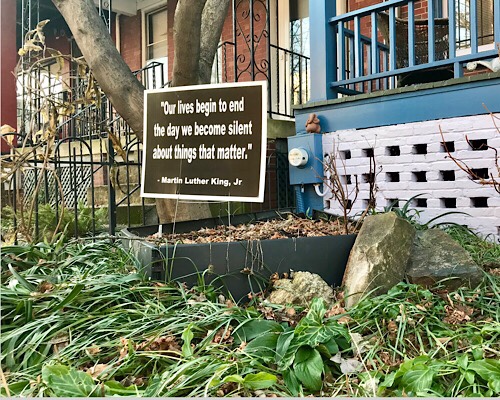
Long time neighbors and participants in the rose garden yoga posse, who have now retired and are moving to be nearer children and grandchildren, gave me their yard sign.

I will miss them for practice and around the neighborhood. I like, if they must go, that I will think of them fondly every time I come home to this exhortation and its call to practice.

Similar Posts

  • | | | |

    “The mind and spirit become ripe…”

    I have been indulging in reading the thriller Angelology (complete with stories of angels and the war between good and evil), which  I picked up at the Books for America shop in Dupont Circle a couple of weeks ago for the kind of night of reading that is the equivalent of a night of watching television if I had a television.  Relatively early in the book, a professor says to one of the brilliant students who is a central character to the plot:  “I have found that our texts will speak deeply to someone or they will say nothing whatsoever.  It depends upon your sensitivity toward the subject.  The mind and spirit become ripe in their own fashion and at their own pace.  Beautiful music plays, but not everyone with ears can hear it.”

    This statement encapsulated the ongoing thinking I do about my attraction to yoga and the tantric philosophy.  I was contemplating especially deeply this week on my return from California, with no particular insight arising, what has drawn me in to this world of meditation and yoga.  What am I doing, having been born in New York City and working as a civil servant in DC, coming from atheist Jewish grandparents and converted to Quakerism parents, finding such joy in learning Sankrit chants and working with energetic principles described in these ancient and medieval Indian texts?  I do not doubt that the practices resonate and the texts speak to me and that the attraction is energetic, just as we are drawn to certain tastes and colors and entertainment and people and no interest arises from others.  I just wonder why these practices and texts and not something else and why they hold me to such a degree that I am moved to teach them.

  • | | | |

    Satgurus and Upagurus, Teachers and Teachings

    In Paths to God, Ram Dass speaks of satgurus and upagurus.  A satguru is the true teacher.  The upaguru is anyone who teaches us something, which, when we are truly open to recognizing the good in all, is literally every one.

    The satguru may refer to that within us that is the power, or the essential pulsation, or the light, or the illuminative wisdom, or the heart unbound by space and time that leads us to know the true Self.  As such, the satguru unfolds the means to experience the love that the satguru is/experiences.  The very rarest of individuals do not have to make any effort either through the various yoga practices (yama, niyama, asana, pranayama, pratyahara, etc.) or practices in another spiritual tradition to experience the fullness of consciousness unbound by self, or time, or space.  The rest of us must engage in shifting our lives to align better with nature to experience the highest bliss of being.  For this, we need teachers and we receive, if we are paying attention, teachings.

    Sometimes a person will will recognize the satguru embodied in a particular human form, as Ram Dass has with Neem Karoli Baba.  Sometimes, the teachers illuminating our journey are acharyas, great spiritual teachers who illuminate pathways and practices for finding the satguru within ourselves and in others.  They are important teachers for many and a profound influence, but except to the extent that we are all the satguru, they are not “gurus,” nor do they hold themselves out as such.   I think of my primary teachers–those I have studied with personally and a couple, like Ram Dass and J. Krishnamurti, whose writings have deeply shifted me–as acharyas.  That they may have human foibles does not diminish the power of what I have learned from them and the joy I have experienced and shared from studying with them.

    Other people we meet — all of them — are upagurus; we can learn from everyone and anyone.  That is what Quakers are taught and seek to practice; that is what Ram Dass is offering for us to consider in both Paths to God and in more detail in Be Love Now. Sometimes we meet a stranger just for a moment, but the stranger in that moment exhibits such grace, that the stranger is one of our teachers for life.  It is by being open and spacious that we get the opportunity to recognize those who have just one perfect teaching for us.  When we are closed off, we can miss both teachers and teachings.

    If we are open enough to seeing the light in everyone, we will also find that even those that trouble us can help us better respond in the highest.  Those are the ones Ram Dass calls “teachings” instead of “teachers.”   And those who will trouble us will come.  We will meet someone and that person will push our buttons.  Perhaps the person demonstrates too strongly some behavior or trait we don’t like in ourselves.  What a great teaching that can be.  When I see such a reflection of myself, I know that when I respond or act in similar ways, I am out of alignment, and it is a great motivator to release the behavior or trait.

    Perhaps someone shows up to help us reenact an old emotional pattern that has not served.  That someone is the laboratory upaguru who has arrived to give us the opportunity to discover whether this time around we are able better able to embody the principles that we are studying.  In being faced with our old stuff, we are given an opportunity, by changing how we respond, to dissolve the old patterns (samskaras) that, if not dissolved by practice, commit us to perpetuate the suffering resulting from our past actions (karma).

    Sometimes the upagurus come from the past.  They are seeing you through the filter of their own past and have reappeared for something on their own journey.   In such people, we perhaps get a teaching that reminds us why we are seeking to better align, why we have sought to shift and change old patterns.  We might also meet in an upaguru who has been part of our past someone who has shifted and grown and inspires us to go further on the path, sharing it for a while.  Those who are parts of our life for a long time, I think generally serve as both teachers and teachings, and we are the same for them.

    With regard to everyone we meet, from an embodied satguru to the most troublesome, the more we are open, the more we hold all that we encounter in what John Friend calls “luminous spaciousness,” the more able we will be both to recognize the true teachers and to learn from the teachings.

  • | | |

    Computer Sabbatical (and Happy Holidays)

    I am planning to be unwired for the next couple of weeks, though if there is an opportunity for a wireless connection or to use hotel internet, I may check emails. I will be in touch when I go back on-line. In the meantime, this is to wish you the best of holidays.

    Peace and light, E — Posted with WordPress for BlackBerry.

  • | |

    Using Technique to Express the Virtue We Wish to Embody

    I got a ride home from the John Friend workshop in Bryn Athyn with my friend, colleague, and student Jen.  Jen’s husband, who is a dance professor at a local college, and her three-year old daughter came up to Philadelphia and visited friends during the day while we were at the workshop.  For the initial part of the road trip home, we sang several rounds of “if you are happy and you know it clap your feet,” a days of the week song, a counting song that involved a wiggle (or was it a wriggle) and a jump, the alphabet, and I think maybe “loop-de-loop,” and had some snacks, after which Jen’s daughter moved into silence and then sleep.  Before moving into silence ourselves, we spent some time talking about what we had learned and experienced at the workshop.

    “Do you have any good sound bites from the weekend?” Jen’s husband asked.  I said I did not have any particular sound bites per se, although there were a few things that would definitely provide inspiration for teaching and blogging.  “I have a good one that I think will make sense to you,” said Jen.  “John said that we can use technique to express the virtue we wish to embody.”  What I liked about the statement is that it put in universal terms that would appeal to a dancer and dance professor, or anyone who understands how technique assists the clarity of artistic expression, an essential element of the yoga philosophy and Anusara principles without requiring prior knowledge of the philosophy or principles.

    The statement is an encapsulation of the “three A’s of Anusara” — “attitude, alignment, and action,” which are the essence of practice (also see my previous post on how these principles correspond to the tattvas).  We always seek in every part of our practice and in every pose to open to grace, to soften and receive, to be open to the fullness of life and love, to see and reveal the good.  This is our “attitude.”  The universal principles of alignment are technique.  They are not just technique for the sake of perfecting technique, to discipline ourselves, or to make ourselves or our practice “correct.”  Rather, learning and practicing the alignment principles in an ever deeper and more refined way enable us to express more clearly and elegantly our attitude — in a word, embody the virtue of being open to grace.

    The songs we were singing in the beginning of the car ride, with an attitude of delight, also can serve the purpose of helping a child naturally to embody virtue.  Jen’s daughter was having fun with the sing-along toy.  She wasn’t singing because she needed to learn numbers, days of the week, and the alphabet to pass a test or to make sure she was right or to please her parents.  They were cheerful and fun for her.  When she sang along, it was out of delight.  She was, though, learning beginning language and arithmetic skills that will help her communicate and get on better in society.   As she grows older, in the absence of these skills, it would be hard for her to express her joyous spirit in a way that deepens conversation, relationship, and ability to participate fully in the obligations of society.   When we learn technique — in whatever area — we will be furthering our ability to embody virtue if we use the technique to enhance our skills to work for, offer, and express peace, love, nurture, and growth, rather than learning technique for the sake of accomplishment, worthiness of praise or remuneration, or needing to be correct.

Leave a Reply

Your email address will not be published. Required fields are marked *

This site uses Akismet to reduce spam. Learn how your comment data is processed.