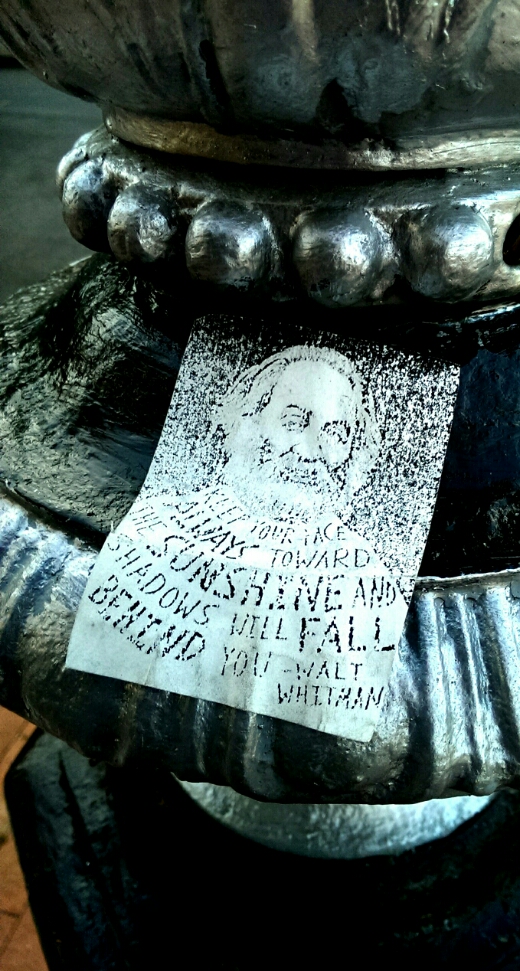
Consignment Shop Find
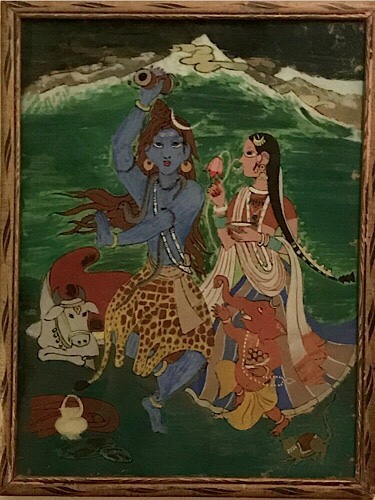
Siva, Parvati, Ganesha, and Nandin, reverse painting on glass, mid 20th century

Siva, Parvati, Ganesha, and Nandin, reverse painting on glass, mid 20th century
Could you find your innards gorgeous–the blood, sinovial fluid, organs of digestion and elimination? What about your inner thoughts and memories, the ones you do not want to share?
That, of course, is not the point, here. What does it mean to be gorgeous inside? As a found exhortation it is to invite us to find (and seek) the wondrous and exquisite place where external (including your internal critic) judgment and values become irrelevant (even while recognizing that we are still working on things).
To find that gorgeous and glorious inner space and rest in it is one of the reasons to meditate–especially those of us who have a tendency to hear at times all too loudly the inner and outer voices of criticism.
Peace and light, E — Posted with WordPress for BlackBerry.
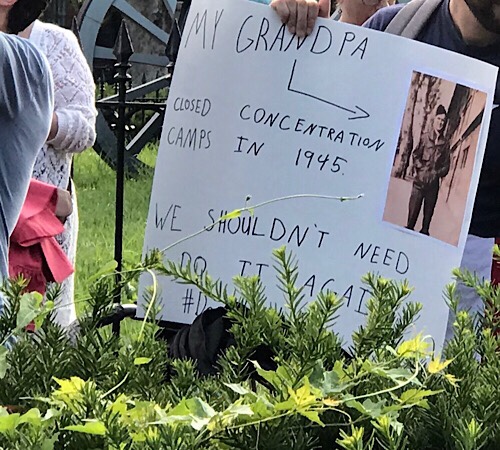
I walk past the Japanese American World War II Memorial on my way to work. This means I mostly walk past without thinking about why it is there. This morning I was moved to reread and remember and ask myself what am I doing about it?

A number of years ago, I attended a week-long workshop with Rod Stryker. He invited us to meditate on absolute stillness — cara sthira — meditation. Sitting comfortably, still the skin, the muscles, the bones. Draw the attention to stillness. The breath and heart will still move, but the concentration is on stillness rather than on any movement. Rod Stryker discussed the next day the challenges of this meditation, especially for those who are intellectual, who enjoy being active in the mind. I found it difficult at the time and even dreamed about the issues the meditation brought up for me. Meditating on stillness can be very challenging in a way that meditating on a mantra or the breath would not necessarily be.
I believe the origin of the meditation comes from the principle of sthira being the absolute unmovable, the essence of being (not dissimilar to Kant’s unmoved mover). We invoke pure stillness, pure potential out of which movement comes because that is part of our essence and a place where we can rest our spirit. See, for example, the Srimadbhagavatam.
I discovered absolute joy in this meditation a couple of years after I learned it. I was suffering from a severe sinus infection and bronchitis simultaneously; I joked that I was fine as long as I didn’t breath through either my mouth or my nose. In the midst of my suffering, I remembered the teaching. For a few days I stayed in the meditation for hours at a time. I found the place where I did not really need the breath. Enough came to survive, but I forgot about wondering how to breath or finding a place for it or my struggles with it. In the stillness, there was space and peace and supreme bliss. Ever since then, I have chosen this form of meditation when I have a cold, a sinus infection, or other challenges with breathing. Meditating on the breath, obviously, will not be soothing when breathing is a struggle. But when even breathing is a struggle, peace can be found in complete stillness.