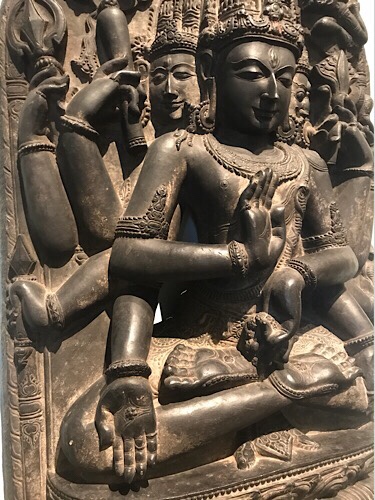
Sadasiva
Quakers speak of allowing the way to open, Buddhists of resting in a space of not knowing.
Today I turned in my federal ID, computer, and keys, after over 30 years as a civil servant. What a privilege to be able to allow myself the freedom not to have made any significant plans for what comes next. After all those decades of focused work, to rest in the spaciousness of not knowing.
A friend whom I first met through work came and shared a meal and helped make the day festive.
The other night after yoga class, a group of us went out to celebrate a friend’s 39th birthday. During the ambling course of the conversation, I said that I was turning 50 later this year. I added that I would grow my hair another couple of inches longer and lose three pounds, and 50 would be just fine (let’s leave aside for now all the societal conditioning that goes along with feeling that such an age marker wouldn’t feel too old as long as my hair was long and my body at a youthful weight).
“Who goes on a diet to lose three pounds?” asked one of my friends. I find that people sometimes look at me and are shocked that I pay attention to my weight. They have an idea that someone who stays slim is just lucky rather than consistently mindful. My grandmother who was 4’11” in her high-heeled slippers was the one who taught me to be mindful in this way. Once or twice a year, she would moderate her diet to lose the two pounds that crept on after one too many desserts over the course of a few months without any other change in her modest, healthful for those days diet.
Going on a diet to lose three pounds means never having to lose 10 or 20 pounds or more. It means returning to mindfully eating a little extra less for a couple of weeks after a couple of months of having eaten a little more than what is perfectly sustaining rather than having to go through a major lifestyle change. In my middle age, I pay attention to my diet not as much for how I look in my clothes and feel about my body, but more for whether what I am eating is healthy for me and the planet. One of the best and easiest ways to be at an optimal weight, feel healthier, and have less impact on the planet is simply to eat less (though this is a new announcement by the government, any one with even an ounce of common sense knew that, no matter how much exotic, novel, or challenging diets seemed more appealing).
Part of eating the right amount for your ideal fit with your body and its relationship to the planet and society is having food that is not necessary for a healthy body only on special occasions (which is different than rigidly forbidding it to yourself). In reviewing what is sustaining for me and the planet while still enjoying a delicious diet, I periodically take a look at what I am eating and think about what is really fulfilling. One of the things I enjoy, but have known really should be a treat is orange juice (which I stopped drinking on other than an occasional basis several months ago and truly have not missed).
If you are eating multiple servings of vegetables and a piece or two of fruit a day, orange juice processed, packaged, and shipped outside of a grower state provides little more benefit to your diet than does a can of soda. If you kept everything else in your diet consistent and aren’t already eating enough to be gaining weight, eliminating the unnecessary glass of juice would not only diminish your carbon footprint (and if it is not organic, your chemicals into the drinking water footprint as well as your carbon footprint), but you also would be eliminating the number of calories it takes to gain a pound over the course of a month. And if you live in one of those states covered in snow and ice and are yearning to eat something from the land of sunshine, eat an orange or some other tropical fruit–organic if you can get it — and skip the processing, the cooking (pasteurizing), and some of the packaging that goes into it being shipped to your grocery store as juice.
This will be my 20th season in my garden. I know that my back garden — where I grow my herbs, flowers, and vegetables — is easily 4-5 weeks earlier than the gardens of my friends’ in Potomac and Silver Spring and the outer suburbs. It is even almost that much earlier than my front garden. I have a brilliantly sunny, south-facing, protected back garden with a brick patio that is against an unpainted brick house and a densely shaded, north-facing front garden. Not only is the back garden sheltered from the wind by the house on one side and the fence on three sides, but the bricks retain enough heat to change the temperature by a a couple of degrees. I have a special micro-climate. My climbing rosebush (pictured in the header) is already in leaf.
What does this mean? While my friends in the suburbs or those with east/west facing houses are starting seedlings for kale and spinach indoors, I can put seeds into outdoor containers in the next week or two without compunction. The seedlings I would need to start (if I don’t instead choose to purchase them from the organic farmers at the market) are peppers and tomatoes for planting in mid-April. If I start with strong 8″-12″ plants in mid to late-April (depending on the 15-day forecast), I can have and have had for at least 10 of the past 20 years, cherry tomatoes in May and peppers in early June. My greens, obviously, bolt earlier. I’ve figured out that certain varieties of chard do better in these conditions, and that spinach and lettuce do better sheltered by the fence where they get afternoon shade, so that I can have them farther into the season.
This kind of knowing by combining general book and teaching knowledge with personal observation of my little space, is much like the yoga practice of svadyaya (self-knowledge), which is the fourth niyama of Patanjali’s yoga sutras. Svadyaya is literally study of the self through the scriptures. Implicit in that is the guidance of a teacher or guru. Ultimately, though, self-knowledge or awareness must be experiential. We make the effort to study and we listen to our teacher, but then we practice. We soften and open to who we (or our garden) truly are — another way of practicing and experiencing the Anusara principle of opening to grace — and then in the context of the teachings, accept who we are. As gardeners, that means accepting what zone we are in, how much shade, water, space, and sun we have. As yogins, it means accepting our strengths and our limitations. We can shift our zone by treating certain plants as indoor/outdoor or as annuals rather than perennials; we can enhance our water flow by storing it in rain barrels, but that is merely expanding the edge rather than making a complete change. We can expand the edge of our practice, but still need to accept the bodies with which we were born.
The Isha Upanishad starts, “That is fullness (purna). This is fullness. Fullness comes from fullness. Take fullness from fullness, and the remainder is fullness.”
My maternal grandfather died when I was just a toddler, so I never got to know him. My mother used to tell us that when he had eaten enough at a bounteous meal, he would say “that was an excellent sufficiency and any more would be a superabundency.”
On Sunday I went over to Lovejoy Gardens to my little plot (approximately 3′ X 7′ raised bed on concrete, half shaded by a fence) and harvested tomatoes. There were about 15 ripe tomatoes. The first thought was that it was too many tomatoes. Then I thought of all the neighbors I had who didn’t have their own tomato plants. I knocked on one neighbor’s door. He gave me tea while I played with the cat. I gave him tomatoes. I went for a massage in the afternoon. I brought tomatoes. I was sent home with freshly made spanakopita. I invited another neighbor over for dinner. We at pesto with basil from the garden and cucumber and tomato salad (cucumber, tomato, and shallots all from the garden drizzled with a little of the best balsamic vinegar and seasoned with just ground sea salt and pepper). We had a lovely visit, and I sent him home with tomatoes. In the next day or two, I will make a batch of tomato sauce and put it in the freezer and have someone over for dinner another night.
There is only “too much of a good thing” or a “superabundency” if we hoard it or try to ingest it all ourselves out of fear, greed, or desire for power or control. When we have enough ourselves and then share the abundance, we simply create more abundance. Once again, I am given again from my garden another sweet insight into the yoga teachings. I am also reminded by this small example that I could share even more broadly from my blessed lot of fullness in global society.