| |

Ganesha (Deity of the Marines?)

A senior colleague and I spent several hours today working together on a very challenging aspect of a long-term project.  When we were wrapping up for the day, I showed him a murti of Ganesha that another co-worker had brought me from the Norton Simon Museum when she had gone on a business trip to Pasadena, where our Los Angeles office is located.

I said that I do not believe in the Hindu deities as gods, but find them helpful for contemplation as archetypes (in the Jungian sense).  I said that being on this project has taught me much about yoga and about Ganesha.

“Ganesha,” I explained, “is not so much the remover of obstacles, but the one who places obstacles in your way to teach you the wisdom to grow and find a more enlightened path from having confronted the obstacles.”  “Oh,” said my colleague, “like the Marines:  adapt, improvise, and overcome.” “Well, sort of,” I replied, enjoying that we found a way to share laughter after our difficult afternoon.

Similar Posts

  • | |

    Found Exhortation?

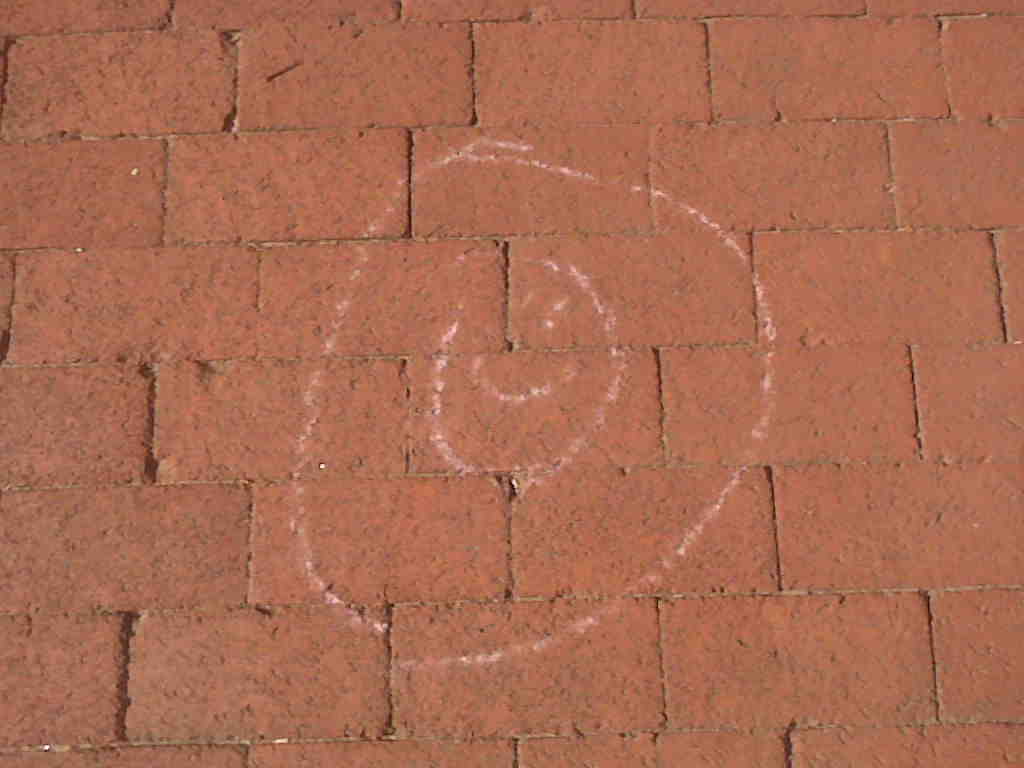
    Someone has been walking around Capitol Hill with pink chalk and drawing circles with smiley faces inside. Impermanent graffiti made longer lasting by the drought. What is the message intended? How many people have noticed (at least one friend of mine has asked about this offering on Face Book)?

    Peace and light, E — Posted with WordPress for BlackBerry.

  • | | | |

    “Hip Openers for Peace”

    Desiree Rumbaugh, in the afternoon break-out session on hip openers yesterday, referenced the earlier teachings at the gathering on love, and said with a giggle that her class was “hip openers for peace.”

    She shared a story of a teacher having his students create pictures representing peace. He picked two images that best depicted peace. The first was a serene picture of a mirror lake in the mountains (not unlike the tantric yoga principle of using our practice to find in ourselves the mirror of divine spirit). The second was of a barren and craggy landscape with a stormy sky. In a corner of the painting, though, was a nest with a small bird singing. Amidst challenge and chaos, one being living peacefully and joyously. This is why we do yoga, suggested Desiree, to find our own place of peace amidst whatever chaos is life. Noting how challenging hip openers can be for body and mind, especially if our bodies feel tight, she said that the practice can be like the second picture. We want to learn how to feel calm and centered even when we are deeply challenging ourselves on the mat, so we can tap into that place when life gets harder than we think we can bear.

    The technology she offered for finding peace in hip openers was not tricks for stretching, but rather to strengthen the core muscles so that the outer hips and the hamstrings do not need to clench to protect themselves. When the core is powerful (as John Friend would say, “adamantine”) then the outside can soften and be open to what comes. This principle, in my experience and as given by my teachers, holds equally true for facing life and the most challenging of yoga poses.

    Peace and light, E — Posted with WordPress for BlackBerry.

  • Dharma without Karma (Please Vote Next Tuesday)

    It’s no surprise:  I find myself more and more consumed by thought and activity regarding the state of the country and what I can do as a citizen (including voting) to make things better.  As I seek to stay engaged, but grounded and without anxiety, I find solace of the teaching in the Bhagavad Gita that true yoga is action without attachment.  To be detached is not the same as withdrawing from action.  In fact, the Gita suggests that the path of action is better than the path of renunciation.

    What is actionless action?  Given the Gita’s fundamental premise that we must act in accordance with our duty (what that means is the subject of much debate that is beyond a simple blog), actionless action does not mean disengaging from the process.  It also does not mean not caring.  Rather, it means that we should act fully in accordance with our principles (which principles should be shaped by the yoga guidelines of non-harming, truthfulness, non-stealing, alignment with nature, non-greediness, cleanliness, contentment, fervor, self-study, and surrender), but with the mental understanding that we are ultimately not in control of the outcome.  We act because not to act is a cop out.  We offer the fruits of our action to forces beyond ourselves.  We act out of love — not selfish love for personal gain — but with loving gratitude for being able to act at all.  We engage fully and then still seek to be free of being unsettled by either pleasure or pain from the outcome.  Whatever the results, we keep acting, we keep doing our duty, fully and with loving engagement.

    See:  BG IV.19-20:  He whose undertakings are free from anxious desire and fanciful thought, whose work is made pure in the fire of wisdom:  he is called wise by those who see.  In whatever work he does such a man in truth has peace:  he expects nothing, he relies on nothing, and ever has fullness of joy.  (trans. Juan Munoz)

    He who has abandoned all attachment to the fruits of action,/ Always content, not dependent,/ Even when performing action,/Does, in effect, nothing at all./ Performing action with the body alone, / Without wish, restrained in thought and self,/ With all motives of acquisition abandoned, He incurs no evil.  (trans. Winthrop Sargeant)

    P.S.  I will have voted in the morning and will be teaching at Wm Penn House on Tuesday so come join me resting in yoga before going home to watch the returns.
  • | | |

    Humility

    Last night at house practice, we were led to think about humility (in Sanskrit vinaya). Yoga, similar to religion, tends to privilege the idea of humility.

    From a one perspective, it is easy to think of the benefit that those in charge–the priests and the moneyed and privileged classes that support religious institutions to get help staying in power–get from preaching the virtues of humility. If the relatively powerless are led to believe that they will benefit spiritually from practicing humility before humans and institutions that hold sway over them, that certainly helps perpetuate a patently unfair status quo.

    We can recognize our own skills and talents and relative worthiness and actively seek justice and fairness, though, and still be humble. However much intrinsic power we have and extrinsic fairness in distribution of power we seek, we can still recognize that we are not ultimately in charge of exactly how our life will play out in the vast and complex web of being. Feeling humility in the face of all that we do not and cannot know is just living in awe at the wonder of life. This, I think, is true and sustainable humility.

    Peace and light, E — Posted with WordPress for BlackBerry.

Leave a Reply

Your email address will not be published. Required fields are marked *

This site uses Akismet to reduce spam. Learn how your comment data is processed.