An Inspiration
If only to have something like this said of my work.
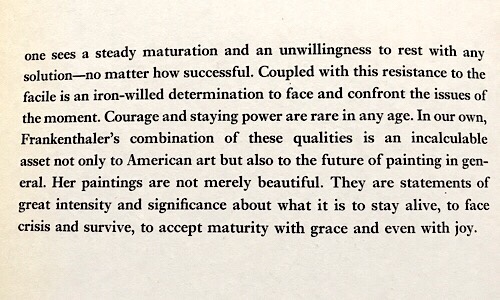

If only to have something like this said of my work.
Above (or perhaps beyond, or maybe more elemental, or more universal — words inevitably tangle us in discussing essential philosophical constructs) the six kanchukas (cloakings or coverings) are the five universal elements. These are suddha vidya, ishvara, saddha shiva, and shiva-shakti. John Friend suggests that we think of the first three of these tattvas as corresponding to the principles of iccha (will), jnana (knowledge), and kriya (action).
When I think of the Anusara principles in practice on and off the mat, I think of them in terms of the tattvas, particularly the five universal elements and the five mahabhutas . Those of you who practice and study Anusara yoga are familiar with the principles of “open to grace, muscular energy, inner/expanding spiral, outer/contracting spiral, and organic energy.” As part of the physical practice of asana, I think of these alignment principles as corresponding to the mahabhutas (the five great elements of earth, water, fire, air, and space/ether; see previous posts on how I experience the alignment principles as relating to the mahabhutas). At that level, “open to grace” has physical characteristics. These principles, when applied consciously, help us to align the physical body with the energy body, so that we can more fully delight in our bodies. When we are in alignment and experience expansion through alignment, we can more optimally move in and experience the physical and mental realms in a way that helps us recognize the universal spirit in all beings.
The reason I come to the mat, the ultimate purpose of yoga in an of itself and for me as a practitioner, is informed by the five principles of the universal. The yearning to connect to the spirit is in essence an opening to grace at an elemental, non-physical level (an uber opening to grace). The next aspect of our practice, which is more important than the physical technical details of the alignment principles, are what John Friend terms “attitude, alignment, and action.” These are by definition more universal and fundamental than the physical principles and correspond directly to the principles of iccha (will), jnana (knowledge), and kriya (action). The essence of yoga, especially from a tantric perspective, is the will (iccha) to embody and experience the union of mind, body, and spirit with a radical embrace of our being. Knowledge (jnana), when used as a way to align with our true nature, is not to correct, but to better enable us to align our body, both physically and energetically, and our mind so we best can experience and express our will to connect. The ultimate action (kriya) of a pose or what we do off the mat is a spontaneous offering or an expression of our will to connect, using ever increasing refinement, skill, and knowledge.
Today I had the honor of leading an online practice for some of the staff at the Latin American Youth Center to give them some support for their incredible service.
This was from a walk a few days ago.

If only wishing could make it so, this yearning of a few for so many countless generations. I will be examining, for the new year, what I can do to diminish conflict in my own life–because that I can do.

I brought sprouted lentil and cucumber salad to a potluck dinner at a neighbor’s house last night. The host had spent a fair amount of time in the kitchen. I commented that perhaps it wasn’t right that I’d brought a salad that only took about ten minutes to prepare. Then I thought about what went into my preparations. First, I grew the cucumber. Then – sprouted the lentils. One of my friends said in response to my saying I’d sprouted the lentils, “Elizabeth, you know there are the Whole Foods and The Harris Teeter. You don’t have to make your own sprouts.”
(Oh, you can just imagine, dear reader, my initial unspoken response in my head.)
“Yes, I do know that,” I responded, but there are so many reasons to do your own sprouting.”
1. Especially in winter, home sprouts are the freshest greens you will get.
2. No salmonella with home sprouts. (This got an enthusiastic back up from a fellow guest who was now thinking maybe she should start sprouting.)
3. Cuts way down on plastic waste. Consider how sprouts are packaged for supermarket sale.
4. Cost savings–a very inexpensive food instead of one marketed as a high-cost gourmet specialty food. (The conversation took on a life of its own; I no longer needed to be the advocate).
The Recipe:
Peel and seed a cucumber or two. Cut into 1/2″ or slightly larger dice. Mince about 1/6 cup sweet onion or white and pale green part scallion (or more or less to taste). Add a couple of generous handfuls of lentil sprouts. Use more sprouts than cucumbers if serving as the main feature of a cool summer light meal instead of as a side salad. Splash with olive oil and then toss to coat. Add a little balsamic, red wine, or sherry vinegar. Toss again. Add salt and pepper to taste. I also added minced cilantro and jalapeno because the main course was enchiladas. For an Italian version, try with fresh basil and a little green or red bell pepper. For a Spanish style salad, use parsley and replace the vinegar with lemon juice. Think of your own variations and don’t be shy about sharing.
In the health food store across the street from my friend Suzanne’s yoga studio in Saratoga Springs.

Peace and light, E — Posted with WordPress for BlackBerry.