Wonder
A red-tailed hawk is common enough to see, but not in the city, and certainly not as a fellow museum-goer. Perhaps nature and culture are not as much a dichotomy as one might think

A red-tailed hawk is common enough to see, but not in the city, and certainly not as a fellow museum-goer. Perhaps nature and culture are not as much a dichotomy as one might think
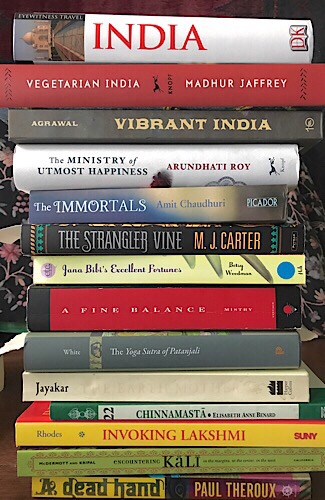 Current stack of to be read in anticipation of upcoming travel. Though I’m on a brief detour into a reread of “Harry Potter and the Deathly Hallows,” which appeared the other day in a nearby “little free library.” The Arundhati Roy is so finely wrought, I can only read a few pages at a time. The Madhur Jaffrey, by serendipity, has a bit about one of places I will be eating.
In the tantric philosophy, one of the aspects ascribed to the ultimacy of being itself is that it is completely free (svatantriya). Even when elemental being manifests itself as limited in time and space (as humans for example), it is part of the very dance, the play (lila) of existence.
I find it fascinating how much of our advertising uses language that in essence promises that we will realize aspects of our divine nature by owning some material thing or indulging in some activity. What is being sold, by those terms, inevitably fails deliver and must thoroughly disappoint. This thing on offer might be a wonderful technological toy that would be great fun to use, but hardly could bring unlimited freedom. If it did, we wouldn’t want to buy the next version.

Peace and light, E — Posted with WordPress for BlackBerry.
When a student asks a question and I do not know the answer, I do not try to answer it then and there. I do go home and take the time to try and find an answer. If I find enough information to be useful, I follow up. Last night, before the William Penn House class, a student asked whether I had received a recent mass e-mailing from John Friend in which he mentioned teaching about biotensegrity. I knew the answer to whether I had received the email–yes, a friend had forwarded it. I did not know, though, how John was using the term biotensegrity. I went and did a little research.
Buckminster Fuller coined the word “tensegrity”as the conjunction of tension and integration. The idea of tensegrity is being actively taught by anatomy teacher Tom Myers, a student of both Buckminster Fuller and Ida Rolf and a teacher of certain of my yoga teachers. It also bears a trademark when called “Carlos Castenada tensegrity.” I never got into the “magical passes” of Castenada’s students turned teachers, but at some point relatively recently found a used copy of “Magical Passes.” As I had delved fairly deeply into Carlos Castenada in my youth, I picked up the book and made it part of my library, though did not read it at the time.
I am not surprised that John is talking about biotensegrity. From my few hours of reading, it seems resonant with the “universal principles of alignment” that were the foundation of his Anusara teachings and also consistent with his movement towards the exploration and teaching of “sacred geometry” near the end of his Anusara days.
Yes, I know I haven’t actually said what is tensegrity or biotensegrity in the yoga/body awareness and movement context. But I do not teach unless I have learned something well enough to integrate it fully into mind and body such that I can articulate it in my own words, and I have not thought enough about the term tensegrity as it relates to yoga practice, though the concept makes initial intuitive sense. If the links inspire interest, I invite you to look more deeply. And I’m going to put “Magical Passes” on my stack of reading, though not necessarily at the top.