Stepping Stone
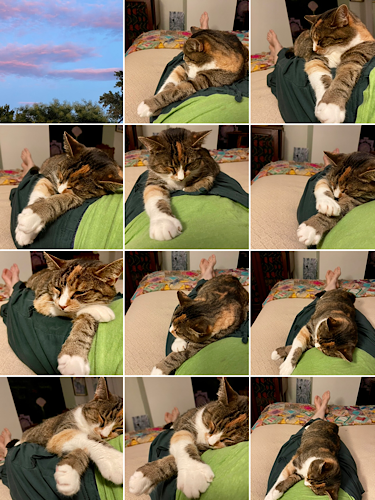
My dharma, whatever I might have thought it is, according to Maitri, is being her cat bed. Is it possible to have multiple dharmas?
One of the six fundamental aspects of being (sat) in the “Shiva-Shakti” tantra that is the foundation of Anusara yoga is svatantrya — freedom. (The others are cit, ananda, spanda, purnatva, sri). Freedom in this sense is an ultimate freedom — the very cosmos is unconstrained and freely creates what we recognize as the fabric of being out of its own play (lila). We, as inseparable from being, although in some ways confined by our embodiment, are essentially free — free to choose whether to recognize our essential nature, to find bliss (ananda) in our embodiment, to recognize the fullness (purnatva) of being, and to honor the essential auspiciousness of being (sri) in ourselves and all that is around us.
In having that freedom, we can also turn away. We can stay cloaked. We can choose violence and anger rather than nurture and love. We can choose, out of our own essential freedom to remain cloaked in ignorance, to throw bricks and threaten death because of a perceived socialist tyranny because of the passage of health care “reform” that denies the right to choose, does not provide basic medical services for all (no single payor or even public option), and gives the pharmaceutical industry a pass, but does some modest regulation of insurance companies and employers. (“Better than nothing, I guess,” as one friend wrote on the internet.)
I see the t-shirt “it’s all good,” and I think, “not!” I also know that I have the freedom for myself to recognize and remember sri, to try and see it in all, including the play of freedom that includes the freedom to turn away from the light. It will be a lifetime of practice.
On this anniversary of my Grandmother Rose’s leaving her body and her daughter, my mother, entering hers, on this Armistice day though none in my lineage were warriors, I made in remembrance and recognition of my ancestors, this mala with a locket (still empty of pictures) that my grandmother bought at the Brooklyn Museum’s shop in the early 1970s–
Rudraksha Seed – auspiciousness and oneness
Iolite – connecting with angels
Laboradorite – perfection and protection
Amethyst – gentle, tranquil, soothing healing
Pyrite – fierce creativity, ingenuity

I am returning to a contemplation of teachings about the tattvas (the 36 elements in Kashir Shaivism; in Vedanta only 25). Each time I go back to study, practice, and contemplate the tattvas, a new understanding arises about how I am in the world and how I might want to shift my alignment to be better able to serve, for want of a better word, the good. The tattvas provide a way of understanding the structure of consciousness [Consciousness], from the most metaphysical, universal elements to the most diverse, individual, physical elements and the relationship between the two. Practicing asana with the Anusara principles of alignment at the same time as reading these teachings has, for me, helped bridge the space between the intuitive and concrete understandings of being in the world. The point of trying to understand these extraordinary philosophical ideas is not for the sake of acquiring academic learning, but rather is an invitation to use the joyous experience of wrestling intellectually, intuitively, and physically to illuminate understanding, as a way to dwell more consistently in the heart.
Reading Sources:
Kashmir Shaivism, The Secret Supreme, Swami Lakshmanjoo, ed. John Huges, Universal Shaiva Fellowship (2003)
Kashmir Shaivism, J.C. Chatterji (SUNY Press, 1986)
The Triadic Heart of Siva, Paul Eduardo Muller-Ortega (SUNY Press 1989)
Dear Friends,
I hope you weathered Ida and are enjoying the glorious days that are following her cleansing rains as we move into the first of the holidays. Although I may have some thought-provoking questions about the historical basis for our Thanksgiving Day, I love taking the time as a society to get together to remember, to heal, and to share the abundance and give thanks for all that we have. For me, one of my greatest sources of gratitude is the practice of yoga and our wonderful community. Please join me for a gratitude-filled week of inner abundance:
Serenity Saturday: November 21st, 3pm-5pm at Capitol Hill Yoga
Oxfam Yoga Fundraiser: Thanksgiving morning, 10am-11:30am, at Willow Street Yoga, Takoma Park
Class Schedule: All open classes will be held as usual Tuesday, November 24th at Wm. Penn House (6:30pm) and Saturday, November 28th (Level 2 at 8:30am, Gentle/Therapeutic at noon) at Willow Street, Takoma Park.
Regrets: No house group practice, Wednesday, November 25th.
More details on the website at www.rosegardenyoga.com. To register in advance for Serenity Saturday, please visit www.capitolhillyoga.com.
I look forward to seeing you soon and sharing the joy of the holiday season.
Peace and light,
Elizabeth