
Similar Posts

  • | | |

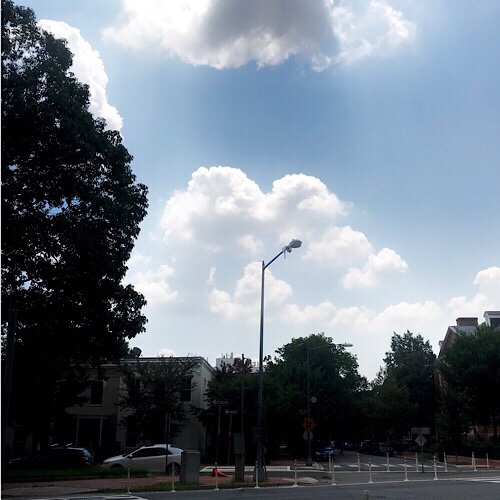
    View From the Fifth Floor

    I got up to stretch my legs and ease my eyes (excellent to do this a few times an hour if you have a desk job). The sky is magically beautiful and captivating out the window no matter what goes on inside (a mostly stressful, thankless day today) or what is on the ground (the view from this window is the homeless shelter, highway, and tax court).

    Find a moment to change your gaze, whether it be closing your eyes to the inner world of meditation or directing them to some small or large beauty or wonder. It will help make what is hard less so–at least that is my experience.

    Peace and light, E — Posted with WordPress for BlackBerry.

  • | |

    When Little Changes Can Be Big

    This past Sunday I went to an afternoon workshop with Leslie Kaminoff.  Though I was familiar with his book and I follow what he has to say about yoga anatomy on Facebook, I had not ever studied directly with him.  Much was familiar, but–and this is why it is important for teachers to study– I did take home some thought-provoking nuances that will invite my own explorations in practice.

    A sound bite that very much resonated, especially from the perspective of therapeutic practice and mindful embodiment is the notion that making small changes to things we do very frequently can have a big impact.  For example, if all we do to optimize our practice is a minor alignment adjustment to how we stand in tadasana (standing “mountain” pose) or fold forward into and rise up from uttanasana (forward bend), we will make a huge difference in how our physical practice influences and helps day to day movement in our body because they are the most ubiquitous of poses in our modern asana classes.

    Next time you’re looking for a bigger change in your health and embodied well-being, instead of looking at big changes and hard effort and feeling overwhelmed, see if there is a little alignment enhancement in a common posture (right now I’m thinking of how I sit in my desk chair) that might shift your everything.


  • | | | |

    “The mind and spirit become ripe…”

    I have been indulging in reading the thriller Angelology (complete with stories of angels and the war between good and evil), which  I picked up at the Books for America shop in Dupont Circle a couple of weeks ago for the kind of night of reading that is the equivalent of a night of watching television if I had a television.  Relatively early in the book, a professor says to one of the brilliant students who is a central character to the plot:  “I have found that our texts will speak deeply to someone or they will say nothing whatsoever.  It depends upon your sensitivity toward the subject.  The mind and spirit become ripe in their own fashion and at their own pace.  Beautiful music plays, but not everyone with ears can hear it.”

    This statement encapsulated the ongoing thinking I do about my attraction to yoga and the tantric philosophy.  I was contemplating especially deeply this week on my return from California, with no particular insight arising, what has drawn me in to this world of meditation and yoga.  What am I doing, having been born in New York City and working as a civil servant in DC, coming from atheist Jewish grandparents and converted to Quakerism parents, finding such joy in learning Sankrit chants and working with energetic principles described in these ancient and medieval Indian texts?  I do not doubt that the practices resonate and the texts speak to me and that the attraction is energetic, just as we are drawn to certain tastes and colors and entertainment and people and no interest arises from others.  I just wonder why these practices and texts and not something else and why they hold me to such a degree that I am moved to teach them.

  • | |

    Signs Around Town (and a Tantic Philosophical Conundrum)

    I haven’t photographed the t-shirt with the statement “it’s all good” to go with the sign below “needs work,” but I would need to if I wanted to show the apparent philosophical tangle of tantra.

    The tantric texts do tell us that it is all good; more accurately, they tell us that all is divine and perfect, and that we are just an element of the “all.” It is hard to believe that when we can see suffering and bad behavior (including some of our own) all around us.

    The tricky thing about the declaration that all is divine is that it does not mean that there is no work to be done. The work, though, is not to fix ourselves or what is wrong or bad. Rather, the work (sadhana) is to study so that with discrimination (viveka) we can determine what is out of alignment and causing our own suffering or contributing to suffering of other beings and move towards and unveil the perfection and fullness that we are.

    It is sort of like finding a great treasure that has been neglected and misused out of ignorance or carelessness at a yard sale. It takes knowledge to recognize that the cheap, discarded thing is a treasure and skill and effort to restore its intrinsic worth.

    Peace and light, E — Posted with WordPress for BlackBerry.

Leave a Reply

Your email address will not be published. Required fields are marked *

This site uses Akismet to reduce spam. Learn how your comment data is processed.