Signs Around Town
I am returning to a contemplation of teachings about the tattvas (the 36 elements in Kashir Shaivism; in Vedanta only 25). Each time I go back to study, practice, and contemplate the tattvas, a new understanding arises about how I am in the world and how I might want to shift my alignment to be better able to serve, for want of a better word, the good. The tattvas provide a way of understanding the structure of consciousness [Consciousness], from the most metaphysical, universal elements to the most diverse, individual, physical elements and the relationship between the two. Practicing asana with the Anusara principles of alignment at the same time as reading these teachings has, for me, helped bridge the space between the intuitive and concrete understandings of being in the world. The point of trying to understand these extraordinary philosophical ideas is not for the sake of acquiring academic learning, but rather is an invitation to use the joyous experience of wrestling intellectually, intuitively, and physically to illuminate understanding, as a way to dwell more consistently in the heart.
Reading Sources:
Kashmir Shaivism, The Secret Supreme, Swami Lakshmanjoo, ed. John Huges, Universal Shaiva Fellowship (2003)
Kashmir Shaivism, J.C. Chatterji (SUNY Press, 1986)
The Triadic Heart of Siva, Paul Eduardo Muller-Ortega (SUNY Press 1989)
When I stepped out of the house extra early to head to a meeting at another Agency, I was greeted by this amazing being suspended on a nearly invisible thread between the house next door and my porch. I hope she spins a web and sets up housekeeping. There are plenty of bugs to eat.

Peace and light, E — Posted with WordPress for BlackBerry.
Are you accurately aware of your limits? Do you sometimes blow past your limits to your detriment? Do you ever enlarge your idea of your limitations in a way that cuts off your ability to live as fully and joyously and generously as is truly possible?

Peace and light, E — Posted with WordPress for BlackBerry.
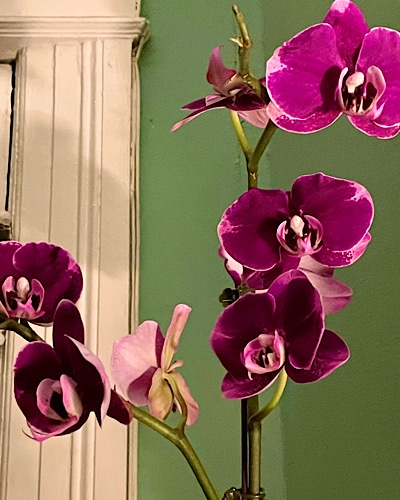
I thought by this time, I might be feeling the cold and the dark, so I brought home a new orchid, which/who continues to bloom extravagantly.
MoveOn just posted this Howard Zinn quote on Facebook: “Civil disobedience is not our problem. Our problem is civil obedience. Our problem is that people all over the world have obeyed the dictates of leaders…and millions have been killed because of this obedience…Our problem is that people are obedient all over the world in the face of poverty and starvation and stupidity, and war, and cruelty. Our problem is that people are obedient while the jails are full of petty thieves… (and) the grand thieves are running the country. That’s our problem.”
It spoke my mind and resonated with what I wrote about yesterday with regard to how to be open to yoga’s invitation to practice humility without ceding power to authoritarian structures. This quote is spurring me to think aboutPatanjali’s eight-limbed path of yoga, and particularly the niyama (observance) of ishvara pranadhana (surrender). I don’t see why a true, radical yogini could not simultaneously surrender to the mysterious outrageousness of being while still being appropriately disobedient to authoritarian structure. But maybe that is because I was raised a Quaker; there’s quite a bit of overlap between some of the tantric yoga principles and the teachings of Quakers.