|

Found Exhortation

Are you accurately aware of your limits? Do you sometimes blow past your limits to your detriment? Do you ever enlarge your idea of your limitations in a way that cuts off your ability to live as fully and joyously and generously as is truly possible?

Peace and light, E — Posted with WordPress for BlackBerry.

Similar Posts

  • | | | |

    Householder Yoga (and Getting Out to Vote)

    To be a tantrica does not mean wild and indifferent  sensual indulgence.  On the contrary, it means fully engaging in all of life.  A tantric life is one in which everything one does–work, family, relationship, consumption, citizenship–is steadily and progressively more informed by the teachings of yoga and infused with the fruits of the practices.  A key aspect of participating fully in the life of a householder in a democracy is to educate oneself about politics and to participate.  Please vote.  Here’s a short video from the ACLU that you might want to watch and pass along to your friends and family.

  • | | |

    Personal History (and Samskara and Opening to Grace)

    A samskara is generally defined as an impression left in us by a past action or experience.  I found myself thinking about the process of samskara yesterday, when I went with long time friends of my family to watch their son taking class at the summer program at the Kirov Academy of Ballet.

    I have not watched a ballet class (except on the occasional film) since I was actively studying ballet as a teenager and young adult.  I have long been conscious of how ballet imprinted my body image and way of looking at myself, but have not found a space before where I was able to look at this aspect of my history with fresh eyes.

    What was different yesterday, was that I was observing with openness.  I was sitting with people I have known all my life, sharing their warmth, love, and parental pride for their son, rather than concentrating on my own history.  It brought back memories, but not in the same way that sitting by myself or with a girlfriend, watching a documentary has done.

    In this open state of reflection, I witnessed something that I knew at some level, but had not given much thought to before:  how much having taken thousands of hours of ballet class has informed the way I teach.  My tendency in my own practice and in my teaching to see the details of  alignment and to try asanas repeatedly until it seems that I or my students have experienced the alignment in the most optimal way for the day is straight out of my experience in ballet class.

    Softening and witnessing instead of feeling or judging from past experience gives the possibility of shifting from samskaras, even ones that are very deeply etched into body and mind.  Being with my friends yesterday, of course, gave me the joy of seeing the spectacular dancing of these young men and the delight of connection.  It also gave me the unexpected gift of a moment of understanding how the Anusara principle of “opening to grace” allows us to shift.  When we are open, nonjudging witness consciousness  (an aspect of “opening to grace”), that is when we have the possibility with each thing we repeat, to experience it new without being bound by our samskaras.

  • | | |

    Gardening, Cleaning, Cooking (and Vinyasa Krama and Kali)

    Vinyasa krama is the art of sequencing.  How a yoga practice or flow is sequenced can determine whether it is uplifting or inward going, exhilarating or calming.  When we are trained and attentive, we start to know the most optimal order to open our bodies and our focus to align with the time of day, the season, the weather, our mood, and our health.  This incredible art helps us be positioned and aligned in a way that we feel free in time and space, rather than being constrained by time and space.

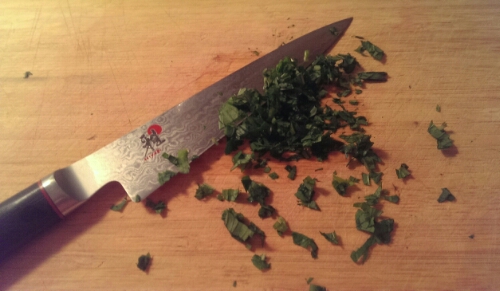
    This morning while I was out in the garden, I was thinking a lot about vinyasa krama and the goddess Kali — goddess of, among other things, time and change, and thus, of sequencing.  I woke very early, brought to consciousness by the long light of the solstice even through closed curtains.  As I went about my morning, rinsing the sprouts while heating the water for my morning coffee; cutting back the greens and herbs before starting breakfast; doing the major pruning and clean-up before doing more decorative garden work; finishing cooking before taking out the recycling; applying a facial mask before starting to vacuum; never walking up or down the stairs empty-handed; waiting to gather the bills until after I was clean and waiting for friends to arrive, etc., I realized how important sequencing is to the richness of my days.  By knowing the best way to order tasks for my needs, my day is simultaneously productive, unhurried, and enjoyable.

    By the time my friends arrived around noon, I had meditated, taken care of the garden, gathered food for my own breakfast and to share with friends, talked to neighbors, cleaned the house and myself, done a little asana, written in my journal, and sorted the mail.  Had I not known from long experience and conscious attention how to sequence all the different elements, knowing which ones went together, which took longest, which ones if done earlier or later would create double clean up, etc, I would have been tired and the tasks unfinished.  Instead, after brunch, I came home to a tended garden, a freshly made bed, and time to enjoy a quiet evening.

    These sequencing principles also apply for me on major projects at work.  If ordered one way, the work is exponentially harder, the deadline a fearsome thing; if ordered another way, everything comes together mostly as it should when it should.  When I order my work with attention (this assumes others cooperate with this endeavor), I have time to do a good, careful job and still take breaks, eat well, and leave the office in time to take or teach yoga class.

    Whether you are doing your home yoga practice or cooking or working, choose to sequence the elements of your practice, your activities, or your day, with attentiveness, reverence, love, and respect, and Kali will support you and not show you her most fearsome face.

  • | |

    State of the Garden

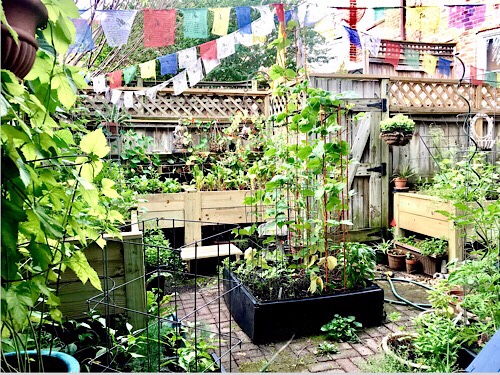
    The grapes are starting to bunch, and for the first time, the kiwi is covered with buds.  Two of the tomato plants have their first flowers.  Snow peas are climbing up the trellises.  Carrots, spring onions, radishes, and beans are sprouting.  There are plenty of cool weather greens and herbs for eating already.  The red roses are blooming.  I pray for sufficient rain.

Leave a Reply

Your email address will not be published. Required fields are marked *

This site uses Akismet to reduce spam. Learn how your comment data is processed.