Weeknight Dinner
Eggs scrambled with broccoli, mushrooms, and shallots with homemade bread (multigrain sourdough cheese bread).
Another opportunity to practice gratitude.
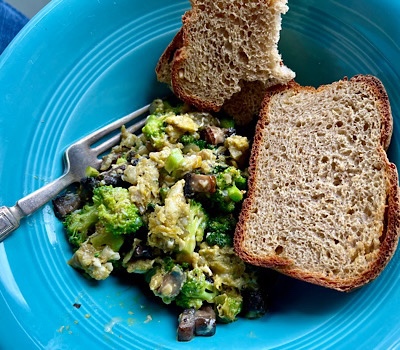
Eggs scrambled with broccoli, mushrooms, and shallots with homemade bread (multigrain sourdough cheese bread).
Another opportunity to practice gratitude.
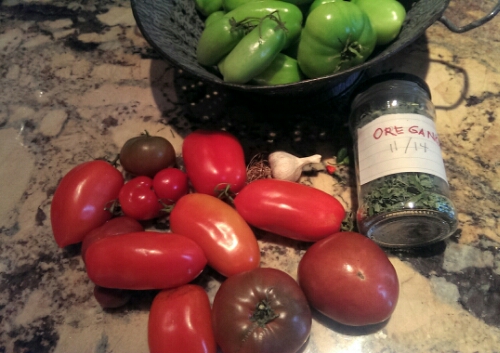
All the tomatoes were picked green. Those that are red changed color, but did not otherwise ripen. Still, cooked for a long time in the slow cooker with lots of red wine, they will make a fine sauce.
I am reminded by the tomatoes, I was reminded at a yoga workshop with Elena Brower that I attended this weekend, a really good question is what are you going to do with the resources you have?
Green Festival is coming to DC again on October 23-24. If you’ve never been (and are in town), it is always enjoyable, if only for the snacks and the comaraderie (odds are high you will bump into people you know). What I find is that I either learn something new about how to live in a more ecologically sustainable way or I get the affirmation that I’m already making a decent effort. Join in the fun if you can.
This article about manners and eating with ones hands gave me a big smile. One of my friends who went on the second India pilgrimage wrote on Facebook right after she returned home that she missed wearing a sari and eating thali meals already. How wonderful the variety of experience on these journeys. Personally, I found the sari cumbersome and binding and not worth the prettiness of the fabric and the compliments (more thoughts on sari-wearing perhaps to come). I was thrilled to get back into my regular clothes (though I was happy enough in salwar kameez). Dal , kitcheree (spiced lentils and rice porridge), and vegetarian/vegan curries have long been a staple part of my diet, so I am already getting the rice and lentils, and the south Indian thali meal is almost completely devoid of vegetables. I was happy enough to get back to my own diet, including Indian-style food of my own preparation.
I am missing, though, being able to be in company and eat with my hands (or hand singular would be more accurate as it is horribly rude in India to eat with your left hand) and getting the chance to walk barefoot outside every day. Though you might not be able to do it everywhere, I highly recommend eating some of your food with your hands and walking without your shoes for some time every day to enhance your sense of touch and your motility.
Last year, when it was dry and hot early, I had an extraordinary season of peppers, tomatoes, and cucumbers. This year, the peppers and cucumbers were not particularly abundant. The heat came too late and the rain has been too inconsistent for them to thrive. The eggplants, though, were ecstatic this year. Every week brought at least two and sometimes four. When cooking for one, it is easy to find two eggplants a week far too many. It was a relief to go to Santa Fe, where I could eat seasonal vegetables that did not include eggplant.
I was delighted, though, knowing I was about to host a party, to come home to five eggplants almost ready to be picked. What better base for a potluck party dish than eggplant? Knowing the crowd, I anticipate baba ghanoush by the bucketful; could not make that. The tomatoes are not longer succulent enough for caponata (they must all become sauce); that was out. I chose, then, eggplant caviar. Not a bad pick. What could be a better offering for a party in Washington DC at this time in history than what is often called poor man’s caviar?
I do not know the historical basis for it being named poor man’s caviar. It does not look like caviar. Not really. It does not taste like caviar. You can put it on bread or crackers the same way you would serve caviar, but that certainly does not further the explanation. It is, though, a delicious and festive dish that pretty much requires only having eggplant growing in the backyard (or a trip to the farmer’s market) and the time to take care of it.
Eggplant caviar is a dish that reminds me that with only a little space and the willingness to provide nurture and pay attention for a season and to cook a simple dish slowly, I can experience what it is to enjoy and share little luxuries without being entirely dependent on money. I am finding that comforting and encouraging. (I do recognize that there are those for whom a little space and times are luxuries they cannot even imagine. For me, choosing the simpler luxuries allows for more to share and offer. Going entirely without comfort would not help much of anything. As for sharing and giving, I certainly do hope those help.)
Recipe (adapted from Thomas Keller’s Eggplant Caviar in “New York Cookbook,” Molly O’Neill)
Take 3 to 5 eggplants, depending on size of eggplant and number of portions desired. Cut them in half, score the flesh and salt it. Let the eggplants drain cut side down, weighted by a heavy plate or pan, for 45 minutes to an hour. Rinse and squeeze out the eggplant. Roast, cut side down, until very tender. (In my convection oven, that’s about 25 minutes at 350F). When cool enough to handle, scoop out flesh and chop coarsely. Drain again in a strainer for 10-15 minutes.
Meanwhile, wisk together olive oil, pressed garlic cloves, and dijon mustard to taste (to be local, you could use walnut oil, and it would taste excellent; I expect, however, that there may be party guests who are allergic to nuts).
Squeeze out the eggplant pulp and mix it with the remaining ingredients. Best if sits overnight or at least a few hours. When ready to serve, adjust the salt and pepper.
Variation Make with mushroom. Skip right to roasting (or even just mince finely and saute until juices evaporate).
Geeta Iyengar, in Yoga, A Gem for Women, sums up the proper diet according to Ayurveda as follows:
“A balanced diet, in moderation, is the best. Ayurveda says that the stomach should be filled with two parts of solid food and one part of water, and that one part of the stomach should be kept free for the movement of air. Food which is not congenial to the system should be avoided. Too oily, dry, spicy, and sour foodstuff are not good for the system. A diet which is balanced, light, varied, and well cooked is ideal for health.”
In other words, to be healthy, we should eat fresh, varied, well-prepared, tasty food. We should eat with sufficient awareness to know enough the effects of what we eat on our energy level, sleep, digestion, and ability to move and think that we know what is good for our system in small, large, or any quantities (and eat mindfully in accordance with that knowledge). We should not eat to the point of fullness and beyond (this is a common suggestion in the West for losing weight, i.e., stop eating when you are full or right before — think getting away from the unrealistic American portion size). Any other dietary practices should serve to find this place of moderation and enjoyment, the two real keys to health and happiness with and in eating. Diets that take us away from balance will be hard to follow, unhealthy, and cause all sorts of other shifts in our mind-body. What is best for you depends on your own knowledge of yourself and your environment.