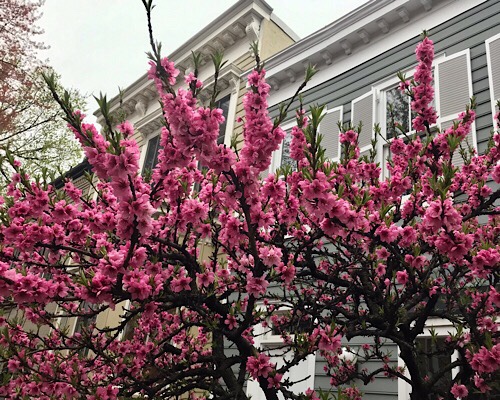
Working From Home Lunch
Chard, beet greens, garlic chives, baby radishes, herbs, flowers from the garden; pantry items

Chard, beet greens, garlic chives, baby radishes, herbs, flowers from the garden; pantry items
When I was out walking at lunch time, I noticed several pieces of lilac on the sidewalk. Somebody with nothing better in his own mind to do had randomly picked pieces of lilac sprays and then dropped them on the sidewalk.
The blossoms were still perfectly fresh. Although I would not have picked any of the lilac’s blooms myself, it seemed a waste to just leave them lying on the sidewalk to be stepped on and to wilt. I picked up a bit, enjoying the scent as I returned to work. It will scent my room for another few hours and then will fade away.
Peace and light, E — Posted with WordPress for BlackBerry.
NYC, Philadelphia, DC.
Last night, we were talking about the parameters of cultivating a steady and fruitful meditation practice, and Paul Muller-Ortega suggested that it was about the balance of stability and flexibility. He had learned the principle from a different source, but I have contemplated and explored the principle in depth from teachings I have received from John Friend.
A critical aspect of the Anusara alignment principles is to find the perfect balance of stability and freedom. We need stability to stay fully and safely in each pose. We need freedom to achieve the fullest and most delightful expression of the pose.
We find the stability both by making certain that we have established our foundation (which is an aspect of the first principle of opening to grace). By then using the three aspects of muscular energy–hugging the muscles to the bone, drawing into the midline, and drawing energy from the periphery to the focal point, we make possible an expansion of our edge, whatever that might be. Having a solid, aligned foundation and affirming our very core with these actions, gives us security and balance. We also want to reach out, to be playful, to expand to our fullest, which we do using the expansive, outreaching organic energy — from focal point to the periphery, from the midline to our outer edges, from the very marrow of our bones through bone, muscle, skin, and beyond.
If we over-emphasize (including natural inclination) stability, then we can get stuck. If we just let ourselves be free, then we end up all over the place. When these elements are perfectly balanced, we can safely find our deepest freedom of expression.
When I teach this principle as the focus of a class, I always invite my students to think of how important the balance of stability and freedom is for every aspect of our lives.
The discussion last night put this principle in the context of the regularity and steadiness of our practice, with the recognition that to stick with our practice, we will sometimes need to vary the time or amount of our practice, or what elements are included in the practice.
To get the fullest benefits of a practice (this applies to any practice and not just to meditation), we need to show up consistently and to practice in accordance with how we have been taught. To stay steady, though, we need to give ourselves the permission or freedom not to show up, or within appropriate parameters, to modify the practice when life gets in the way of what we think would be the ideal practice. If we think we have to do things at the exact time and place every day in a perfectly precise way, we become rigid. On the other hand, if we are loosey-goosey about it, then we do not have much of a practice and will not realize the benefits that we could get.
Where in your practice or life would more stability and steadiness give a field for greater freedom and happiness? Where could you give yourself a little more flexibility so that you feel that steadiness brings the possibility of joy, rather than tying you down?
Peace and light, E — Posted with WordPress for BlackBerry.
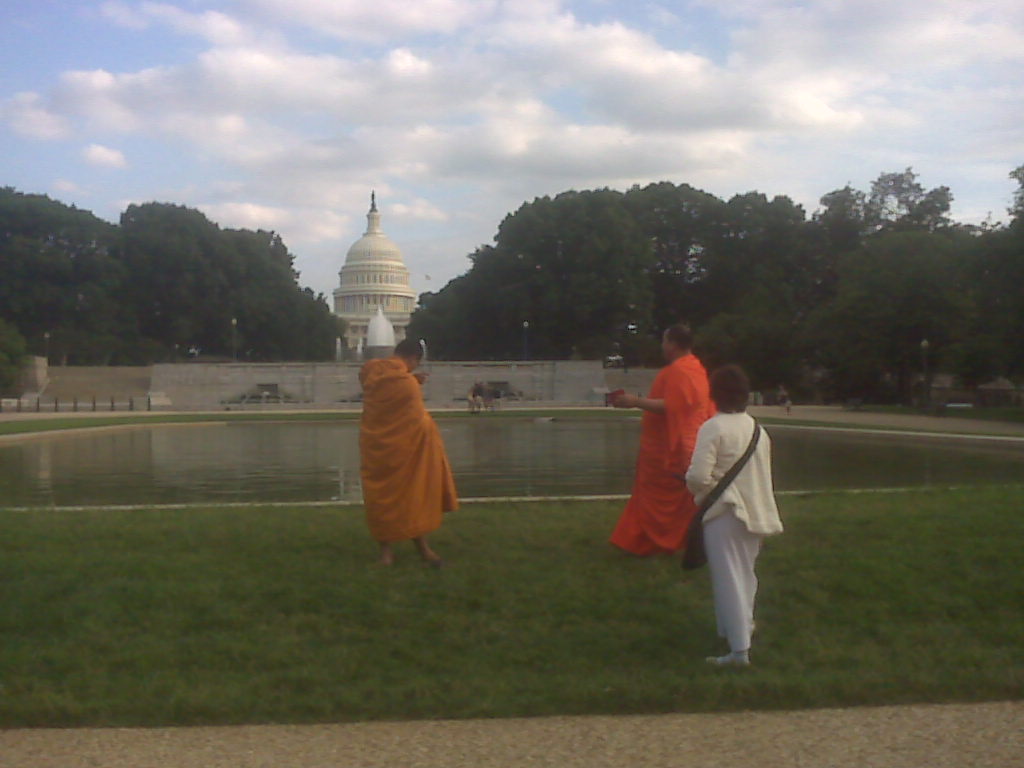
With his camera,
I took three pictures
of one monk smiling
At the Capitol. He was
in his orange robe.
I took One picture
with my phone.
Of three monks. Or
Perhaps they were
two monks and
an accolyte.
Here it is.
Peace and light, E — Posted with WordPress for BlackBerry.
Friend, yogini, and neighbor Jess will be performing a Beethoven program with the Capitol Hill Chorale this weekend. A friend asked if I wanted to have dinner on Sunday, and I suggested we instead go to the Atlas Theater to see the concert. “Great idea,” replied my friend, “I have a friend in the Chorale, too.” Support the local arts, businesses, and friends, and get entertainment that doesn’t require getting in a car (or at least a very short ride) or a plane. Come join us!