Similar Posts
- Asana, Pranayama, and Yoga Practice | Community and Family | Food for the Mind (Yoga Philosophy, etc) | Meditation
Message From a Teabag
This morning, a friend suggested that if he took into account the needs of others when making plans, all he would be doing is serving others, and he would never get to do what he wants. “Why would I want to do that?” he asked.
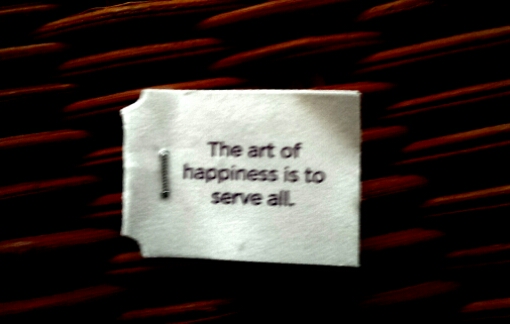
I think that’s a common enough question in this society. By uncanny coincidence, the teabag I selected right after the question was posed suggested a possible answer.
As we are taught by the stories of the monkey deity Hanuman, whose main characteristic is a longing for devotion that he demonstrates (while still being utterly himself) through service (seva) cultivating mindful relationship is the highest service to our own self and not just to those with whom we are in relationship.
To take care of our selves can be done with consideration of others without sacrificing our own needs. The answer, I think, is in how we assess and balance our own needs. For me, when I consider the impact of my planning on others with whom I am in relationship as well as my own needs, for example, of freedom, autonomy, and personal delight, I am also considering my needs for companionship, mutuality, connection, and respect. If I completely privilege the former, I may be neglecting the latter and vice versa.

Different Ways of Turning Your World Upside Down
Yesterday at the William Penn House class, we were emphasizing strong working of our tailbones. One of the regular students came to class even though she was still exhausted from recent and sudden major loss and upheaval in her life. She wanted to be with the spirit of the class even if she would not be able to do everything.
When we went to the wall to work on half and full arm balance, I advised her to give it a try if she felt up to it and then said to do legs up the wall if she knew trying to hold the arm balance would be too much. After all, I pointed out, legs up the wall (vipariti karani) is just half handstand upside down. And what is awesome about both the poses is that the both turn us upside down (albeit in energetically different ways) and can thus help give us a fresh perspective on how we are in our bodies and minds.
Finding Ayyappa
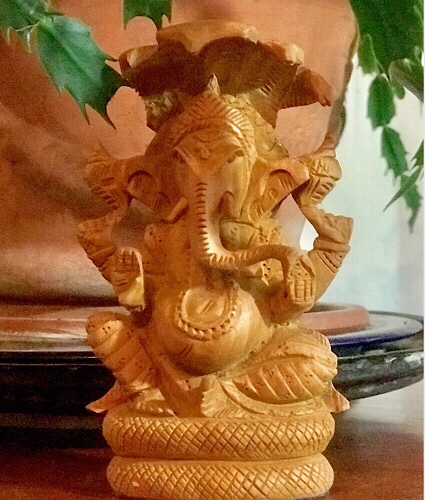
A couple of weeks ago, I found a carved wood murti of Ganesha in a box on the sidewalk with some other stuff and a “free” sign. This Ganesha had serpents (nagas) rising over his head like a canopy–not uncommon imagery. Ganesha was “free” most likely because one of the nagas had broken off. It made me think of Ayyappa, Ganesha’s brother by a different mother. Ayyappa is apart from the others. Of Shiva’s three sons, he is the one who is either or both missing or extra. The trunk was also badly glued, but that can be remedied.