| |

Practice Question

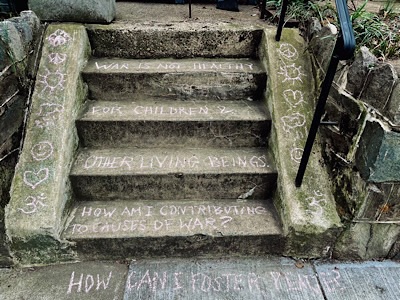
I found myself thinking this morning of the poster from when I was a child that said, “war is not healthy for children and other living things.” I wrote it on the front stairs and then asked myself the question, how do I contribute to the causes of war?” And so that I am not only asking what I must change or stop doing, I also ask myself, how can I foster peace?

Similar Posts

  • |

    Fall Session Theme–Inner Light

    This morning, when I called weather, the meteorologist announced that sunrise is at 7am, sunset at 6:58pm.  As the nights grow longer than the days, it is a wonderful time to become more introspective, to use the principles of alignment to focus mind and body so that we are drawn ever more sweetly to our inner light.

    In my classes this Fall, I will be emphasizing how we can use the Anusara principles of alignment to help continuously refine and focus our attention on our own and unifying sense of spirit.

  • | |

    One Person’s Weeds

    Last year, some romaine lettuce must have bolted.  I have baby romaine lettuce coming up everywhere.  Having reverted to the wild, it is quite bitter.  It is also taking up a fair amount of space, so to be able to plant more appealing things (new herbs and greens) I will be pulling it up.  It has become, in essence, a weed.  Later in the year, I’ll also have a surfeit of volunteer epazote and purslane, which many would pull as weeds.  Those, I actively encourage, eating young the ones that come up over and over again through the bricks and confining in containers a few others to grow larger and to reseed.

    Even though it is too bitter to be palatable raw, the now “weed” romaine tastes fine cooked as a tender green.  So it does not get discarded.  I just won’t make myself eat it in its bitter form as the salad green that it is “supposed” to be.  Instead, since it is nourishing and tasty as a cooked green, it is a welcome early addition to the garden.

    Just I have challenges and tribulations from whatever is my overall plan for the garden, I have my share of aches, pains, challenges, and disappointments, in life and in my yoga practice.  The question is how to discriminate (viveka) among those that are poisonous, those that are bitter, and those that can be made nourishing and sweet, through the cooking of understanding, practice, and effort.

  • |

    When to Bring in the Tropical Plants (and stress v. distress)

    From late September through the first week when there either are two or more nights forecast to below 38F or one night below 35F, I assiduously watch the 15-day weather forecast to determine when to bring in my tropical plants (orchids, bromiliads, a night-blooming jasmine plant (now 8 years old), a bay tree in a 24 inch pot (now 12 years old)).  I also bring in the lemon grass and lemon balm I have in containers so that they can be the perennials they would be in a warm climate; here, left outside, they are annuals.

    When I first had a few orchids — over 10 years ago now — as soon as there was a hint of cold weather (below 45F) I rushed the plants inside, believing that if they were tropical, they needed to be inside.  In one of the early years, the first night below 40F was in late September.  The plants really suffered from a full seven months inside.  I have since learned (by studying and personal observation) two things about my tropical plants.  The first is that they are a lot happier outside than inside (when inside is not a properly humid, sunny greenhouse).  The second is that they like cold weather as long as it is not near or below freezing.  They especially like cold rains like we had the other weekend.  The stress of a few weeks of nights in the 40sF, in fact, seem to help the orchids bloom.  Now, by waiting until the last possible minute, and bringing them out as soon as it seems like the danger of last frost (for my backyard, which is very early) has passed, the orchids are outside at least seven months of the year.

    Thinking about how the orchids flourish with the stress of some chill, but not too much, reminds me of what my teacher John Friend talks about in yoga practice of the difference between stress and distress.  Some stress actually strengthens us.  This is why one of the best ways to avoid or at least slow the process of osteoporous (according to the general medical literature to I’ve read) advocates weight-bearing exercise.  Putting weight, i.e., stress, on our bones and muscles strengthens them.  Too much, too fast, however, will injure our muscles and bones.

    So, especially for those of us with injuries (prior or current) or physical challenges such as arthritis, it is optimal to exercise, to seek our edge, to put ourselves under stress, mindfully and intentionally.  We need to be aware, though, of the subtlety of the edge between stress and distress so that we are strengthened not injured, just as exposing the orchids to some fall weather invites them to bloom, but actual freezing or near-freezing temperatures will harm or kill them.

Leave a Reply

Your email address will not be published. Required fields are marked *

This site uses Akismet to reduce spam. Learn how your comment data is processed.