Art and Culture | Asana, Pranayama, and Yoga Practice | Community and Family | Food for the Mind (Yoga Philosophy, etc) | Meditation
Signs Around Town (Excerpt)

At “Taste of DC” here come (not in any particular order):
1. Respiratory diseases from air pollution resulting from cooking methods, factory farmed meat, manufacture of packaging, and food transportation.
2. Antibiotic resistance from factory farmed meat.
3. Diabetes from refined sugar and carbohydrates.
4. Cancer from food additives, food cooking methods, manufacture of plastic food packaging, and air pollution.
5. Heart disease from fatty and high cholesterol foods.
5. Foot, ankle, knee, and back problems from ill-fitting high heels with a narrow toe box.
6. Tooth decay from refined sugars and carbohydrates and later gum disease and heart conditions from poor dental hygiene.
6. Waterborne diseases from air and water pollution secondary to food manufacturing and packaging and attendant waste and unnecessary medication, surgeries, and other medical treatments for illnesses resulting from food and clothing choices.
And don’t forget lost productivity for sick time. I do not think anyone needs to be rigidly any kind of diet all the time (not raw, not Ayurvedic, not vegetarian, not vegan, not local, not slow), but wouldn’t it be nicer to eat well most of the time (and if you have even the most modest of kitchens, healthy meals are in fact cheaper than packaged junk food–assuming one knows how to cook, which I know is a big assumption), wear comfortable clothing, and have more time, strength and money for creative and loving pursuits?
Yesterday, the first of the year, I pulled off the shelf and opened at random Anne Lamott’s “Bird by Bird.” I’d found it used some time ago and was interested, but other things got ahead of it on my reading pile. The page to which I opened seems highly topical for what is coming this year:
For instance, I used to think that paired opposites were a given, that love was the opposite of hate, right the opposite of wrong. But now I think we sometimes buy into these concepts because it is so much easier to embrace absolutes than to suffer reality. I don’t think anything is the opposite of love. Reality is unforgivingly complex.
May we find enough love to suffer well the complexities to come this year. For me, I know that deepening and recommitting to my practice will help me find what more I can offer.
Mixed message? Not really. If you don’t hesitate to sit regularly each day for meditation at home, it will be a lot easier to wait for a seat at a restaurant.
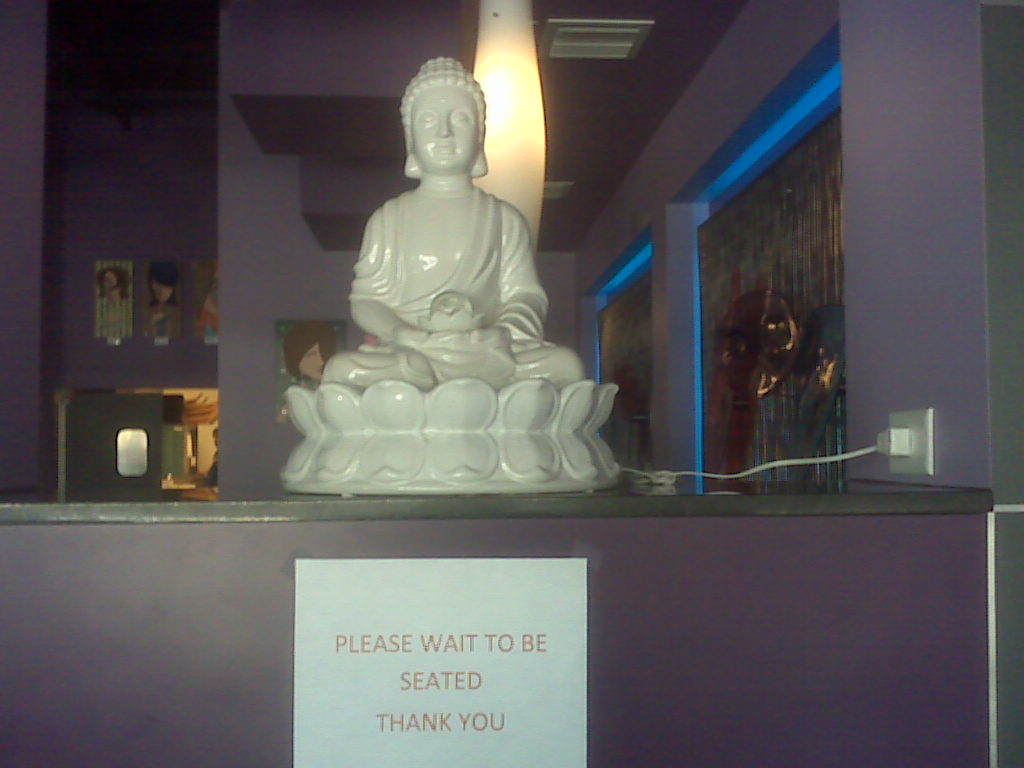
Peace and light, E — Posted with WordPress for BlackBerry.
Ether (akasha) is the fifth of the mahabhutas. In science and perception, it is the space between the other elements, it is that in which the other elements reside. It is to some degree, the critical element of how we are able to perceive the other elements. I find focusing on the Anusara alignment principle of “open to grace” is the best way to experience the element of ether in myself. By softening, opening, and inviting spaciousness, I can better experience the subtle elements and appreciate how it is that I experience them.
The subtle elements or the panca tanmattras are smell (gandha), taste (rasa), form (rupa), touch (sparsa), and sound (sabda). The subtle elements are not what we sense (which is composed of the mahabhutas) nor are the tanmattras our sense organs. Rather the tanmattras are, as it were, the space in which perceptions arise, the ability to be perceived.
The next sets of elements are the panca karmendriyas, the organs of locomotion, which correspond to how we physically move, digest, and change in the physical world, and the panca jnanendriyas, the organs of perception or cognition, which correspond to our sense organs themselves. Our movement in and perception of the world bridges the physical elements, the perceptability of the physical world, and ourselves as physical beings, beings who move in the physical world, and beings who perceive the physical world. All of this, I think of as needing space or residing in space. As I consciously think of space giving a place for the world, my movement in it, and my perception of it, I become more conscious of consciousness. The physical practice of “opening to grace” and experiencing the element akasha makes possible for me in my practice knowing or experiencing a greater consciousness.
To start discovering your own understanding of akasha, try this meditation: listen to the sounds beyond the room without trying to analyze or change them. Appreciate how far in space your senses and consciousness can be. Then bring your attention into the room and hear the sounds in the room. Then open your ears to the sounds within you — your heart beat, your breath. Then open to all the sounds (don’t try to change or analyze them), both those physically far away and those within your own body, and be aware of them as all residing within your own consciousness. Appreciate that your consciousness is as spacious as the world around you and within you. Rest in the space of consciousness.
See whether spending a few minutes using this meditation technique helps you when your day has gotten too busy with work, errands, family or other demands. I find it very helpful.
Have you hugged (or otherwise taken care of or sent loving energy to) a tree today? Have you paused to appreciate the shade and delicious air trees provide you?

Peace and light, E — Posted with WordPress for BlackBerry.
Today, there were to be 1,000 artists at the inauguration. I saw a few of them on this weekend’s walkabout, and studied for a morning with a dancer and movement artist who was participating (David Lakein; contact improvisation workshop at Dance Exchange). The class was thought-provoking and suitable for the weekend honoring the inauguration. On the morning of the inauguration, we, after not having made any attempt to get tickets of whatever sort, ended up being invited in to the Koshland Science Museum for free hot chocolate and a comfortable place to view it on a big screen. Not quite the power of being huddled against the cold with hundreds of thousands of other people on the Mall, but still, not too shabby for a completely impromptu way to share the event with others.