Sleeping 

Since arriving home, I’ve managed to do laundry, pay bills, shop for groceries, bring the tropical plants inside, and get a little exercise, but mostly, I’ve been sleeping. Uma is all for it.

Similar Posts

  • | | | | |

    Web Version of E-Newsletter (Yes, I’m Still Teaching)

    Dear Friends,

    My apologies for being so long in sending a proper newsletter.  2014 was a challenging year for me.  I started the year sick, ended the year sick, and was limited by injuries for several months out of the year.  Work was intensely challenging on just about every level, day after day, week after week, and it continues to be so.  And then there’s concern about the state of society and the planet and trying to figure out what I, honoring my capacity and limits, can do to do more good and less harm (I’ll never get this sent if I get side-tracked in that direction).

    I also had some great adventures, including a major home renovation and an extraordinary trip to Cuba, but then was working too hard in between to appreciate and integrate fully my experiences (which is a yoga lesson in itself–addressing whether we need more stimulation when we haven’t had time to address/process previous experiences whether delights or challenges to mind, body, emotions, creativity).

    Yes, I’m still teaching, even though working as much as I am these days.  You can find me leading an all levels group practice with a wonderful group of people on Tuesday nights from 6:30pm -7:45pm at William Penn House in Capitol Hill.  100% of the proceeds (pay what you can; suggested donation $12-15) support the work camp program at William Penn House.  There’s also a weekly group practice for more advanced students on Wednesday nights.  Email if you are interested in the Wednesday night practice.  More info on classes on my rose garden yoga website.

    Yes, for those of you who don’t subscribe,  I’m still blogging.  With the help of wonderful web designer, friend, neighbor, and fellow yogi, Jess C, I just updated the look of the website.  I hope to find time to blog about the many layers of meaning that went into the new design, which has the colors of Kali (goddess of sequencing); the murtis are  Dakshinamurti (Siva as teacher) and Saraswati (goddess of learning, the arts, etc.); the books are a small, but important to me as yogini, portion of my library.

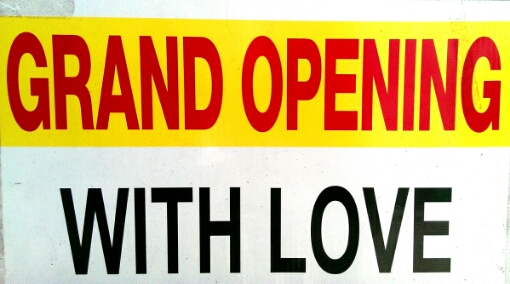
    If you’re in town, join me for practice one of these weeks or perhaps we’ll run into each other another class or workshop.  Please let me know how you are.  Best way to be in regular touch are to subscribe to the blog.  When there isn’t an interval between working and living and loving, and all the rest, to share more detailed written contemplations about living yoga,I’ll share the signs and exhortations I see around town and remind myself and anyone else who wants the reminder that no matter what is going on, there’s always a moment to appreciate a little beauty–perhaps to notice a heart-shaped cloud in the sky.

    Feel free also to friend me or like “Rose Garden Yoga” on Facebook.  Instagram possibly coming soon in my copious free time.  Ha.

    Peace, love, and light,

    Elizabeth

  • | | | | |

    April Greetings–Delving into the Essential (Web Version of E-Newsletter)

    Dear Friends,

    It has been a mind-boggling several weeks.  The magnitude of the upheavals and the impact on all of the world, including human beings, is beyond my ability to grasp.  Closer up than the unfolding devastation in Japan and the escalating war in Libya, which daily adds to the bankrupting of this country and planet by our wars, I found myself supporting committed organizations, signing petitions, and writing emails saying that I preferred to be locked out of my work place with no pay than to have taken away any existing protection of the environment or provision health care for low income women.  As my mind tries to expand enough to stay present and active, I am more grateful every day to have and share the practice of yoga.

    Practicing helps us minimize suffering by changing how we relate to pain and the full range of human emotion.  The goal, I think, is to fully and joyously engage in life with an intention to live as harmoniously as possible with all beings, including our individual selves, and simultaneously appreciate and be wonderstruck at the extraordinary and wild vastness of being that makes the time and space of the known universe seem finite relative to life (lives) on earth.  When we can find both perspectives simultaneously, then we can be engaged, but not attached (vairagya).

    How do we focus this intention to live fully and harmoniously in this way?    In the past six weeks, I have had the unbelievably fortuitous combination of circumstances to be able to study with John Friend for three days; to attend the Mahasivaratri celebration with Douglas Brooks, Krishna Das, John Friend, Amy Ippoliti, and Sianna Sherman; Ross Rayburn for a weekend workshop at Willow Street;; Desiree Rumbaugh at a special three-hour practice the following week at Willow Street; and Paul Muller-Ortega via telephone conference.

    Wow, that was a whole lot of input for my practice and contemplation, while living itself was getting more intense.  But, it turned out not to be too much because of the singularity of the teachings.  The message I heard from all of these teachers in their own unique and inspiring voices was that is is a good time to get down to get back to basics, or to put it another way, to explore more deeply the essential principles of practice (and of life).  By getting back to the basics in the practice, we can start knowing at a deeper level what is essential for us to relate as deeply and joyously and non-harmingly (yes, I know it isn’t a word, but I’d like it if it were) on and off the mat to ourselves and all in our web of relationship.

    In both my practice and my public class offerings, this Spring, I am especially focused on exploring what is essential to experience life at its most joyous while still be conscious and committed to the need for effort to change.  In addition to continuing my regular class offerings, I am pleased to be offering a short course in restorative yoga at Willow Street, “Cultivating Relaxation with Restorative Yoga.”

    Restorative yoga is perfect whether you are looking for a gentler way to get started with yoga, an opportunity to relax, or alternative practices for when you are feeling stiff or in pain, or a way for advanced practitioners to explore the alignment principles at the subtlest levels. We will explore a variety of types of supported postures and prop-assisted stretches to enable you to relax into optimal alignment, discover your own space of deep rest and peacefulness, and open your body. The course will also offer simple techniques to ease into sleep, find mini-relaxation moments when things are hectic, and sweeten your home practice–what could be of better service these days?  Everybody welcome. 6 Thursdays, 4/21-5/26.

    To get news in between the occasional email offerings or to see my latest short thoughts, please “like” my new “Rose Garden Yoga” page on Facebook.

    I look forward to seeing you in person soon.  As always, please feel comfortable being in touch by comment on the blog or by email.
    Peace and light,

    Elizabeth

  • | |

    Hot Water Bottles and Wristwarmers

    One of my father’s joke bits of wisdom is “everything in moderation, including moderation.”  When I first studied philosophy academically, I was very much taken with Aristotle’s concept of the “golden mean,” which (this is a gross oversimplification) advocates living in moderation as a way of right living.  Pantanjali in the niyamas in his Yoga Sutras invites the yogin to balance effort (tapas) and surrender  (ishvara pranadhana) in our practice.  The Bhagavad Gita suggests that extreme austerities are just as indulgent as wildly excessive consumption of food, sleep, and comforts.

    What does that mean in our modern, middle class lives in a time when we are being confronted head-on with the impact on the earth and our fellow beings of the way we, as a society, have been consuming?

    In part, I think it is mindfulness.  It is not denial, but balance — choosing ways to consume less, but still not feel deprived.  I am fortunate in that much of what we are learning now about both lifestyle and impact (the stuff under the “green living” umbrella) is not new to me.  My parents were children of the Depression and my father had a modest income. I went to Quaker youth camp in upstate New York in the 1970s, and I did volunteer work for the first Earth Day when I was in college.  We turned the lights off when we weren’t in the room, we turned off the faucets when we were brushing our teeth, or lathering our hair in the shower.  We creatively changed what we cooked out of Julia Child, Craig Claiborne, Virginia Lee, or Diana Kennedy or the New York Times Food Section with what we learned from Diet for a Small Planet.  We wore warmer clothing inside to be able to keep the heat down.  It is important for me to try to live mindfully, but I also very much like to be warm and comfortable, love the feel of beautiful fabrics, and one of my greatest pleasures is eating well.

    I have a number of reasons I like to keep the heat down in the winter:  it feels better on my sinuses because the air is not as dry and I do not like to have to run a humidifier (yet another electrical appliance); it costs a lot of money to keep an old row house at even 65F in the cold months; and I am concerned about my carbon footprint.  I can get really cold when I am working at my desk or getting ready for bed.  I don’t like being cold, and it seems silly to insist on being miserably uncomfortable just so I can feel better from the perspective of some perceived moral ground.  So I try to create a balance.

    Hot water bottles and wrist warmers are part of the balance.  Two hot water bottles taken to bed (and then I use the water on the plants the next morning) makes going to bed toasty and delightful, but not too hot in the middle of the night.  If I am working at home and it is midday, I can warm myself up with a two-minute handstand or a few sun salutes or some abs work or other arm balances. That’s not an option if I am on a conference call or at the office.  Nor does it make sense after dinner when it is time to get energetically quiet.  The wrist warmers, though, make an amazing difference (I also enjoy wearing them when I start practicing until I warm up as another layer that easily can come on or off.  I kind of like the way I look and enjoyed all the complements I got when I was meandering around New York over the holidays.  They are a great way to use scrap yarn (especially if you don’t have the time, yarn, or inclination for a larger project — see my post on “Sauca (and the blanket).”

    If you want to make your own wrist warmers and you are a fantastic knitter, you can go for four double-pointed needles, multiple colors, and add a thumb section.  For those of you who are newer to knitting or who want wrist warmers very quickly, here’s all it takes to make the one’s shown above.

    1.  Two needles of appropriate gauge and less than a skein of yarn.

    2.  Measure loosely around your knuckles.  That’s the right width for your wrist warmer (notice that the girth of your knuckles and your forearm a couple of inches below the elbow are about the same).  Then knit about a two-inch square to make sure you know how many stitches you get per inch horizontally.  When you have your gauge correct, unravel your test square to use that yarn in your wrist warmers.  I recommend rechecking the gauge about an inch or two into your first wrist warmer to make sure you were right.  It is easier to start over at that stage than to try and fix it later or have to give them away to someone larger or smaller (unless you want to).

    3.  Cast on the correct number of stitches for how many stitches per inch you get with your yarn and needles and the width you measured around your knuckles.  It is OK to round to the nearest half inch.  First two rows are simple rib — k1, p1.  Then do basic plain knitting (k first row, p return row) until the first wrist warmer is about 6-8 inches long and reaches almost the desired length up your lower arm.  Then do 6-8 rows of moss stitch (row 1 — k1, p1, row 2, p1, k1) [or you could just do more ribbing].  Cast off.  Measure second wrist warmer against the second.  Turned inside-out, using the knitting yarn, sew into a tube, leaving a whole for the thumb a the end with just the double row of ribbing.  The sewn part at the knuckle end should be about 2/3 to 3/4 inches, then there should be about a 1 1/2 to 2 inch whole (just hold it up on your hand to make sure it fits).

    4.  They will stretch out as you wear them, but if they are a little too wide or tight, you can wet them and then make them either longer and thinner or shorter and wider by blocking.

    4.  Bored with the colors you have at home?  It’s pretty easy to swap with a fellow knitter.

    5.  Want to be just a little fancier?  Do stripes by alternating colors when you change rows.  Want to practice cables.  Do one center cable, just remember that it won’t be in the center if you want it to go on the top of your hand; it will start a quarter of the way in.

    6.  New to knitting?  Go into any yarn store, tell them that this is your project, and they’ll tell you a good yarn, what needles you need, and show you how to cast on, knit and pearl.  There are farmers at the Dupont Circle Fresh Farm Market on Sunday who have beautiful homespun, hand-dyed yarns.  They might not show you how to knit, but they include patterns for hats.

    7.  Have fun.  Be creative.  Be part of a fashion wave.  Stay warm.

Leave a Reply

Your email address will not be published. Required fields are marked *

This site uses Akismet to reduce spam. Learn how your comment data is processed.