| | | | |

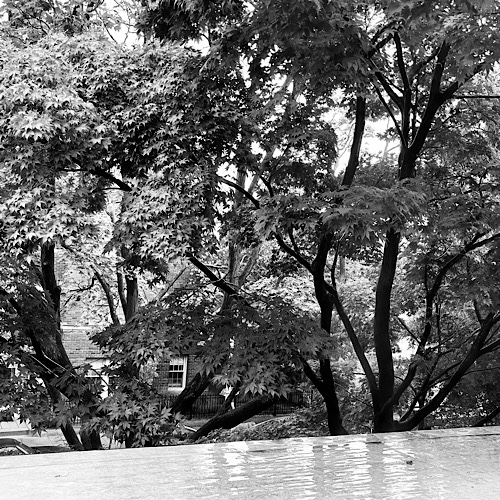
View from the Window (Rainy Day)

Afghanistan Lebanon Dreamers Haiti

Wildfires Hurricanes Earthquakes

Ebola Plague Delta-Variant

Vaccine Refusers

Etc

As long as I am well fed in my comfortable home, far better, when I am not actively working/serving, to garden and meditate and study and try to create some joy than to wallow in hopelessness. And make a little art to remind myself of beauty.

Similar Posts

  • | | |

    “If there were lights to turn on…” (and Purna) (at the Anusara Grand Gathering)

    The first two days, including the Solstice, of the Anusara Grand Gathering were bright and blue and sunny and pleasantly cool in the morning and warm in the afternoon–“perfect” New England summer days.  The third morning dawned cloudy.  By the time the morning session was underway, a pleasant drizzle had turned into a deluge.  Rain started coming in from the sides where the tent was open, and then the roof started leaking.  The clouds were sufficiently dense that the light was no more than at dawn or dusk.  It was getting pretty dark and wet in the tent.  At one point, after having told stories about rain being regarded as blessings in Hindu rituals and exhorting us in surya namaskar to jump forward and splash in a puddle like a kid, John said, “I would turn the lights on, but there aren’t any lights to turn on.  So this is perfect!”

    One of the conundrums in explaining the philosophical principle of purna, which means “perfect” or “fullness” is reconciling it with the evident fact that our divine perfection or fullness aside, we are still working to shift and realign our minds and bodies through the practices.  The divine consciousness, which is everything, say the yogis, is utterly perfect as it is and completely full (or fully empty and thus all potential, depending on how you look at it).  We are told that we (and all of being) are the divine consciousness manifest and then given a slew of techniques and instruction to help us change ourselves.

    If we are completely perfect and full, what is the point of learning all the technique and seeking to expand and shift our bodies and minds?  The yoga teachings say that we forget that we are this fullness and perfection, and it is our forgetting that leads to suffering (which is different than pain, but discussing that distinction will have to wait for another blog entry).  The practices are not to perfect or improve us, but rather to shift our alignment (mind and body) so that we remember the perfection of ourselves as spirit.  When we remember, we are better able to recognize the perfection in ourselves, other people, beings, things, or events, even what we find challenging or difficult.  From this space of recognition, in my experience, we naturally become happier and more generous of spirit.

    I think that moment at the Anusara Grand Gathering is a perfect (word choice intentional) illustration of the apparent dichotomy of seeking change and appreciation of the perfection of every moment.  If there had been lights to turn on, John would have turned on the lights so that we could have observed the alignment better during the demonstrations and he and the assistants could have seen the students more easily.  The universe did not have it in store for us to have a light-filled dry day; we were getting a wet and dark one whether we liked it or not.  Having no lights to turn on, John reminded us in a light-hearted way that the teachings and practices would invite us to fully embrace and enjoy the weather we got and practice space we had (while staff were busily making alternative arrangements for classes later in the day), getting the most out of it.  I thought it was pretty fun to practice in the cool rain, though it’s easy for me to say since I and my things stayed dry, and the rain was a welcome respite from the worsening drought in the DC area.


  • |

    “First principle” (and akrama and krama)

    When I think about the Anusara alignment principles in the context of the tattvas (see earlier posts), I think about “opening to grace” appearing in two places on the tier.  As “first principle” it is the first among a larger sequence about how we come to the mat, rather than just the first of the physical principles.  “First principle” not only starts the practice and the dialogue, but is already there. It is, in this sense, so fundamental that it is not part of the sequence, but is sequenceless (akrama).  If you are fully conscious of “grace” and can embody it in all aspects of your physical, energetic, and mental day to day existence without further instruction, study, or practice, then there is no need for other practice or instruction (this I think is a very rare being, and certainly I’m not such a being).

    The next set of tattvassuddha vidya, ishvara, saddha shiva, and shiva-shakti (see link above), correspond to the Anusara alignment principles of “attitude, alignment, and action,” which although they are themselves described in sequence, are fundamentally sequenceless as they happen all at the same time and are more elemental than the practice of the physical/energetic alignment principles in sequenced practice.

    In this way of understanding the play between the sequenceless and sequenced, we have a universal “first principle” that embodies the purpose of all we do on and off the mat.  It is followed by how we want to practice, described in a way that becomes less of just a concept (which as a universal concept is akrama) and more of a practical understanding (which applies when we are in space and time and therefore in the krama of embodied existence).  As we dance in this play between the sequenceless and the sequenced, we come to practice (or to do any activity) with the “attitude” of wanting to live the “first principle,” to know and experience what is fully present and not bound by time and space.  We then (because we must) study and practice specific “alignment” to try and express this attitude with our “actions.”

    The physical/energetic alignment principles then come in as a the way of better refining, studying, and practicing the desire to recognize with mind and body the “first principle.”  The sequence of “open to grace, muscular energy, inner spiral, outer spiral, organic energy” comes then at the level of physical and mental practice to return us back to “first principle.”  “Open to grace” is first in this sequence, too, but as “first principle,” for me, it is something more than the first of the alignment principles.  “First principle” is not just the start of how we practice when we practice Anusara yoga, but the whole reason for practice.  It is the universal, overarching, blissful element of being that draws us to the practice because of our yearning to know it.

Leave a Reply

Your email address will not be published. Required fields are marked *

This site uses Akismet to reduce spam. Learn how your comment data is processed.