Art and Culture | Asana, Pranayama, and Yoga Practice | Community and Family | Gardening | Meditation
Urban Forest Bathing (Lunchtime Walk)
I got a ride home from the John Friend workshop in Bryn Athyn with my friend, colleague, and student Jen. Jen’s husband, who is a dance professor at a local college, and her three-year old daughter came up to Philadelphia and visited friends during the day while we were at the workshop. For the initial part of the road trip home, we sang several rounds of “if you are happy and you know it clap your feet,” a days of the week song, a counting song that involved a wiggle (or was it a wriggle) and a jump, the alphabet, and I think maybe “loop-de-loop,” and had some snacks, after which Jen’s daughter moved into silence and then sleep. Before moving into silence ourselves, we spent some time talking about what we had learned and experienced at the workshop.
“Do you have any good sound bites from the weekend?” Jen’s husband asked. I said I did not have any particular sound bites per se, although there were a few things that would definitely provide inspiration for teaching and blogging. “I have a good one that I think will make sense to you,” said Jen. “John said that we can use technique to express the virtue we wish to embody.” What I liked about the statement is that it put in universal terms that would appeal to a dancer and dance professor, or anyone who understands how technique assists the clarity of artistic expression, an essential element of the yoga philosophy and Anusara principles without requiring prior knowledge of the philosophy or principles.
The statement is an encapsulation of the “three A’s of Anusara” — “attitude, alignment, and action,” which are the essence of practice (also see my previous post on how these principles correspond to the tattvas). We always seek in every part of our practice and in every pose to open to grace, to soften and receive, to be open to the fullness of life and love, to see and reveal the good. This is our “attitude.” The universal principles of alignment are technique. They are not just technique for the sake of perfecting technique, to discipline ourselves, or to make ourselves or our practice “correct.” Rather, learning and practicing the alignment principles in an ever deeper and more refined way enable us to express more clearly and elegantly our attitude — in a word, embody the virtue of being open to grace.
The songs we were singing in the beginning of the car ride, with an attitude of delight, also can serve the purpose of helping a child naturally to embody virtue. Jen’s daughter was having fun with the sing-along toy. She wasn’t singing because she needed to learn numbers, days of the week, and the alphabet to pass a test or to make sure she was right or to please her parents. They were cheerful and fun for her. When she sang along, it was out of delight. She was, though, learning beginning language and arithmetic skills that will help her communicate and get on better in society. As she grows older, in the absence of these skills, it would be hard for her to express her joyous spirit in a way that deepens conversation, relationship, and ability to participate fully in the obligations of society. When we learn technique — in whatever area — we will be furthering our ability to embody virtue if we use the technique to enhance our skills to work for, offer, and express peace, love, nurture, and growth, rather than learning technique for the sake of accomplishment, worthiness of praise or remuneration, or needing to be correct.
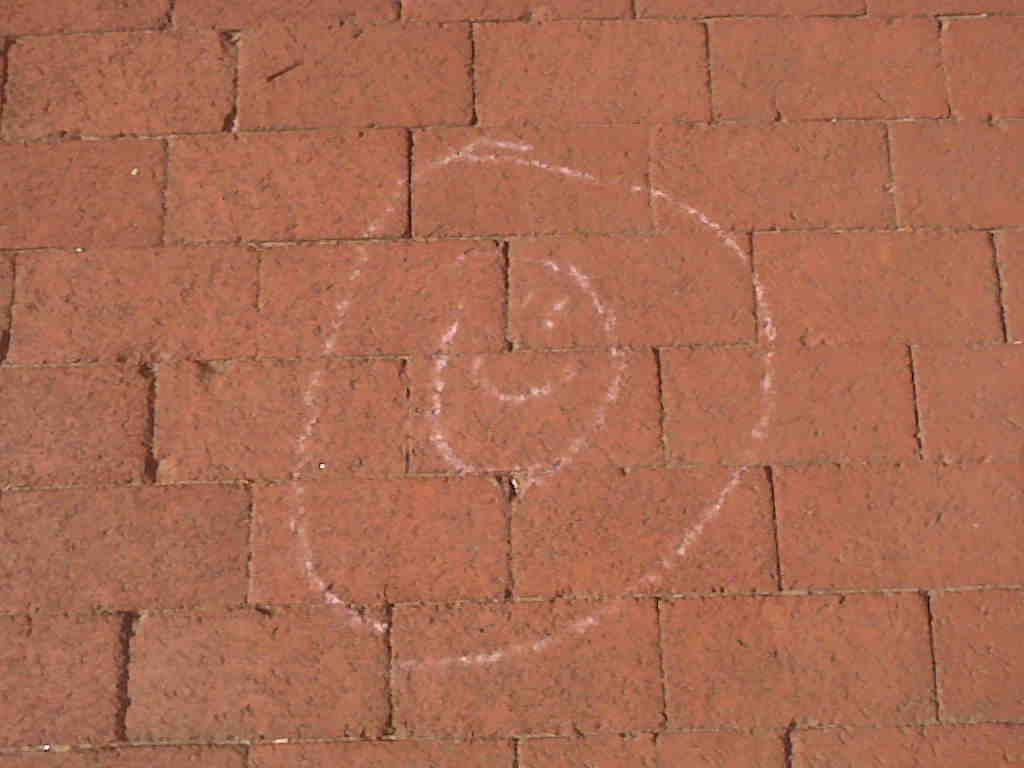
Someone has been walking around Capitol Hill with pink chalk and drawing circles with smiley faces inside. Impermanent graffiti made longer lasting by the drought. What is the message intended? How many people have noticed (at least one friend of mine has asked about this offering on Face Book)?
Peace and light, E — Posted with WordPress for BlackBerry.
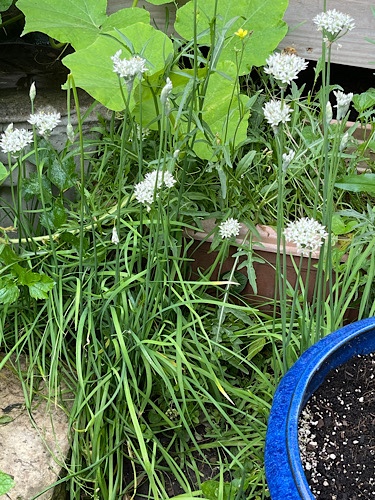
The garlic chives are blossoming.
Down by the river
I met a crane enjoying
An early dinner.

Last night I went to see the revival of the Bernstein musical version of Voltaire’s Candide, now playing at the Shakespeare Theater’s Harmon Hall (discount tickets available), which was absolutely a delight — fantastic staging and direction, luxurious costuming, enthusiastic performances. Throughout his journey, which is beset with cruelty, hardship, natural disaster, and other mishaps wherever he goes, Candide sings of his tutor’s optimistic advice that “all’s for the best in this best of all possible worlds.” The application of this philosophy leads to some silly results, including the Monty Python-worthy lyric “it’s a great day for an auto da fe.”
I have a friend who, after telling me of various life challenges and griefs, inevitably signs off with the phrase “it’s all good,” though I am not sure she believes it. I thought of her repetition of the phrase “it’s all good,” while I was watching the musical. Later in Candide’s travels, he encounters a second philosopher scholar who (I’m paraphrasing loosely) contradicts the “it’s all for the best” philosophy of Candide’s tutor by telling Candide to just look around and he will know that things are not in fact always for the best. A fluffier version of the debate in the novel, as to whether things are all for the best when there is so much cruelty and devastation, is interwoven into the rest of the play.
I’ve never had a desire to wear the t-shirt proclaiming that “it’s all good.” I look around me, and I simply do not believe it. I do believe wholeheartedly, though, Voltaire’s premise that we have the responsibility to “cultivate our garden.” As my teachers John Friend and Paul Muller-Ortega espouse, we should “respond from the highest,” regardless of what we experience and encounter. By having our response make the best of all possible worlds from things that are not evidently for the best, we bring more light into the world, whatever is our world view. I can only hope that with steady practice of yoga and meditation, I can keep ever truer to these teachings when I am seriously challenged.
Do you, too, find yourself unexpectedly observing holidays? I’d forgotten the day when I was moved to make pizza for dinner.
