| |

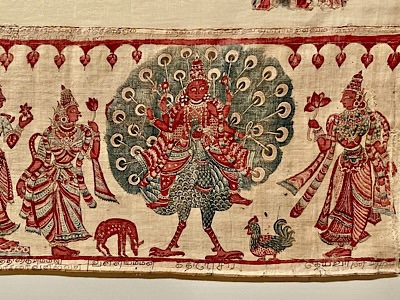
Peacock as Ride (Vahana)

Here’s Murugan (a/k/a Subramanyam or Kartikeya) with a fantastic peacock ride (vahana) in one of the magical pieces of fabric on exhibit at the Textile Museum.

I wish the evident influence of colonialism and global capitalism that influenced what textiles were created and preserved over the centuries.

Similar Posts

  • | |

    Negation, Affirmation (and a new yard sign)

    I went to a delightful brunch yesterday hosted by friend and neighbor K, who lives on the other side of the Hill.  A number of the guests turned out to live within a couple of blocks of me on the Northeast side.  In describing my house to those who lived farther from the Capitol than I (knowing my block was part of their usual walking path), I said, “mine is the one with the ‘War is not the answer‘” yard sign.  “Oh yes, I know which one it is,” was the uniform response.

    K said she did not have the yard sign because she did not want a negative message in her front yard.  It served its purpose for a time, she claimed, but she wanted a more positive message.  I replied that if the sign said “peace is the answer” it would not have the same p0litical meaning.  People would just think, “yes, peace is nice, but whatever,” and keep walking.  We all agreed that was likely, but I left still thinking about the conversation.

    One of the reasons K gave for wishing to turn the sign on its head, was she did not want something renunciatory, and she referenced the principle of “negation” in Buddhism.  I knew what she meant.  Advaita vedanta has a phrase, “neti, neti” or “not this, not this” which means extinguishment of the individual self and a life of the senses and mind to unite with the ultimate Spirit.  The Buddhist “nirvana”  literally means “void.”  I did not engage the conversation in such a way as to bring it to tantra lest I go too far in the direction of yoga geekiness, but the conversation certainly led me to think in that direction.  Tantra seeks to do exactly what K was seeking:  to turn the phrase, “not this, not this” into an embrace that will reveal truth and light by means of affirmation rather than negation.

    Interestingly, though, I think a possible inspiration for K’s yard sign dilemma could come from from Buddhism:  metta meditation (note:  I have been offered this meditation in various settings and have practiced it many times, but it is not my regular meditation practice, so I hope I am not misinterpreting or mischaracterizing it here).  The theory behind metta meditation is to distance one from anger to cultivate calm.  In this creation of calm comes a general demeanor of loving kindness and compassion.  I personally become calmer by embracing and aligning with all my emotions, including grief and anger, but still find the languaging of the metta practice beautifully inspiring.

    In that spirit, I suggest as a possible rewording of the yard sign that still serves the political message, the call to serve:   “may all beings be free from war.”

    Or maybe FCNL should make a sign with the query:  “what do I do in my life to remove the causes of war?” Is that still a negative, if we are calling for positive actions to remove causes?
  • | |

    Lessons in Non-Attachment (Compliments of RIM)

    After 27 hours, plus or minus a few minutes–but who is counting–service was restored to my Blackberry this morning. The reason I had a Blackberry instead of an IPhone in the first instance was because I preferred CREDO (which donates a percentage of profits to causes I support) instead of giving money to political candidates I oppose as do Verizon and AT&T. CREDO now has Android-based phones, which offer all sorts of exciting features that are really quite mind-boggling, if I stop to think about it. I have never been one, though, to give up something that still works fine, just because I could get something newer and more exciting.

    It is interesting to see the articles and comments on the internet about the worldwide Blackberry outage. Much is being said about how this outage will tip users over the edge and send them out to buy another phone because of outrage because of the loss of service. Others note their attachment to the Blackberry and say they will get over the outage because of their attachment. Still others note that doing without email on one’s phone for a day or two is just not a big deal, and they, on their high horses, post mocking comments at the crackberry addicts.

    I most certainly noticed how accustomed I am to sending and receiving communications with my handheld when I didn’t have it for a day not by my choice. My other computers (plural is not a typo) were readily available, so it was no big deal. If I were to lose service when on the road and expecting to meet other people with whom I had not made prior specific arrangement, as is the case for tomorrow and the coming weekend, I would have had to make some shifts. It would have been annoying, though, and would not have felt like the end of the world or a cause for outrage (there are just too many other things more worthy of outrage).

    The episode did leave me thinking about our dependence on technology and how that dependence has shifted both for the good and bad how we relate to our family and friends and the tens of millions with whom we are connected in the ether; how we are attached to our habits and our expected ways things should work, and whether we get stirred up when things don’t go according to plan, desire, or expectations; and how a steady practice of non-attachment can help us open to make the best of things.

    Yes, I looked at the latest phones offer out of curiosity, but no, I won’t be getting one just yet. My three-year old BB is working just fine for now.

    Peace and light, E — Posted with WordPress for BlackBerry.

  • |

    Take a Moment (and be in it)

    On unexpectedly beautiful days like yesterday, I make sure that I get out during the workday.  I’ll ask a co-worker, “did you go out?”  Often the response is, “I couldn’t go out; if I went out, I wouldn’t have wanted to come back in.”  This is not an uncommon response.  I so treasure the spaces of delight in the midst of any day, that it is hard for me to appreciate that response on an emotional or visceral level.

    But what my co-worker is saying is that she will get so caught up in longing (pain) that pleasure for a short time is not worth the pain.  Thinking about it in that way, I understand.  Patanjali cautions us not to get caught up in the “pairs of opposites,” pleasure and pain.  Both the longing for pleasure and the avoidance of pain take us out of the moment and make it hard for us to connect to the essence of being.  If we are always yearning and avoiding, we cannot rest in the bliss of being.

    When we take a walk outside, or stop to eat a nourishing lunch, or pause for five minutes to meditate during the work day, it will only have fleeting benefits if we do it just for the pleasure.  If we can consciously bring ourselves into the moment and simply rest in our own being, then it will help us just be (in the state which is free from pleasure and pain/longing and avoidance) while we are in the whirlwind of activity and challenges of our day.

Leave a Reply

Your email address will not be published. Required fields are marked *

This site uses Akismet to reduce spam. Learn how your comment data is processed.