Signs Around Town
Dear Friends,
My apologies for being so long in sending a proper newsletter. 2014 was a challenging year for me. I started the year sick, ended the year sick, and was limited by injuries for several months out of the year. Work was intensely challenging on just about every level, day after day, week after week, and it continues to be so. And then there’s concern about the state of society and the planet and trying to figure out what I, honoring my capacity and limits, can do to do more good and less harm (I’ll never get this sent if I get side-tracked in that direction).
I also had some great adventures, including a major home renovation and an extraordinary trip to Cuba, but then was working too hard in between to appreciate and integrate fully my experiences (which is a yoga lesson in itself–addressing whether we need more stimulation when we haven’t had time to address/process previous experiences whether delights or challenges to mind, body, emotions, creativity).
Yes, I’m still teaching, even though working as much as I am these days. You can find me leading an all levels group practice with a wonderful group of people on Tuesday nights from 6:30pm -7:45pm at William Penn House in Capitol Hill. 100% of the proceeds (pay what you can; suggested donation $12-15) support the work camp program at William Penn House. There’s also a weekly group practice for more advanced students on Wednesday nights. Email if you are interested in the Wednesday night practice. More info on classes on my rose garden yoga website.
Yes, for those of you who don’t subscribe, I’m still blogging. With the help of wonderful web designer, friend, neighbor, and fellow yogi, Jess C, I just updated the look of the website. I hope to find time to blog about the many layers of meaning that went into the new design, which has the colors of Kali (goddess of sequencing); the murtis are Dakshinamurti (Siva as teacher) and Saraswati (goddess of learning, the arts, etc.); the books are a small, but important to me as yogini, portion of my library.
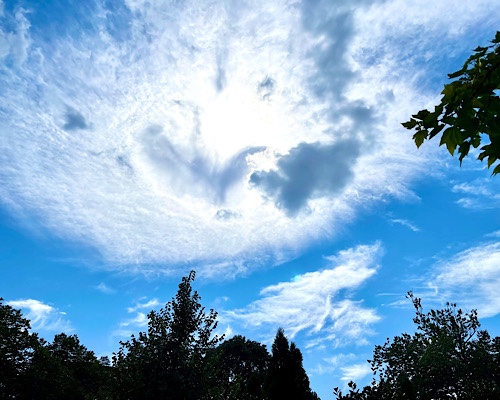
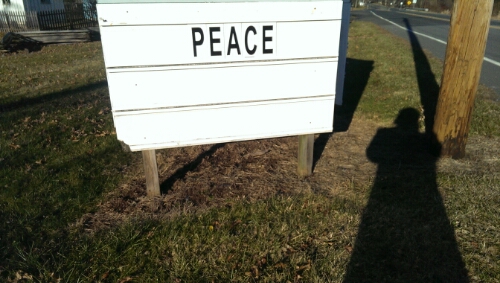
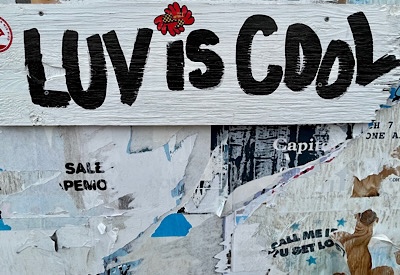
If you’re in town, join me for practice one of these weeks or perhaps we’ll run into each other another class or workshop. Please let me know how you are. Best way to be in regular touch are to subscribe to the blog. When there isn’t an interval between working and living and loving, and all the rest, to share more detailed written contemplations about living yoga,I’ll share the signs and exhortations I see around town and remind myself and anyone else who wants the reminder that no matter what is going on, there’s always a moment to appreciate a little beauty–perhaps to notice a heart-shaped cloud in the sky.
Feel free also to friend me or like “Rose Garden Yoga” on Facebook. Instagram possibly coming soon in my copious free time. Ha.
Peace, love, and light,
Elizabeth
In classical yoga, maya is the illusion that the tangible world is what is real. Only atman is real; the world we experience through our senses (and our senses them selves) as reality is an illusion. We renounce the world to escape the temptation of being drawn into it as reality. In so doing, though, we ineluctably must come to the conclusion that all that is ill with the world is as much an illusion as that which is tempting. In turning away from the world we would be also turning away from the pain of seeing inequity and suffering and the desire to seek change in the tangible, sense-experienced world.
As I was walking around New York City, ankle-deep in slush and being hyper-stimulated by the lights and the noise and the smells and the bustle and the choices, I found myself thinking about maya and that in its classical sense has two surface temptations for me. The first is the temptation to turn away from the stimulation, to reject consumption of more than needed to exist. In the face of such excessive stimulation, the idea of nothing, of utter simplicity, of quiet seems desirable. If the turning away is another form of seeking pleasure or escaping pain, though, it is still in the trap of maya — the worldly illusion that binds us in the pair of opposites–pleasure and pain. The second temptation, the temptation to withdraw from everything except seeking the light within, is more subtle. If we truly are to turn away from the world of the senses, we turn away from notions of justice and equality and freedom that are based how we live in the material world as much as we turn away from consumption.
The true path of renunciation, of pure meditation, is a rare and beautiful path, but to stay in the world and to withdraw ineffectually in such a way might earn the hackneyed epithet “navel gazing.” My path is not that of the renunciate yogin, nor do I have the fortitude to live a life of Christian poverty, which would reject riches and live for service. Where can we find the support in the yoga path to stay engaged and yet still live mindfully, fostering the expression and recognition of spirit in ourselves and others?
In tantric philosophy, maya is understood somewhat differently than in classical yoga. The maya is not the world itself. When we think that getting and having and avoiding is all that there is and that it is separate from spirit, then our lives are cloaked by maya, and we are ignorant (avidya) of the true bliss of spirit (satcitananda). To know spirit, we must see through maya. To do that requires discrimination (viveka) in what we take into our senses and ethically responsible action in the tangible world to align our lives in a way that expands the opportunity to recognize spirit, which in my mind includes having less material disparity in society, which disparity most assuredly makes the essential truth of blissful consciousness more opaque (due to the play of maya) for both the haves and the have nots. While we make our attempt to live with more discrimination and grace and with less cause of conflict or suffering (doing better some times than others), we still try to recognize and savor the exquisite divine in each sight and taste and sound and creation. How extraordinary always is New York in all its wild manifestation!