Art and Culture | Community and Family | Food for the Mind (Yoga Philosophy, etc) | Meditation | Photos
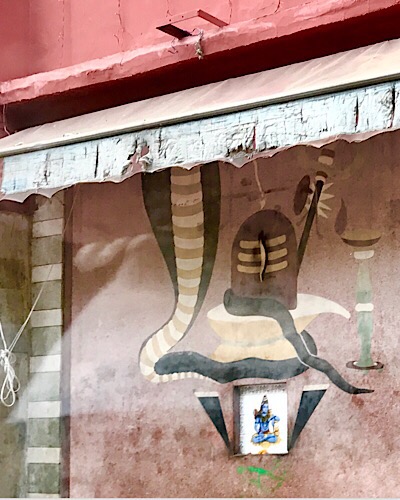
Jai Shiva
When I was walking into work in the cold rain this morning, the song “Plastic Jesus” arose in my head. I thought that I didn’t know many of the lyrics, but when I got back and checked for recordings to see just how much I was missing, I realized it was because there aren’t many lyrics. Here is Paul Newman singing it in Cool Hand Luke. The Levellers have a great cover (with some variations on the lyrics–listen carefully), as do the Flaming Lips. The original is harder to find.
With it’s gentle tongue in cheek message, the song invites us to contemplate the real purpose of any spiritual practice (including the yoga — see, for example, Patanjali’s Yoga Sutra, at 2.46-2.48): to be sufficiently full of love and devotion and recognition of spirit, that we are not ungrounded or driven to suffering when faced with discomfort or inconvenience. And if we get really good, freedom from suffering in the face of true pain, loss, and outrage. That is, of course, a key reason for practicing.

Peace and light, E — Posted with WordPress for BlackBerry.
I’ve been living with blooms from bulbs since just before Christmas. The amaryllis in the vase is the third bloom from a bulb I bought at the beginning of January; the third stem got too tall, so I put it in a vase, so it would not topple over. The orchid I have had since it was about half this size and have been tending it by bringing inside and out with the seasons for over a decade. It has bloomed every February without fail. The paperwhites were a gift. I enjoy a little of the scent, but find the usual presentation of several flowers simultaneously overwhelming. I have brought them to flower one at a time. As soon as the bulb flowers (and inevitably needs to be propped up somehow), I have cut the flowers to put in a vase and started the next bulb. By the time the flowers in the vase have faded, the next bulb is budding.
The cherry blossoms — this is why I dreamed of cherries blossoming; I had them in my bedroom. In a previous post, I showed the nearly bare branches from a tree that had fallen in the blizzard. Although gardeners would call bringing the branches inside “forcing,” I wonder whether I really “forced” these blooms. What I did was take branches that would have gone to a landfill, brought them into an auspicious environment and invited them to bloom. This seems to me, not unlike using props in yoga: I might not be able to experience the full opening of a pose myself, but if I properly use props, I can expand what I can experience. It is not the same as doing it on my own, but it still gives me a different sense of the beauty that can be experienced, just like bringing in branches that otherwise would have fallen or need to be pruned into the house to reveal their glory in advance of the spring blooming outside.
The last photo is of dogwood and cherry that were on the side of the street two days ago (cherry tree down at the Japanese War Memorial); dogwood in a pile on the north side of the street in the 300 or 400 block of D Street, NE. Start your own blooms, there is more winter in the forecast. I am fairly certain from my previous experiment that the cherries will start blooming in a couple of weeks, but it remains to be seen whether the dogwood will want to open.
|
|
Dear Friends,
I hope you are having a rich and full summer.
To celebrate the yoga with John Friend, the delightfulness of the Pacific Northwest, and to get a break from routine — in a word to take a vacation — I will be out of town next week.
While I am on break (September 1st and 2nd), no Wm Penn or house classes. They resume as usual on Tuesday, September 8th.
There are wonderful subs for Willow Street classes this Saturday, August 29th, but there are no classes at Takoma Park, Willow Street, Labor Day weekend (Saturday, September 5th).
Upcoming: Free class week at Willow Street on September 12th. Start of the new session September 19th.
Serenity Saturday, September 19th.
See you soon.
Peace and light,
Elizabeth