Weeding (and the 5 Acts of Siva)
It took focused and intentional removal and destruction of the burgeoning weeds to reveal and give space to grow the exquisite asparagus.
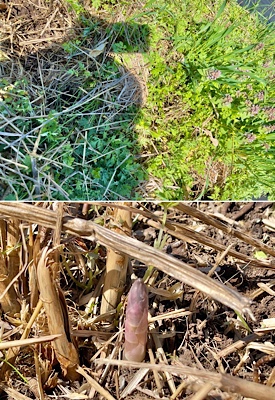

It took focused and intentional removal and destruction of the burgeoning weeds to reveal and give space to grow the exquisite asparagus.
Yesterday I wrote to my DC elected officials and to the budget office to let them know how important it is to me that local municipalities fully fund public transportation, as the budget year comes to a close. Metro officials are threatening to close down many bus lines entirely, which will mean that far too many people will be unable to get to work, especially for low-paying jobs. Hundreds of workers are scheduled to be laid off, which means (as an icy cold budgetary matter — the budget after all being a moral document) that they will need services and no longer will be paying taxes. Disrepair, injuries, and accidents will become even more prevalent, and service will be slowed at already overtaxed and overcrowded times. Our air quality will go from yellow/orange to orange/red from the increase in gridlocked traffic. I discussed the issue and the urgency of making our voices heard with several co-workers today.
I left the office at 5:40 pm this evening to go to take Suzie Hurley’s 6:15pm class at Willow Street, Takoma, Park. I was standing on a metro train at 5:46pm. The ride is supposed to take 13 minutes from Judiciary Square metro. We reached Takoma Park at 6:27pm. I went over to the studio when I arrived. If the door was open, I would have looked in and caught Suzie’s eye and quietly seen whether I could slip in. The door was closed, and I could hear that the class had already started doing standing poses. Under circumstances where being late is clearly not my fault (and I try to avoid those by being willing to be early if it turns out the travel has been optimally sequenced), I will join the class just after centering and before the asanas begin. As much as I would have liked to have taken a yoga class after the slow metro ride, I felt that I shouldn’t risk disturbing the other students by coming so late. I instead will be doing a long, deep, slow, inward-moving practice when I am finished writing, corresponding, getting ready for practice and sleep, and doing some preparations for tomorrow’s work day.
In my growing acceptance that I would be arriving too late to Takoma to take class, I thought about the email I had received earlier in the day about the Friends Committee on National Legislation’s “Our Nation’s Checkbook” campaign. The email reminded me that a third of my tax dollars are being spent on war. “What about investing in green jobs, preventing more home foreclosures, and funding diplomacy to prevent wars?” I was asked. “What about public transportation,” I thought, as I sat on the stationary train between stations. “How many trains could be operated efficiently and safely for each fighter aircraft?”
How do I want to live? What are my priorities? When does short-sightedness or immediate personal satisfaction impact my long-term health and happiness and peaceful co-existence on a crowded planet? For what purposes do I practice? How would I like to invite others to live?
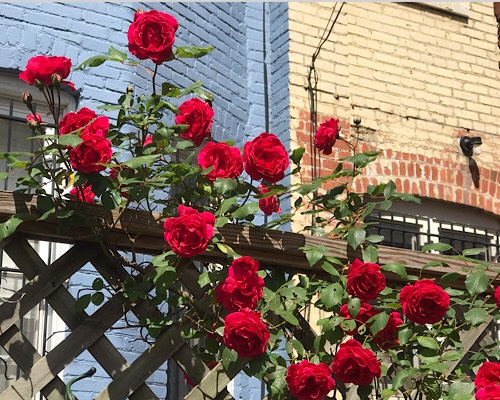
The ride home, of course, had nary a problem. A train arrived in under five minutes. The ride back to Union Station was exactly 11 minutes. Everyone had a seat, and the car was nearly full, so it was at perfect capacity. It was still light, and lots of people were out because of the balmy night and the beauteous blossoms, and I felt safe strolling home instead of taking the bus. What a beautiful night!
I was volunteering today at William Penn House, which was providing a comfort station for marchers during the day, as well as being full to capacity with guests.
I was doing some work in the office when a woman who looked about my age came who was in town with a group of women from Long Island for the March.
She came in to William Penn House for a bathroom, not because of any connection to Quakers or the house. But while she was waiting in line for the bathroom she ended up in conversation with the executive director, who said that the board member volunteering downstairs was also from Long Island–perhaps she knew me. It turns out that we went to the same elementary school and lived near enough to each other that we rode the same school bus.
It is just one of the reminders I’ve had this weekend of how connected we are.
We all (or at least most of those who would be reading this blog) have heard the Buddhist-inspired saying: before enlightenment, the laundry. After enlightenment, the laundry. The question is whether after the moments of enlightenment can we infuse doing the laundry with more joy, acceptance, and peace. A young adult acquaintance asked me the other day whether I was readjusting ok. I did not know to what he was referring, and he had to explain that he was asking how I was doing on my return from my India trip. “It was just a vacation–albeit an extraordinary one,” I replied. “Life continues.”
“The good experiences just slip away like dry sand through my fingers,” he made a motion of letting something slip away.
“When you practice and when you get older, it will be easier to bring the temporary, good experiences into your life without feeling they are lost when you have moved onto the next thing,” I said with hope that would actually be true for him, he seemed so bereft.
The yoga teaches us neither to be out searching for the highs nor actively avoiding the lows; the dance of grasping and avoiding is what makes us suffer. That does not mean that the highs, the times of wild abandoned joy, the experiences of utter fulfillment, of exquisite understanding are of no value. What brings joy is a thing of wonder and an opportunity to deepen our ability to love and be generous. They are only a problem if we ruin our time by vainly clinging to or trying to repeat the sensation. As our practice (and our understanding of a life well-lived and loved) matures, we understand that there is no readjusting in the return to the day to day. We welcome what we have had, try to remember what we have learned, including how much joy and delight we are able to drink in, and approach each day as another opportunity to seek and share connection.