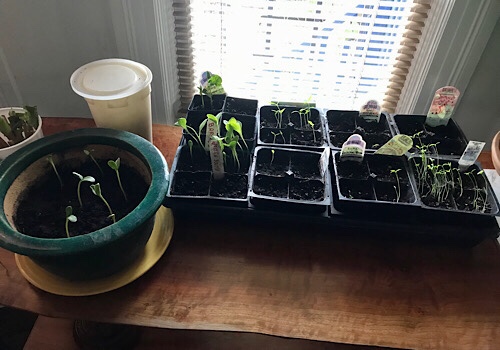
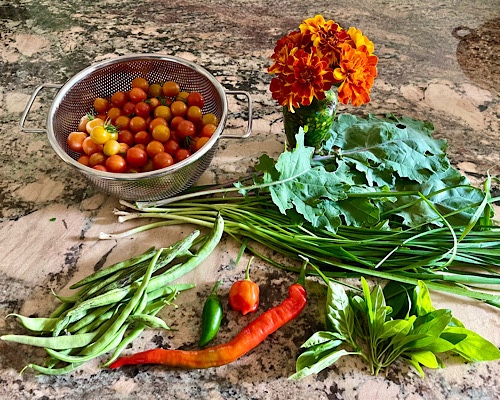
Today’s Gifts from the Garden

I love having things around the house that I have brought home from my travels. They help me imagine other times and places.
The crystal conch shell I brought home from India. The turtle with its fire opal I brought home from Mexico.

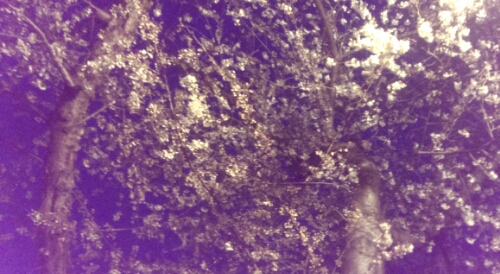
I was standing around with some neighbors–all masked, but needing to say hello. When getting into political discussion with a neighbor who seems to think there might be a return to “normal,” I happened to glance up and notice how beautiful was the sky.

When we choose a tantric path, we choose to experience pleasure as an expression of spirit, rather than seeking to transcend such experience as would one who is on the classical renunciatory yoga path. The choice to remain engaged, to honor mind and body as divine, comes with great responsibility.
When we choose engagement, we choose to experience the divine reality not just of pleasure, but also of pain. The true tantric path does not turn a blind eye to ugliness and suffering. Just taking the pleasure without recognizing its opposite is not authentic practice. If the pleasure of the sunrise is “real,” then the garbage on the beach is just as real.
Recognizing the reality of ugliness and pain as part of the play of the real does not mean, though, that it should diminish our joy in the beautiful and in the dance of the play of opposites of life.
Rather, it is our delight in and engagement with beauty that invites us to serve as best we can to alleviate suffering, to try and clean up the garbage where we can. In other words, as we recognize that ugliness and destruction are part of the play (lila), we seek to be heart-full rather than heart-broken when we witness the suffering from violence to others or our living planet. If we let our hearts break, we become blind to the beauty. Like those who only see what brings pleasure, those who only see the painful are also not experiencing all of the real.
As I head back to the world inside the Beltway, I bring the deepened and replenished sense of beauty and the dance that I always get from collective study and practice. I will try to share the privilege of having this experience by doing my best to clean up what garbage I can, while still dancing and loving in the light.
I wanted to share this article on “ecotherapy,” a term I had not heard before. I found the article interesting because for years now, I have gradually practiced all the elements listed in the article as treatment for depression, not because I had been told by a therapist to do so, but because, despite my feeling the repercussions of going against the grain, I felt happier and healthier settling in one place, traveling more slowly, connecting with my pets, and tending a small patch of nature.
These shifts in lifestyle simply feel to me more in alignment with my own nature and that of the earth. I found, incidentally, it gave me much more time overall to do things. People ask me how I do so much (usually referring to the day job, the yoga teaching, the gardening and cooking, the volunteer work). Thinking of the way they live, and what they do, they ask when do I rest? I say that my life is in fact rather slow and restful. I rest when I meditate. I rest when I am taking the time to make a home-cooked meal — every day when I am in town, often two or three times a day. I rest when I am tending the garden. I do not think of cooking and gardening as chores, but as ways to nurture myself.
I rest when I am commuting because it is on foot or sitting on the bus or metro (note: instead of getting anxious or angry when metro is slow, think of it as an opportunity to draw into yourself and meditate, contemplate, or read).
Not having moved or changed jobs in years, even though there have been serious challenges with both where I live and my job, I had the time, money, and energy that would have been used up in a major upheaval, to engage in the study and practice to become a certified Anusara yoga instructor, and before that, to study drawing and photography and to exhibit my art. Staying in place, I continue to have time to study and to read (not watching TV helps alot, too, for finding time). The choices are different with children in the house, but it is still possible to make choices that require less racing around for the family.
This, to me, is a larger aspect of vinyasa krama, the art of sequencing. When we sequence how we move in space and time in a holistic, sensitive way that honors the rhythms and cycles of our bodies and the earth’s, then we feel less trapped or overwhelmed. When I was trying to keep up with society, I was often sad and anxious. Now I am much less so. I have often attributed it to these choices. Now, I see, society has given us a word for it — ecotherapy. With a word coined for it and put in the press, will people feel more comfortable practicing it?
I think a lot about what leads people to get injured on and off the mat. Often it is that desire for a certain goal or distraction keep us from the sensitivity and mindfulness that enables us to appreciate and act on the principles of cause and effect before the injury or accident occurs. One of the great benefits of a steady practice of yoga and meditation is that it can help us be more sensitive and aware of where and how we and all the things around us relate in space and time, the critical awareness for preventing injuries in the first instance.
Peace and light, E — Posted with WordPress for BlackBerry.