Mercy
As part of my walk in the neighborhood, I joined a March on the Capitol advocating for health care for all/Medicare for all. What does it mean to have mercy or to be merciful? I am quite certain inaction is inconsistent with mercy.

As part of my walk in the neighborhood, I joined a March on the Capitol advocating for health care for all/Medicare for all. What does it mean to have mercy or to be merciful? I am quite certain inaction is inconsistent with mercy.
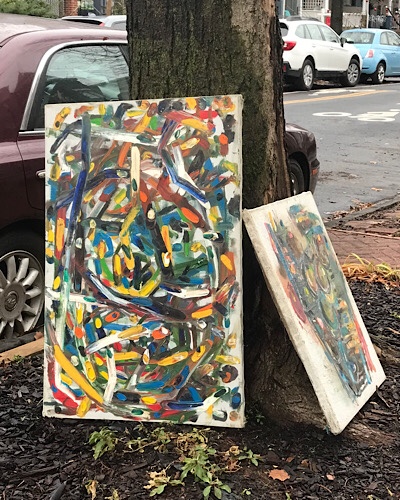
I spent some time looking at these paintings I encountered on my walk this last day of the holiday break. I decided to leave them for someone else, but I liked the bold colors.
In discussion of erudition and spirituality, much use is made of the metaphor of light. Light takes us out of darkness, reveals the truth of illuminated wisdom, is the truth, is pure consciousness, etc.
When I noticed the shape in the sidewalk pavement culminated by a shadow, I found myself thinking that we cannot fully experience light without shadow. Not because we cannot understand something (e.g. good) without experiencing its opposite (evil), but because absolute light blinds us to the point of destroying the ability to see even the light. We need shade or dark sunglasses to see what is differentiated when the sun is at its most glaring.
Just as the stone in the photo would not be revealed as a heart but for the shadow crossing it, so too, we cannot know the deepness and authenticity of love or spiritual teachings and practices until we discover that we can stay true to them through challenge and adversity. The shadow does know, just as the light reveals.

Peace and light, E — Posted with WordPress for BlackBerry.
“You like looking at clouds, don’t you?” asked one friend, as we took a walk along the shore after the workshop on Lakshmi this weekend. Another added, “did you always see so many heart-shaped clouds?”
“Yes,” I answered the first. “I always have.” To the second, I note that although I did not pick them out so frequently before, they are often there to be seen for those who are paying sweet attention.

Dear Friends,
A cool breeze is blowing through my window as I write, giving a foretaste of glorious fall weather to come.
Although already fully immersed in the throes of work after last week’s study trip to Oregon with John Friend, I am brimming from the teachings and comraderie. Such a trip reminds me of how crucial it is to study and connect to help bring the benefits of yoga off the mat and into my daily life.
This week is free class week at Willow Street Yoga. It is a great way to try out new classes or teachers or to bring friend who is been shy about starting or returning to yoga. I’ll be teaching both my 8:30am Level II and my noon Gentle and Therapeutics classes this Saturday, September 12th. Bring a friend and come check it out.
Looking for an extra class or one great to bring a drop in friend? Come join us for the Tuesday night class at William Penn House. All levels of practitioners welcome. Special prices for public interest workers, students, and seniors.
Wednesday night advanced/intermediate group practice proceeds are still 100% for charity. This month’s cause is “Yoga Salutes Non-violence” a yoga sun-salute practice that raises money for local domestic violence shelters. For more information, check out my friend Cheryl’s website at: http://www.heartofgraceyoga.com/YSNV.php
Upcoming Workshops: Next Saturday, September 19th is the next Serenity Saturday at Capitol Hill Yoga. Get ready for the shift into Fall with a sweet afternoon of deep relaxation and nurture. Can’t make it this month? Put October 17th and November 21st into your calendar for a great way to ease through Fall. To register, please go to: www.capitolhillyoga.com
Looking Ahead: Already trying to make your Thanksgiving plans? If you will be in town, plan to share your gratitude at the 7th Annual Thanksgiving Day fundraiser for Oxfam, which I will be leading at the Willow Street Yoga Center’s Takoma Park studio.
For more information on classes and workshops or to enjoy the blog, visit: www.rosegardenyoga.com or join me on facebook.
Peace and light,
Elizabeth