Art Around Town
I spent some time looking at these paintings I encountered on my walk this last day of the holiday break. I decided to leave them for someone else, but I liked the bold colors.
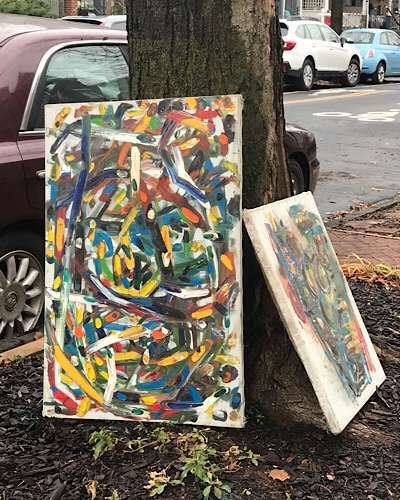
I spent some time looking at these paintings I encountered on my walk this last day of the holiday break. I decided to leave them for someone else, but I liked the bold colors.
Last night, Paul Muller-Ortega, as part of the introductory talk for the meditation intensive, spoke at some length about the principles of ardha, kama, dharma, moksha.
As I have written about before, in the classical yoga view, it is the renunciation of the first three–material well-being, love and relationship, and right work or path, that leads us to the fourth–liberation. From a tantric yoga perspective, it is living and having the first three from the perspective of illuminated wisdom and discerning (viveka) insight (pratibha) that makes us free (jivanmukti) in this life.
One of the most exquisite things about a steady practice and study, is that each time we revisit a core concept, we hear and understand new aspects to bring into our lives.
When speaking of approaching these elemental aspects of human being, Paul noted that ardha includes not only material well-being, even wealth, but also the power that wealth brings and how we use it. Although he only mentioned that briefly amidst several other concepts, it really resonated with the current state of my being in relationship to the world and our country.
I have been contemplating deeply about wealth and power in this time of budget debate, and how they can and should be used to bring nurture, peace, and health to the maximum degree possible. (You might guess that I don’t think increasing spending for war and decreasing spending for education and health is going to bring us freedom).
Thinking about the power of money as part of our contemplation of our material well-being is something of critical importance at this time. If we shun or disdain in our minds wealth and power while still yearning for our own comforts, than we have lost an opportunity to bring the yoga principles into our lives as optimally as possible. (Of course, grasping and coveting money and power is completely destructive of the possibility of happiness, but most of us think about that, and it is why some say they are bad — money being the root of all evil, etc.).
If we are really in the world and want to be happy and to share and spread happiness, while living in accordance with the principles of the yamas and niyamas, especially the yamas: ahimsa, satya, aparigraha, brahmacharya, asteya (non-harming, truthfulness, non-greediness, aligning with spirit, and non-stealing), that is when we will start opening up the possibility of true living liberation.
Imagine, instead of thinking about material well-being as a “guilty pleasure” thinking of ways in which you can use your own well-being (and work through your practice to discover greater health and strength) to be a voice and power for good in your own individual way.
Peace and light, E — Posted with WordPress for BlackBerry.
A friend from the DC Sunday contact improv jam (one of my favorite places to play) sent this link showing a clip from a documentary in progress about the importance of play to our health. One of the things that I love most about Anusara yoga is that John Friend has always described its practice as being “seriously playful.” I was born serious nature and have worked hard in my adulthood to learn to play spontaneously, and what is being offered here resonates for me.
This is a long clip, but well worth the time. Anusara yogis, notice how familiar some of it sounds. Enjoy!
When I was waiting for the metro to go to Willow Street Yoga this Saturday morning to offer a free gentle/therapeutics class (new session starts for the class next Saturday, January 15th–all welcome), I heard a very disturbing announcement on Metro. I only take Metro once or twice a week. I am pretty certain I would have noticed it if I had heard it before; in rush hour, of course, it is hard to hear the announcements when the platforms are full. What I heard was this: “Metro police have advised that all passengers are subject to random searches of their carry ons.” A reasonable person might want to know what is a “carry on” for these purposes. My first question to myself was “don’t random searches of this type violate the Constitution?” (Yes, the American Civil Liberties Union is actively engaged in the issue).
I find random searches just for boarding the metro with a carry on an unfortunately not particularly shocking example of how far we have allowed the “war on terror” to be waged against all of us. Perhaps there are readers of this blog who are not shocked or perhaps believe that these searches are warranted; I am open to listening to why. I know that it was not front page news, and my friends have not been talking about it. This was just another one of those awful things we have started taking for granted, which is something that I hope is getting progressively harder to do.
My biggest question for myself was what I would do if the police asked to search my handbag. The odds are slim to none that “random” would in practice include a reasonably well-dressed, clean, small, middle-aged, middle class, fairly evidently American-born, white woman. But what if random was really random and I happened to be in the wrong place at the wrong time? Would I refuse to let my bag be searched on principle? Would I be willing to lose my job and possibly go to jail for my conviction that such a practice misses the mark completely for its intended purposes and tears at the very fabric of a free society and our individual liberties? I find that I do not know the answer. Partly it is attachment to my own security. Partly it is that I do not know whether it would be better just to allow my bag to be searched and not engender conflict than to engage in conflict that will certainly harm me, severely limit my ability to give financial support for important fights and causes, and potentially could harm others around me, even if ultimately, with the help of many I am sure, I were to be a participant in reason prevailing and the practice ceasing.
In thinking about how unsure I was of my ability to act if I were to be put to the test, I was reminded of the situation at the beginning of the Bhagavad Gita, where Arjuna is paralyzed by inability to act in the face of the hideous spector of violent death and destruction that would result from going to battle even to rectify an injustice. Arjuna looks out on the battlefield where battle is enjoined because of the injustices that have been done (we’ll leave it for another day as to whether the violations of law in the Mahabharata are ones that a modern thinker might agree should give rise to the epic battle in the Bhagavad Gita.) Krishna explains to Arjuna that it is his dharma to go to battle; he is a warrior and these wrongs must be rectified. The general day to day principle that governs the life of a yogi — ahimsa or non-harming — is trumped by the greater need to rectify the societal injustice. Arjuna must join in battle because leaving the injustice uncorrected will in result in greater harm to the order of society, even the cosmological order itself. See Stephen Phillips, “Yoga, Karma, and Rebirth” (discussing the interrelationship between the individual practice of ahimsa and the need for cosmological order in Indian philosophy).
I am not likely to be put to the test here, but that is part of the evil of the practice. What can I do? What should I be doing in the face of a direction in society that gives rise to policies like these and the gunning in Arizona yesterday? It takes great discrimination (viveka), more perhaps than I have, to know how and when to act. I do know that it is not right for me as a citizen or a yogi to stand aside. I offer this very public statement of my beliefs and I gave a generous donation to the ACLU yesterday. I am sure that is not enough, but it is a start. As our society moves in the direction it is moving, more and more of us must contemplate, evaluate, and begin to expand how we act and participate to see a world where ahimsa is not just personal, but all persons and beings have the possibility of being free from suffering.