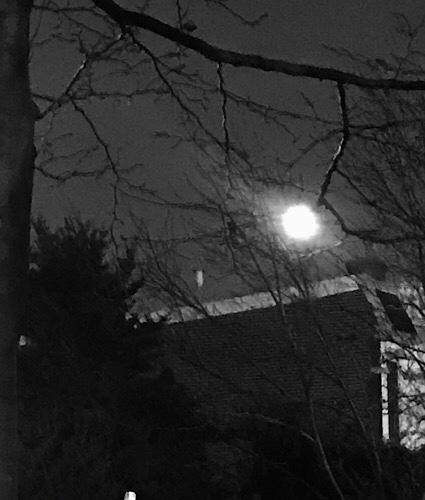
Morning Walk—After the Rain

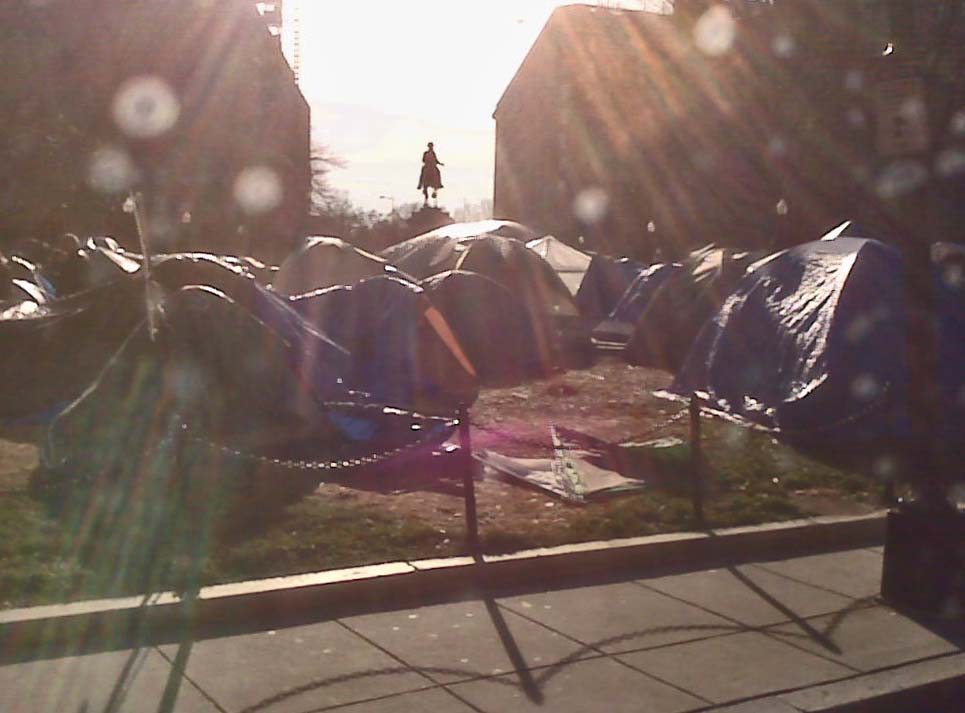
I was not witness to the most abject poverty in India (both because of where I went and because of how I was guided). These makeshift, but semi-permanent shelters seen from the window of the bus made me think of the Occupy movement. They are nothing like those of Occupy and much of what Occupy is trying to warn against forgetting to care. And, oh yeah, McPherson Square is still occupied, though more and more uneasily.

“You like looking at clouds, don’t you?” asked one friend, as we took a walk along the shore after the workshop on Lakshmi this weekend. Another added, “did you always see so many heart-shaped clouds?”
“Yes,” I answered the first. “I always have.” To the second, I note that although I did not pick them out so frequently before, they are often there to be seen for those who are paying sweet attention.

Ether (akasha) is the fifth of the mahabhutas. In science and perception, it is the space between the other elements, it is that in which the other elements reside. It is to some degree, the critical element of how we are able to perceive the other elements. I find focusing on the Anusara alignment principle of “open to grace” is the best way to experience the element of ether in myself. By softening, opening, and inviting spaciousness, I can better experience the subtle elements and appreciate how it is that I experience them.
The subtle elements or the panca tanmattras are smell (gandha), taste (rasa), form (rupa), touch (sparsa), and sound (sabda). The subtle elements are not what we sense (which is composed of the mahabhutas) nor are the tanmattras our sense organs. Rather the tanmattras are, as it were, the space in which perceptions arise, the ability to be perceived.
The next sets of elements are the panca karmendriyas, the organs of locomotion, which correspond to how we physically move, digest, and change in the physical world, and the panca jnanendriyas, the organs of perception or cognition, which correspond to our sense organs themselves. Our movement in and perception of the world bridges the physical elements, the perceptability of the physical world, and ourselves as physical beings, beings who move in the physical world, and beings who perceive the physical world. All of this, I think of as needing space or residing in space. As I consciously think of space giving a place for the world, my movement in it, and my perception of it, I become more conscious of consciousness. The physical practice of “opening to grace” and experiencing the element akasha makes possible for me in my practice knowing or experiencing a greater consciousness.
To start discovering your own understanding of akasha, try this meditation: listen to the sounds beyond the room without trying to analyze or change them. Appreciate how far in space your senses and consciousness can be. Then bring your attention into the room and hear the sounds in the room. Then open your ears to the sounds within you — your heart beat, your breath. Then open to all the sounds (don’t try to change or analyze them), both those physically far away and those within your own body, and be aware of them as all residing within your own consciousness. Appreciate that your consciousness is as spacious as the world around you and within you. Rest in the space of consciousness.
See whether spending a few minutes using this meditation technique helps you when your day has gotten too busy with work, errands, family or other demands. I find it very helpful.
Vegetable Dal made in the slow cooker and saffron brown basmati rice garnished with cilantro and charcoal salt
I don’t like to leave the house with the slow cooker on, but when I’m concentrating through a long work day, it is great to get it started and then leave unattended until dinner time.


Peace and light, E — Posted with WordPress for BlackBerry.