Similar Posts

  • |

    Roasted Brussels Sprouts and Other Vegetables (and the Goddess of Sequencing)

    Cooking is not only an exquisite opportunity to notice and appreciate the various characteristics of the elements of our meal and how they react to heat and fat and cooking times and methods, but a wonderful way to appreciate how everything is ordered in time and space and to honor Kali — the Goddess of Sequencing.

    Brussels sprouts seem to be fashionable this year.  I’ve always liked them.  My preferred method is to braise them:  saute lightly in olive oil and/or butter in a heavy pot with a lid, splash some dry sherry, wine, or vermouth into the cooking pot and stir until the liquid is absorbed, add some broth or water (not quite to cover) plus salt and herbs of your choice, simmer until the brussel sprouts are tender and the liquid is absorbed.

    My friends are gushing about roasted brussels sprouts.  I think the tenderizing, fat-adding delight of roasting has made the much maligned brussels sprout more accessible:  toss with olive oil, salt, garlic, and herbs such as rosemary and thyme.  Roast at 400F until tender and browned (15-20 minutes).  Use peanut oil, ginger, garlic, and soy sauce or Braggs amino liquids for an Asian meal.  Try safflower oil, turmeric, ground ginger, garlic, and ground coriander seeds to serve with Indian food.  Use just butter (or if vegan a light, relatively flavorless oil such as safflower or canola), salt, paprika, and pepper for an Eastern European flavor.

    Whenever I roast vegetables, I toss in an extra head of garlic (separated into cloves), and serve some with the vegetables and reserve some for cooking something else with roasted garlic.  Include a variety of vegetables.  Just remember that different vegetables need different cooking times.  To recognize the mysteries of the Goddess of Sequencing in time and space — you have two choices in roasting vegetables.  You can cut the vegetables into different sizes (so you would leave brussels sprouts whole, cut winter squash or turnips into cubes a little smaller than the brussels sprouts, and potatoes into wedges or rectangles that are narrower than the brussels sprouts for them all to be golden and tender, but not overcooked at the same time.  As an alternative (as we do with sauteing or stir-frying), you can add different vegetables at different times.  You might need a combination of both techniques.  If you wanted to add mushrooms to the mix, since those would need to be larger than brussels sprouts, you would want to add the mushrooms later lest they get withered — how much later depends on the size of the mushrooms relative to the other vegetables.

    Enjoy (and give homage)!

  • | |

    Acqua al 2 (and Community)

    Last night, after yoga class, I went with a couple of students to the new Italian restaurant at Eastern Market, Acqua al 2.  I’d been shown the inside before it opened, but this was the first chance to go and eat.  A long-time neighbor, yoga student, and friend is the mom of one of the co-owners and has known the other owner since childhood.  The co-owners were both were raised in the District and have returned after college, along with many of their friends to live, and work, and be with family.  I went to eat with the eagerness of knowing my friend and her family better and supporting them, more than for the purpose of needing to be one of the first to check out a new dining opportunity on the Hill, although that was certainly another pleasure.

    As we planned the dinner (we have been awaiting the opening for some months and talking about going since then), I thought about how different it is to go to a business where I feel a connection to the proprietor or the workers.  I felt more open to what would be there, more joyousness at its very existence, and a yearning to find it wonderful and be supportive.  When the business is run by a stranger, or even more removed, some corporation whose duty is mostly to shareholders, the natural forgiveness for quirks that we have for those we like, welcome, and love is missing, and we ourselves miss out the essence of true relationship.  Getting to share this new place with my friends was a superb reminder how important is community and how we can support it and cultivate it.

    What a delight that, even as a NY-bred food snob, I can cheerfully recommend the restaurant.  It is larger than most restaurants on the Hill, so it does not feel like a neighborhood-style Hill restaurant. but I think the neighborhood was ready for something larger.  The atmosphere is lovely:  communal seating in front near the bar for those who have forgotten to make reservation (yes, you already need them, unless you are coming after 9 [kitchen serves until 11]), spacious, pleasantly lit, comfortable tables, and  a great mural on the outside, which transforms a concrete wall a foot along the side of the restaurant into a view of Florence.

    We started with the “zuppa del giorno,” which yesterday in keeping with the unseasonably cool weather, was a warm bread and tomato soup that was a rich and flavorful concoction.  Given the lateness of the hour, we didn’t have the entrees (though I’ve heard good reports).  We shared at our table for three, the pasta sampler (for two), which was five different vegetarian pastas of the chef’s choosing, and the salad sampler (which you can get as all vegetarian if you ask).  We each had different favorites of the pastas, but all were good and very classic in preparation and presentation.  The salads were light and fresh, with an emphasis on bitter greens, which I like, and were an excellent foil to the rich pastas.  The pastas came out one by one, giving an opportunity to have two or three bites to savor, with then a little wait in between for the next one.  This was not a meal to be hurried; things come at a European pace.   I was too full for dessert, but my friends insisted.  The cheese cake is the kind that is more like mousse than the heavy American cheese cake and my companions raved.  I had a fruit tart that was well-prepared — most of which I took home.  I will enjoy eating it today after speaking on a telephone seminar with people I know are asking challenging questions.

    The restaurant is still getting its rhythm.  It was packed with lines out the door even at 8pm on a Tuesday night just two weeks after its opening, which is no doubt inviting the staff to live up to intense challenges.  The food is sure to be good, and if you go with the generosity you would have for family and friends starting out on a new venture, you will have a delicious experience.

    Note:  Plenty of vegetarian options with the pastas and salads, but it would be harder to find vegan on the menu (given that it is a Florentine restaurant).  My only wish based on last night’s meal, is that the restaurant would use more environmentally friendly containers for taking things home.  Right now, it is using foil trays with a plastic cover, so if you anticipate bringing part of a dish home, try to remember to bring your own carry container.

  • | | | |

    This Week’s Garden Highlights

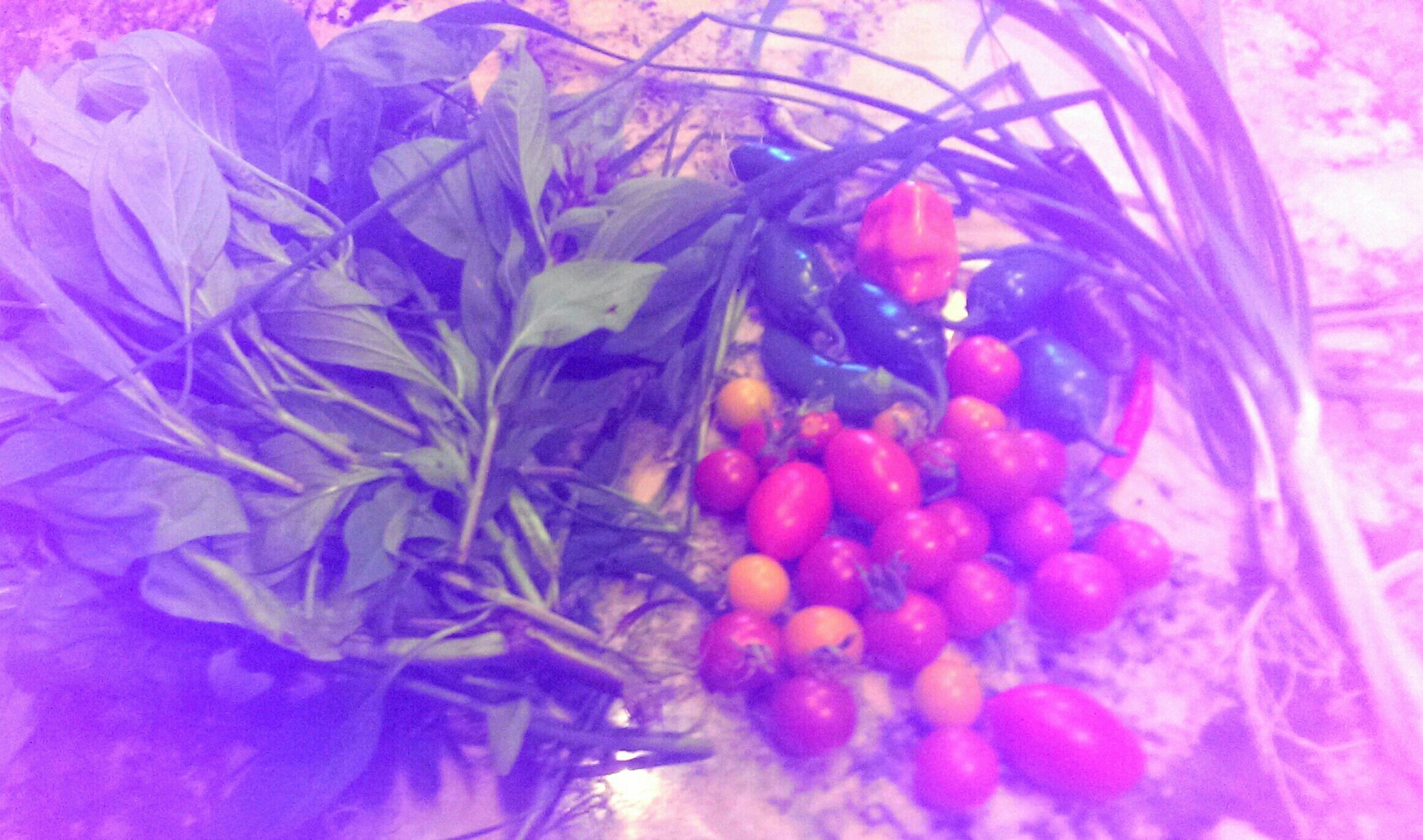
    Basil, persimmon tomatoes, plum tomato, saqweet banana pepper, turenip and greens, tricolor carrots (the white are maturing much faster than the orange and the red), anaheim peppwer, okra, jalapeno pepper. (Not shown: grapes, kale, and the three cucumbers I had midweek, one of which still needs to be eaten).

    Peace and light, E — Posted with WordPress for BlackBerry.

  • | | | | | |

    Prasad (and Opening to Grace)

    During one of the sessions at the workshop last weekend in New Jersey, John Friend made a passing reference to the difference between receiving and taking.  He did not go into any detail because it was not central to the theme of the class, but it led me to contemplate on my own about the difference between taking and giving in the context of yoga practice.  In so doing, I thought about the concept of prasad — which is food that has been blessed and is offered to those who have participated in worship (puja).

    When offered prasad, one does not take it.  Instead, the cupped palm is turned up to receive the prasad.  The recipient does not get to pick through the basket and choose which sweet looks the biggest or the tastiest, but simply receives with gratitude the sweet or fruit that is infused with the intention of spirit.  The active part is the showing up with openness and receptivity to the offering, the blessing, the nourishment being offered.

    Coming to yoga class or doing our own practice (asana or meditation) should be, I think, like preparing to receive prasad.  What is primary in the practice of Anusara yoga is being open to grace, but we can no more force openings or enlightenment (grace and insight always elude grasping),  than forcing any particular physical posture or goal really yoga practice.  The point of effort in yoga to improve and expand alignment and knowledge is to enable the practitioner to receive more fully all the potential gifts and grace of practice, and then in turn make fuller and more complete offerings to others.

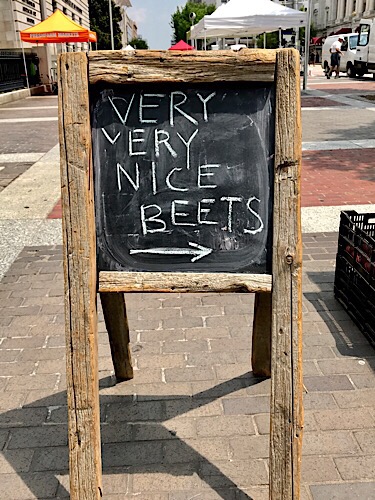
    Below:  offerings at the Chelsea Farmers’ Market

  • | | | | |

    A Moment of Insight (and suddha vidya)

    A rather conservative co-worker, who was one of the people who would have to go grocery shopping last night lest the family be without perishable food for a few days, was talking to me about the impending snowstorm (including me advising him of the one forecast for next Tuesday/Wednesday).  “It shows,” he said, “how easily our infrastructure and food supply can be disrupted.”  I gave it a little pause, and then replied, “this is why I talk about gardening in our own yards and switching away from agribusiness to a more sustainable and self-sustaining way of living and seek to shift myself, though it is difficult.”  He said, “hmmm,” letting the idea stick in his mind, but not wanting to carry the discussion further.  I know him well enough to have dropped it for the time, but also know he will think about it and perhaps over the years, for his beloved daughters or out of perceived necessity, start making small shifts.

    In yoga practice, the concept of suddha vidya — illuminative wisdom — is both revealed and practiced.  When we start practicing or even before, we may have occasional and early insights into fundamental truths of being, but without steady practice and contemplation they will be fleeting and not shift our way of living.  If we practice and study continuously, though, our insight will become steadier, more consistent, and will start to illuminate all states of our being on and off the mat.  The more I practice, the more it is illuminated for me the connection of all beings and my need to live in a way that is more open, tolerant, loving, and aligned with the complex web of our interconnection.  My co-worker’s insight might not have been “yoga,” but it was indeed a moment of illuminative wisdom in its recognition of a misalignment of society that tears at the fabric of our being.

Leave a Reply

Your email address will not be published. Required fields are marked *

This site uses Akismet to reduce spam. Learn how your comment data is processed.