Be Here Now (Var.)
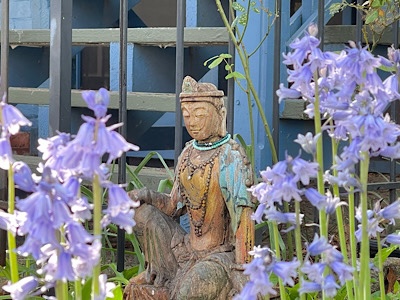
Last year I decided to bring this murti of Kuan Yin outside. I asked my neighbor if it was ok, as her parents came here from China, . My neighbor welcomed this presence in the space between our yards and also appreciated that I asked.
What does it really mean when we think, when we say that we have power?

Peace and light, E — Posted with WordPress for BlackBerry.
Peace and light, E — Posted with WordPress for BlackBerry.
The second sutra of the Siva Sutras is “jnanam bandhaha” (knowledge is bondage). In the context of the Siva Sutras, this tells us that getting caught in trying to acquire knowledge of the manifest world and all of its infinite minutiae can lead us away from a sense of connection to a universal spirit.
We have the phrase in the work place that the “devil is in the details” both because getting caught up in the details can take us away of accomplishing a desired result and because the details need to be worked out to realize the result, and the details (not the theory) are the hard part. At the societal level, for example, working out the details of a health care bill and how it will actually function seems to be preventing us, as a society, from offering health care to all. On our yoga mats, we need to understand the details of physical alignment so that the practice strengthens and optimizes our health, rather than taking us physically and energetically out of alignment, but we do not want concentration on the details to take us away from heart and spirit.
The “devil may be in the details” but we cannot stop the details from being part of our existence. As much as we need not to get so bogged down in the details that we have discord, distrust, unhappiness, and ineffectiveness, we also need to cultivate knowledge of the details. As beings embodied in space and time in the manifest world, we need to cultivate knowledge so that we can recognize when the details are not in optimal alignment, so that we have sufficient knowledge, strength, intuition, and subtlety to be able to shift the details so that they lead towards good for ourselves individually and collectively.
What a devilish conundrum.
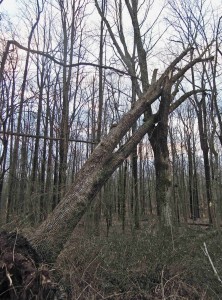 Another blink of Siva’s eye, another,
As a friend has been saying, trip
Around the sun. Decades from now,
A parent walking in the woods with a child,
Or one lover to another, or a forest guide
Might point out the signs from the
Big hurricane of 2012. I expect 2013 will
Be momentous and full of joy, ephemeral,
Another trip around the sun.