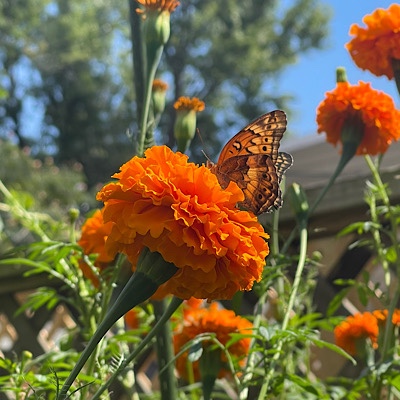
Blossoms Around Town (Support Pollinators)

If you are looking for a good way to practice and enhance your standing poses, please check out this video by John Friend. If the link doesn’t work for you, go to Yoga Journal on-line and go to their videos section.
I never cease to marvel at the wonders of technology. I never cease to be grateful for my teacher and the teachings. Don’t take anything for granted.
When I saw this headline the other day, the first thought that came to mind was how much pleasanter life would be if those spending huge amounts of effort and money to “fight” gay marriage would pour that energy into educating children, tending gardens, and being friendly with their neighbors. The next thought, which was not unrelated, was that the headline was a prime example of how the action of mayiya mala serves to alienate us and cause unnecessary rancor.
The three malas or cloakings, in tantric philosophy, are aspects of consciousness that prevent us from recognizing the unifying spirit in all beings. We tend to hear a fair amount in yoga class about the first of these —anava mala, which clouds or covers over our recognition of the divine in ourselves, thus leading to feelings of unworthiness–but there is less focus on the other two (the third is karma mala, which is the illusion that we are doing everything all by ourselves–that’s an oversimplification. Perhaps more another time).
At an elemental level, mayiya mala is the distinction between subject and object that leads us to feel separate from other beings. When this separateness makes us feel threatened or needy, then we can behave very badly indeed (mild understatement). I believe that our superficial requirements of outer sameness–think dress codes or neighborhood rules on what one can plant in one’s front yard–are exactly because we fear difference. If we can instead accept difference as part of the play of what actually connects us (see through mayiya mala, then we can more easily love and embrace others and widest variety of creative expression.
On our mats, one of the things that leads to injury is mayiya mala. When we forget that we the purpose of the practice is to seek the peaceful joyous space within ourselves and instead get competitive or acquisitive about postures (or external emblems of “spiritual advancement”), we are getting caught up in the differences and comparisons generated by mayiya mala and get compelled to push and strive in unhealthy and dangerous ways. When we remember the true purpose of practice, we will seek to expand, but with such sensitivity that we do not hurt ourselves. This, of course, is easier said than done.

Peace and light, E — Posted with WordPress for BlackBerry.
I was just led by a friend’s Facebook posting to the website for an upcoming movie about the Siddha yoga ashram (Siddha yoga was part of the teaching and practice lineage of John Friend and Paul Muller-Ortega, and both have told stories about how useful the fierce ashram discipline was for them, but who adopted too much of the ashram style in their yoga organizations for me ever to have tried to be in the inner circle). In watching the trailer and reading the background materials for the movie, it struck me that the most important point for me is that the followers who were most injured were those who doubted least and who were the most hungry for an authority and love figure.
As a born and bred doubter (how could I not be one who consistently doubts as part of my spiritual practice, given that I am a culturally jewish, New York intellectual who was raised on the Quaker system of queries and advices, who studied western philosophy and law, and who works inside the Beltway?), I believe that you will always be able to get the good out of teachings without losing your own control, sense of self, and discriminating (viveka) ability to evaluate your commitment to a teacher or organization and the teachings offered, if your faith is in your own intuition and education and not in any one human or organization or specific teaching.
Faith (in Sanskrit shrada), in order to serve us well, needs doubt; it needs questioning; it needs testing at every point of the way or it is superficial faith. Don’t let anyone–particularly someone with whom you study or engage in religious or spiritual practice ever tell you otherwise. Sometimes doubting with faith means getting involved or staying fully committed to an organization or teacher despite misgivings or despite troubling behavior (assuming you are not sticking with being abused yourself or standing idly by when witnessing the abuse of others). After all, no humans, organizations, or relationships are without their shadow sides. Sometimes doubting, even with faith, means a radical and complete separation–quietly or loudly. Sometimes what is best for you is something in between. Learning to be in community is part of the practice, after all, keeping in mind that you are the company you keep.
All I can say is this: Please doubt. Please doubt with sincerity. Please doubt with love. Please doubt with respect. Please educate yourself, and with appropriate doubt, have faith that there is good in connecting and in the teachings, no matter how challenging is getting and sharing the teachings and the practices with and through the filter of others.
Martin Luther King, Jr. said: “A true revolution of values will lay hand on the world order and say of war, “This way of settling differences is not just. …A nation that continues year after year to spend more money on military defense than on programs of social uplift is approaching spiritual death.” Still, the Pentagon suggests that Martin Luther King “might” have supported the war in Afghanistan. Not sure on what basis.
Last night at the Willow Street Book Club, where we were reading Ram Dass’s Paths to God–Living the Bhagavad Gita, one of my fellows raised the question of how we could read as a spiritual guide a book whose context is war. Another asked a similar question from the perspective of a feminist. It was a fabulous, engaged, lively discussion, and I hope to see more next month.
It would be an injustice to the text and the historical context to read entirely out of the Bhagavad Gita the duty of a warrior to kill, a wife to practice suttee, and persons born into each caste to accept their lot in life in a society structured on the caste system. There is much richness in the text, though, that can provide guidance for a feminist, pacifist, who believes that “all men are created equal.”
We have reread “men” in the Declaration of Independence to include women and those of all races (though we cannot manage to rewrite the Constitution to explicitly state that women are equal, but that’s a thought for another day). Similarly, without doing injustice to the text, we can see that the ultimate teachings about living in accordance with duty (svadharma), love, devotion, and sacrifice in the Gita, like the concepts of “life, liberty, and the pursuit of happiness,” provide guidance and force for social action and spiritual devotion beyond a historical context that oppressed and bound on the worldly plane the very persons who are now seeking the deeper meanings in the text. In fact, I believe that we can use the essential intent of the text to teach and transform the oppressors, to use the very text to show why the violence and oppression of the historical context is injust and needs to be changed so that the spiritual intent can be expanded and spread beyond the privileged.

Turnips, red spring onion, kale, arugula, dandelion greens, parsley, garlic chives