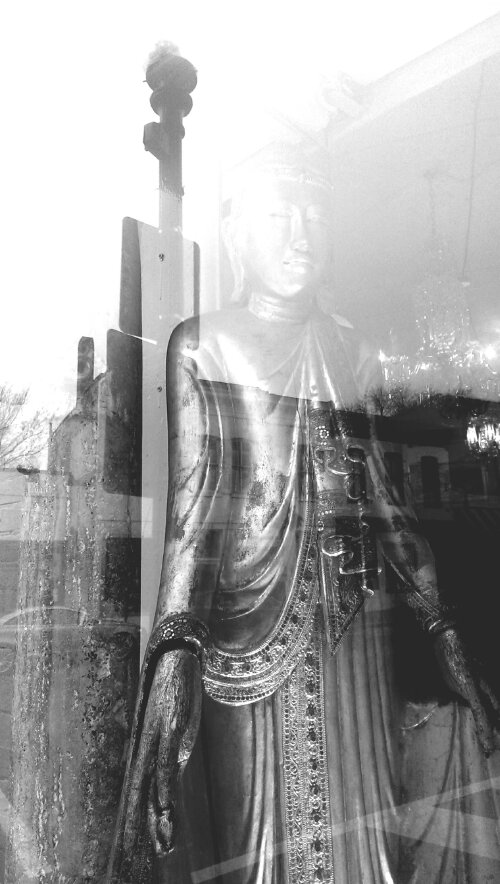
On the Way to Work (Reminder of the Importance of Citizen Engagement)


Peace and light, E — Posted with WordPress for BlackBerry.
Last night I was thinking about what that phrase means. I was talking with a friend who has a similar enthusiasm for studying, practicing, and teaching yoga, who also has a full-time job/career. At some point in describing the number of hours I have spent studying with John Friend and other Anusara teachers, it came out of my mouth that I have been able to pursue this passionate engagement with yoga because, as others have said to me, “I don’t have a life.” My friend, being in the same society after all, initially went right along with that statement as if it was a perfectly reasonable thing to say.
Then we started questioning it. It is not as though we do not both have rich, full, engaged, active lives. How did the vernacular come up with a phrase that says we do not “have a life,” if we are not so occupied with the things that society would have us do (for the “modern” woman I think this means high-powered career, husband, children, nice house) that we have enough time and flexibility to deeply pursue and explore beyond what we are supposed to do?
Vinyasa krama — the art or essence of sequencing is meant to help us align in space and time, so that we experience being and practice in the most optimal way. Last time I was with John Friend, he gave as a homework assignment, writing down Anusara sequencing principles. What I found wonderful about thinking this through, was it was not just about how to sequence a practice to reach a particular apex pose (though that is an important aspect of designing a class or practice). Here’s the list I came up with (not in any particular order and I am sure I’ve left some out):
First principle (open to grace always comes first)
Attitude, alignment, action
Open to grace, muscular energy, inner spiral, outer spiral, organic energy
Set the foundation of the pose first (for teaching and observing this also applies to looking to the foundation first)
Breath leads the way
Stabilize the periphery, move from the core
Root to rise
Major principles before applying refinements (i.e., open to grace, ME, IS, OS, OE before loops)
Sensitivity, stability, adjustment (for hands on/therapeutic adjustments)
Curvature before length (spinal alignment)
Shins in, thighs out
Initiate actions from the back body
I could blog about these for weeks and how, although they are simply articulated physical alignment principles, they would apply to actions off of the mat.