Christmas Eve Walkabout (and Satcitananda)

I left the house this morning around 7:30 to go up and teach my regular classes at Willow Street, Takoma Park. In the afternoon, I led a restorative workshop. It was delightful to be with two dozen yogis who decided the best way to spend the last Saturday in July was to take a mini-break from the heat and the bustle resting deeply and exploring inside. I felt wonderfully supported, having had amazing assistants, an excellent work-study helping at the desk and with clean-up afterward, and truly enthusiastic students. I could not have asked for more, especially given how long a day it was following an intense return to work immediately upon traveling back from the retreat with Paul Muller-Ortega all in the same week. After the workshop, I went out for an early dinner at Woodlands (Indian food) with a friend who had taken the workshop.
When I got home, feeling ready to do my own deep relaxation, I found tall ladders leading up to the roof. I had been warned by the project manager for the solar panel installation that I am having done that the roofer who was working on putting up the parapet structure to hold the frame might be here today. I hadn’t expected the roofer to be here at 7:30 pm, though. As long a week and day as I might have felt that I had, these guys, whom I am sure worked hard outside all week in the heat, were really having a long day.
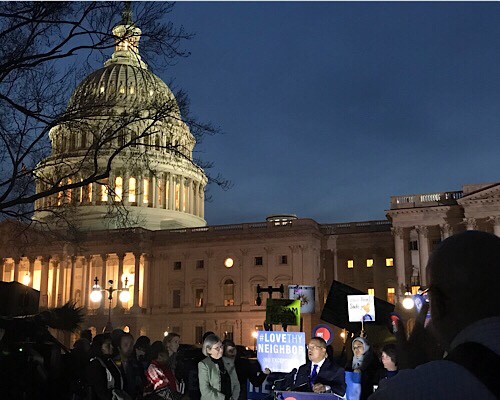
After work and before going to an evening asana class, I joined in at the People’s Filibuster on the looming tax bill. Speaking were a mixture of dedicated elected officials and people of the cloth. Several of the latter were arrested today for reading the Bible out loud inside the Capitol–perhaps because instead of reading the passages that support ill treatment of women and those who don’t follow a traditional heterosexual mold, they were reading the passages about how Christ advocated treating the poor and the sick.
The crowd chanted “kill the bill” and “not one penny,” but it had the resonance of gospel or kirtan.
Have you called your elected officials (or sent a postcard)? Do you have friends or family you can get out to vote? How are you going to use your voice to further spirit?
I formally took leave today.
First, I went to a dance practice led by Margot Greenlee (BodyWise Dance), which was a lab for exploring techniques to enable those of a wide range of mental and physical capacities to express themselves through movement. Very inspiring.
In between dancing and going to the Phillips Collection to see The Warmth of Other Suns: Stories of Global Displacement exhibit, I paused on the grounds of the Capitol and gave witness to the climate strikers.
I meditated on the bus.

Dear Friends,
I hope those of you who are local were able to get out and enjoy the unseasonable warmth and the badly needed rain. After work, I took a most delightful walk in the rain on my way to get a massage. It was still pleasant after the session, but the wind had picked up, and the temperature was falling. I write this as I am getting ready to go into my yoga studio for a long, deep, full restorative practice.
And what better time could there be to relish restorative yoga than when we are seeking to remember the promise of spring while still enjoying the coziness of winter? There is still room tomorrow (Saturday, February 25th) in the workshop at Willow Street:
Finding the Warmth Inside: Relax Into Optimal Alignment with Anusara Restoratives: After a little gentle stretching and self-massage to bring awareness to the breath and body, we will enjoy the exquisite application of Anusara’s Universal Principles of Alignment to restful and supported restorative postures to release old patterns and invite in the new to find greater ease of body and mind. A great workshop and practice for all levels.
Peace and light,
Elizabeth
Quaker, George Fox famously called people to “walk cheerfully over the world, answering that of God in everyone.”
I have been thinking about that in the context of joy as part of the resistance. One might also think about it in the context of “right action” in the Bhagavad Gita.
It’s not just enjoying oneself however one might or having fun.
It’s finding and expressing joy in kindness, generosity, community care.
I wake each morning thinking not just how I can fight, but how can can spread comfort and safety so that those who are being threatened have some room to cheerful themselves.

To be empowered is not the same as being in power over others.