Similar Posts

  • | | | |

    Haiku About An Assignment

    I’m attending via the Internet a year-long series of lectures through the Upaya Zen Center about Socially Engaged Buddhism. On the honor system (the program consists only of watching zoom or YouTube lectures and a Facebook forum with no interaction with any leading the program other than group emails), as part of the year, we are supposed to have a “social engagement” project informed by Buddhist principles of right living.

    Social engagement as an intrinsic element of spiritual practice/observation seems completely consistent with the principle of Quaker practice I was raised with —that of putting one’s faith and recognition that there is good in every being—into how one lives and works. It also resonates with my understanding of the yoga practice of seva (“selfless” service), which I have tried to make a consistent part of my personal yoga sadhana.

    After much intentional and spaciously open contemplation of this exhortation to have a project, and in response to my listening to the lectures and the questions and observations of others listening to the the program, I came to the conclusion that, actually, I could not take on another thing without it being toxic to myself.

    In fact, after 30 committed years, I’ve given notice of my intent to retire from the Federal civil service at the end of the year. I am also doing less volunteer work than I had been prior to the pandemic. For the rest of the year, I am continuing my concerted efforts to share my experience and knowledge to make sure my co-workers are prepared to take on the responsibilities for the complex project that has been largely my responsibility to lead and coordinate for over a decade. That, along with what it is taking for a mindful emergence from pre-vaccine pandemic living, is taking all the energy I can give and still be healthy.

    I continue to budget to make reparations, to speak out, and make other consistent offerings, but am at last releasing the need for measurable accomplishments, rather than feeling compelled to find or produce more.

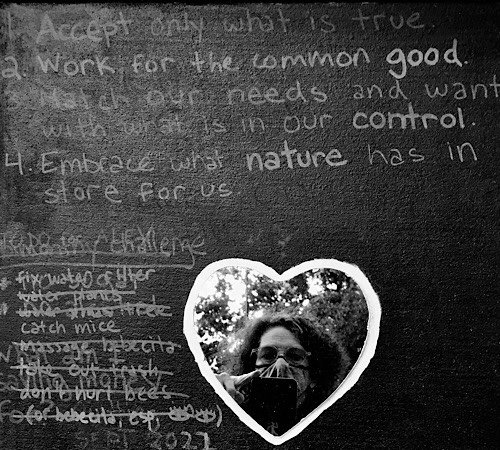
    As saying that I am doing what I have already been doing has not seemed sufficiently responsive, and after these months of trying to articulate what I mean in a way that would not sound dismissive of the task, I wrote this haiku:

    This is my project:

    Be kinder to myself and

    Also to others.

    PS It is, I am sure, just a coincidence that it is Bastille Day.

    PPS Get out the vote!

  • | | |

    My Own Personal Cloud (and the Malas)

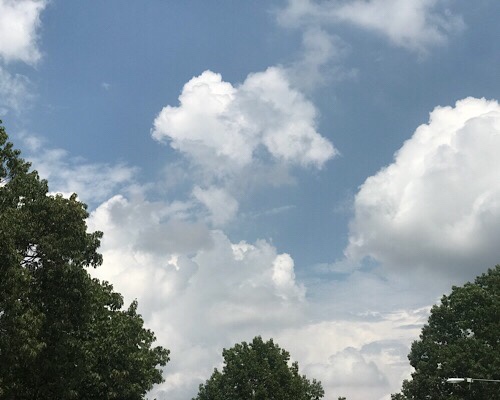
    Last night another storm front passed us by with only a trace of rain, leaving us deeper in drought.  The wind picked up, the temperature dropped, and the clouds scattered, leaving the sky scrubbed bright blue and the air fresh.  Though this morning on my walk to work there was hardly a cloud in the sky, a rather menacing gray cloud hovered directly over the building where I work.  Observing this odd cloud led me to ponder about how I often feel that I have my own personal cloud–everyone else has purpose in their lives and is worthy of love, but not me (this is a bit of an exaggeration, but you get the idea).

    The reality is that all of us get such feelings to a greater or lesser degree some of the time.  It can be a helpful step in clearing away feelings of unworthiness to remember that it is part of the human condition.  The tantric yogis say that there are three cloaks or malas (anava mala, mayiya mala, and karma mala) that result from the manifestation of diversity from the pure universal out of its own play.  The sense of unworthiness we sometimes feel (anava mala) comes from forgetting that we are spirit, and anava mala– in whatever form it appears to manifest–is just because of the loneliness of not remembering our true self.  When we experience or create conflict or unhappiness out of the illusion (maya) that separateness and distinction are the only state of all that is real then we are in thrall to mayiya mala.  When we think we are completely in charge and responsible for everything we do and how it impacts the world, that is karma mala at work.

    We practice to pierce through the clouding of our individual consciousness by the malas.  By inviting ourselves to open to the luminous space of consciousness and to surrender to the very fullness of our being, we reduce the impact of the malas on how we conduct our lives.  Our practice helps us to remember our worthiness so that we can be happier and freer and do our work and engage in our relationships with more love and light.  It helps us remember the light in each being so we are naturally drawn to respond with more compassion and friendliness to everything on the planet.  The grace of dissolving  kriya mala is that when it is not obscuring our vision, we can engage fully on our path, but still accept that we are ultimately not in charge and do not know what the universe truly has in store.

  • | | | |

    Found Exhortation (and the Women’s March on Washington)

    I was volunteering today at William Penn House, which was providing a comfort station for marchers during the day, as well as being full to capacity with guests.

    I was doing some work in the office when a woman who looked about my age came who was in town with a group of women from Long Island for the March.

    She came in to William Penn House for a bathroom, not because of any connection to Quakers or the house. But while she was waiting in line for the bathroom she ended up in conversation with the executive director, who said that the board member volunteering downstairs was also from Long Island–perhaps she knew me. It turns out that we went to the same elementary school and lived near enough to each other that we rode the same school bus.

    It is just one of the reminders I’ve had this weekend of how connected we are.

Leave a Reply

Your email address will not be published. Required fields are marked *

This site uses Akismet to reduce spam. Learn how your comment data is processed.