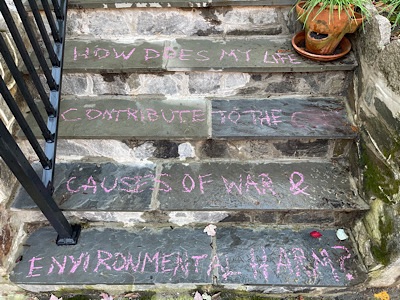
On the Way to William Penn House for Tuesday Night Yoga Practice

Last week, I used as a theme sukha — ease, comfort, happiness. I was inspired by Lorin Roche’s discussion of translating in his “version” of the Vijnana Bhairava, which he entitles “The Radiance Sutras.” In it he notes that “[e]ven more literally, sukha is (according to some etymologies) composed of su, good + kha, space. A good space.” At first blush, teaching about sukha might seem to be off-topic from my session theme of sequencing principles. The whole purpose, though, of seeking to understand, practice, and optimize our sequencing in time and space on and off the mat is to find just that. It is to be in a “good space,” to feel at ease, whether we are being challenged or delighted.
I found myself contemplating sukha yet further this week (it is a recurring practice and contemplation theme for me — I love Patanjali’s sutra “sthiram sukham asanam”), as I have been observing and helping the foster cats make mine their new home. When we are uprooted or out of alignment, we are not in a good space. It is a struggle to feel happy or at ease. When we find our rhythm again, then ease unfolds.
There is a set of principles that generally works for taking uprooted animals (or people) and helping them feel at home. Part of making them at home is their new person holding him/herself in a “good space” for the newcomers, which indeed helps them find their own, which is its own yoga.
The blessing of yoga for us, and why we take ourselves to challenging difficult places on the mat, is so that we can, by use of intelligent sequencing of practices, techniques, and mindsets, discover how to feel connected to our own spirit wherever we are in time and space — the essence of ease in this body and mind. The more we can do this for ourselves, the more we can do it for others.
This morning, when I was walking to work, a young mother stood on the sidewalk talking with a friend. Her daughter, who was perhaps a little over a year and new to walking, lit up with a huge smile when I came within range. She dropped her mother’s hand and ran over to me, holding out a flower petal. That her hand was slightly grubby and the petal crumpled only made it more adorable.
Nearly eleven hours later, as I get ready to leave the office and head up to Takoma to teach a restorative yoga class, I find myself recalling the offering, with such innocence and joy, of the flower petal.
What we want to do with our practice and teaching is to have it be, at least on one level, such a spontaneous, delighted, and innocent offering that any perceived obstructions or interference with a sense of grace (such as a long hard work-day and attendant fatigue) dissolve. We can melt into the knowledge that practicing and making offering is just the right thing to bring us back to our own fullness (purna).
What we choose as the particulars of the practice, of course, will be tempered by our physical and mental condition.
Peace and light, E — Posted with WordPress for BlackBerry.

My goal is a harmoniously engaged mind, not an empty mind (which is the goal of many yoga/meditation traditions). But if it is an emptying to allow a natural replenishment, that’s another conversation.