Similar Posts

  • | | |

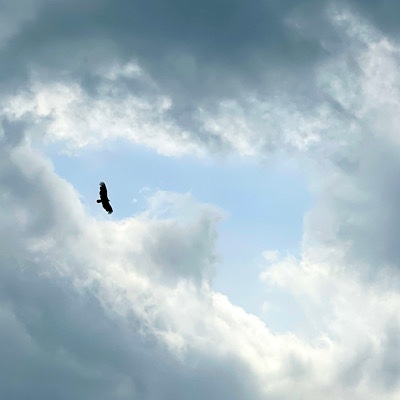
    Probably a Cooper’s Hawk

    “Wow!” exclaimed the well-dressed woman who was walking towards the Senate office buildings as I was walking in the opposite direction to the DOL through the park on the North side of the Capitol. We had both paused absolutely still to appreciate the drama of the moment.

    A raptor flew in and landed on one of the high tree branches. There were a few warning chirps and calls and then everything froze into stillness and silence. After a few minutes the bird flew off, and gradually the squirrels, sparrows, starlings, etc resumed their usual morning activities.

    “Did you notice how every thing became still?” I replied.

    “Yes,” said my companion in the moment of appreciation and observation. “It hardly seemed real.”

    We then moved on to go about our business, becoming conscious again of the noise of the city as the small animals and birds went back to their usual activities.

    I looked it up when I got to work. It was most likely an immature Cooper’s hawk.

    I did not even think to photograph the moment lest I disturb it. These are the trees after the fact.

    Peace and light, E — Posted with WordPress for BlackBerry.

  • | | | |

    “Remember Thich Nhat Hanh”

    My boss with whom I’ve worked for over 20 years and who has an unfortunate tendency to get agitated (gentle understatement here) at the workplace has just discovered Thich Nhat Hanh.  My boss was intrigued by Thich Nhat Hanh’s suggestion that when you find yourself getting angry, “don’t.”  Knowing that he is still going to have to take action in response to the things that tick him off (and, as I would add, that not getting angry is distinct from disengaging, failing to act, or being apathetic), my boss still invited us to say to him when we see him getting worked up, “remember Thich Nhat Hanh.”   I liked that.  I like that he recognizes a need to change and grow and is starting to take steps after years of appearing not to be aware of the impact of his tendencies on himself and his co-workers.

    One of the best ways I know to shift our reactiveness is to develop a steady meditation practice.  If you don’t already have one, I invite you to begin to develop a daily meditation practice, which could include conscious breathing or visualizations.  If your practice is only sporadic, notice how much better it is when your meditation is part of your daily routine.

  • | |

    Another Encroachment on Individual Liberties (and Arjuna’s dilemma)

    When I was waiting for the metro to go to Willow Street Yoga this Saturday morning to offer a free gentle/therapeutics class (new session starts for the class next Saturday, January 15th–all welcome), I heard a very disturbing announcement on Metro.  I only take Metro once or twice a week.  I am pretty certain I would have noticed it if I had heard it before; in rush hour, of course, it is hard to hear the announcements when the platforms are full.  What I heard was this:  “Metro police have advised that all passengers are subject to random searches of their carry ons.”  A reasonable person might want to know what is a “carry on” for these purposes.  My first question to myself was “don’t random searches of this type violate the Constitution?”  (Yes, the American Civil Liberties Union is actively engaged in the issue).

    I find random searches just for boarding the metro with a carry on an unfortunately not particularly shocking example of how far we have allowed the “war on terror” to be waged against all of us.  Perhaps there are readers of this blog who are not shocked or perhaps believe that these searches are warranted; I am open to listening to why.  I know that it was not front page news, and my friends have not been talking about it.  This was just another one of those awful things we have started taking for granted, which is something that I hope is getting progressively harder to do.

    My biggest question for myself was what I would do if the police asked to search my handbag.  The odds are slim to none that “random” would in practice include a reasonably well-dressed, clean, small, middle-aged, middle class, fairly evidently American-born, white woman.  But what if random was really random and I happened to be in the wrong place at the wrong time?  Would I refuse to let my bag be searched on principle?  Would I be willing to lose my job and possibly go to jail for my conviction that such a practice misses the mark completely for its intended purposes and tears at the very fabric of a free society and our individual liberties?  I find that I do not know the answer.  Partly it is attachment to my own security.  Partly it is that I do not know whether it would be better just to allow my bag to be searched and not engender conflict than to engage in conflict that will certainly harm me, severely limit my ability to give financial support for important fights and causes, and potentially could harm others around me, even if ultimately, with the help of many I am sure, I were to be a participant in reason prevailing and the practice ceasing.

    In thinking about how unsure I was of my ability to act if I were to be put to the test, I was reminded of the situation at the beginning of the Bhagavad Gita, where Arjuna is paralyzed by inability to act in the face of the hideous spector of violent death and destruction that would result from going to battle even to rectify an injustice.  Arjuna looks out on the battlefield where battle is enjoined because of the injustices that have been done (we’ll leave it for another day as to whether the violations of law in the Mahabharata are ones that a modern thinker might agree should give rise to the epic battle in the Bhagavad Gita.)  Krishna explains to Arjuna that it is his dharma to go to battle; he is a warrior and these wrongs must be rectified.  The general day to day principle that governs the life of a yogi — ahimsa or non-harming — is trumped by the greater need to rectify the societal injustice.  Arjuna must join in battle because leaving the injustice uncorrected will in result in greater harm to the order of society, even the cosmological order itself.  See Stephen Phillips, “Yoga, Karma, and Rebirth” (discussing the interrelationship between the individual practice of ahimsa and the need for cosmological order in Indian philosophy).

    I am not likely to be put to the test here, but that is part of the evil of the practice.  What can I do?  What should I be doing in the face of a direction in society that gives rise to policies like these and the gunning in Arizona yesterday?  It takes great discrimination (viveka), more perhaps than I have, to know how and when to act.  I do know that it is not right for me as a citizen or a yogi to stand aside.  I offer this very public statement of my beliefs and I gave a generous donation to the ACLU yesterday.  I am sure that is not enough, but it is a start.  As our society moves in the direction it is moving, more and more of us must contemplate, evaluate, and begin to expand how we act and participate to see a world where ahimsa is not just personal, but all persons and beings have the possibility of being free from suffering.

  • | | | |

    Yoga Around Town

    I went to an in person yoga class today for the first time since before the pandemic started. I was alone in choosing to mask and distance—but the ventilation was good. I really enjoyed being there. In conversation after, a couple of people whom I have missed seeing quietly volunteered to me that they were fully vaccinated. I appreciated that.

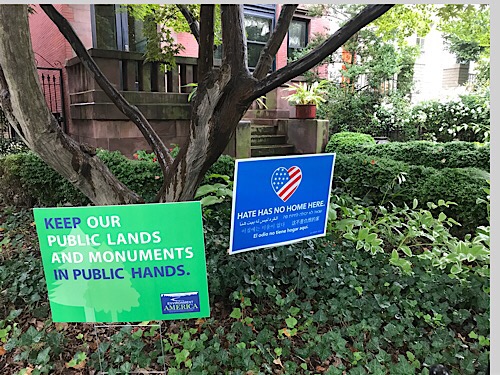
    I passed this on my walk to practice.

Leave a Reply

Your email address will not be published. Required fields are marked *

This site uses Akismet to reduce spam. Learn how your comment data is processed.