Shadow and Light
I’ve heard people say the brighter the light, the darker the shadow, but never the darker the shadow, the brighter the light. Curious. May more light shine in what is too much darkness.
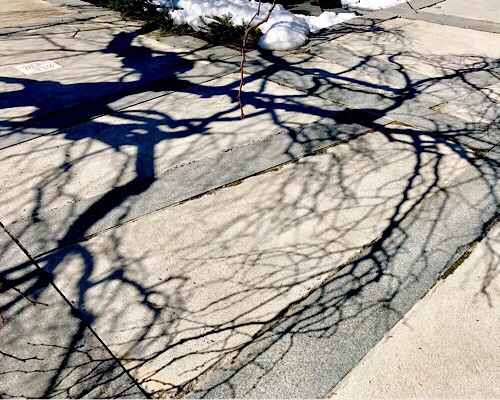
I’ve heard people say the brighter the light, the darker the shadow, but never the darker the shadow, the brighter the light. Curious. May more light shine in what is too much darkness.

Peace and light, E — Posted with WordPress for BlackBerry.
Last night, I took some lovely photos in the rain when I was walking to get a massage (it is pretty awesome to get a massage on a Monday night; try it sometime and see how it changes your perspective on the work week). After I came home and had dinner, I resisted the temptation to curl up on the sofa with a book. Instead, I got on the computer to take care of email correspondence that had accumulated over the day and the weekend while I was at the workshop with John Friend. I uploaded the photos from my walk and tried to post an entry. I got a message when I was in WordPress saying that the photo upload had failed. I exited from that screen and tried to access the file uploader. I could not get in. I then exited the prompt that I had failed. It would not let me cancel. Next, I exited the admin portion of my blog. The computer was not happy about that, but eventually it seemed to close the program. After that, I could not get back either to my public page nor to the admin page. I tried several times, but to no avail. I sent an email to my website designer–could she get in?
I woke to an email from my website designer saying no problems for her. After I did my morning practice and before heading into the office, I tried again. On my home computer, no access at all to either the public or administrative portions of the site. I reloaded Firefox. That did not do the trick. I scanned my computer, but it showed no errors. I have access to the blog from my Blackberry, my office computer, and my IPad, but not from my home computer–my central place, the place where all my files and photos and bookmarks and maximum computer capabilities are one.
As Alice (in Wonderland) would say, “curiouser and curiouser.” I am sure with research and trying lots of alternatives, we will find a solution to this peculiar glitch.
I think staying fully connected to the ultimate loving ground of our being can feel like this strange denial of access to my blog. We get glimpses. We have studied enough to know what it is on an intellectual basis. We feel connected when we are at a big workshop (or sometimes it looks like every one else has found the bliss and we are the only ones who are not tapping in–note to self, usually that’s not true) or are in class or practicing, but not when we get challenged by daily life.
Two things serve to bring us back to center–the first is to keep practicing and making the effort, just as expanding knowledge and trying different strategies will get me back my full blog access; the second is grace (and being open to receive it). And when grace comes, we then need to keep practicing so that we stay connected and can live in and from grace more and more of the time and remember and reconnect more easily when we get disconnected.

Peace and light, E — Posted with WordPress for BlackBerry.
When I was eight or nine, a teacher asked everyone in my class to say what they wanted to be when they grew up. The other children named the various jobs or professions that appealed to them at the time. I responded that I wanted to be independently wealthy. At that age, I was expressing something I already knew from family issues. Though I did not have the words for it or a clear understanding, what I was saying was not just false precocity. I knew at a basic level what is taught in yoga: I would need enough material support (ardha) to follow my heart in love (kama) and work (dharma); then my life could be free (moksha).
When I was 22 and visiting my friend Dan, he asked me what I really wanted to do with my life. We had just graduated from college. Dan was working for a sculptor who was a professor in the art department; I had just moved back to New York, had just gotten over a failed attempt to serve as an office manager for an off-off Broadway theater, was in a place of deep emotional and financial struggle, and was trying to determine what work and corresponding further education I wanted. “I want to be content,” I said. “That’s too passive,” he replied. “No, that’s not what I mean,” I tried to explain. “For me being content being satisfied and engaged with my work and life, but still working hard and having goals. It’s not just hanging out.” I had all sorts of things that I found interesting and possibilities for a life path, but I didn’t have one specific career or life plan that I was certain would be more fulfilling than any of the others. They just would have satisfied me in different ways. Because of the dilemma of too many choices, I wanted to be able happy with whatever choice I made, even if it seemed like a compromise. I was conscious that once I picked, because of the inherent limitations of time and space, that I would either have to be content with my choice or be unhappy. I have since learned to think of contentment (samtosha), which is one of the niyamas of the path of yoga expounded by Patanjali, as a practice rather than a goal (and it is a very important and continuing practice for me). Contentment is not an end, as I had thought when I was 22; it is just one part of the path to a goal of living liberated (jivanmukti), experiencing self as spirit in all that one does.
On a recent telephone seminar, Paul Muller-Ortega, my meditation and philosophy teacher, in the midst of a broad dialogue regarding various studies and practices, spoke a little of ecstatic serenity. Memories of the discussions I had had long ago about what I wanted welled up in the forefront of my thoughts. In thinking about what is my intention now, especially with regard to my practice (sadhana), I witnessed my previously stated intentions as just stages on the path to this discovery. As soon as I heard Paul say the phrase, I thought, “that’s what I want; I want to be ecstatically serene.” I seek to be always in some part of my conscious being still and peaceful, while simultaneously being passionately engaged in what life brings to me and I bring to life.