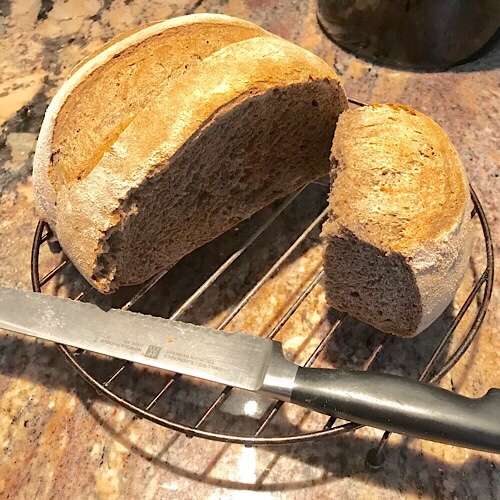
French Country Sourdough Multigrain (wheat, spelt, buckwheat)


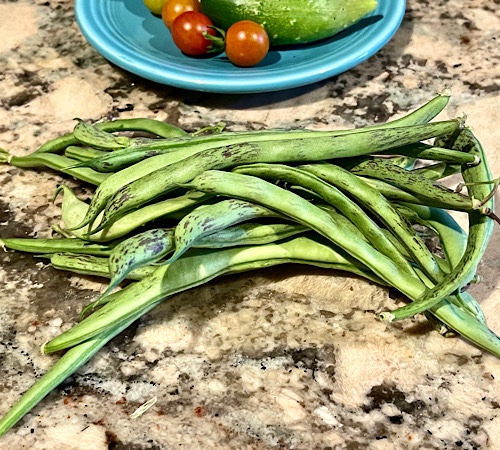
turkey mole; butternut squash and Brussels sprouts roasted with rosemary and garlic, buttered whole grains (rice, wild rice, millet, green wheat); beans from the garden flavored with bay, celery, and epazote; cranberry sauce with orange and cardamom; fresh garden herbs, greens, and flowers
Yesterday I celebrated the bounty of Thanksgiving with my friend Pat and her children, which was just delightful. The food was bounteous and delicious, but not to the point of groaning excess. While I was at the yoga fundraiser in Takoma Park, Pat and the children were cooking.
Jonathan, who is eight, made the cranberry sauce. Being the superb cook that she is, Pat said it’s just the recipe on the back of the bag (one bag cranberries, one cup sugar, one cup water, cook until the cranberries are split and liquid starts to gel), except that she replaced the water with apple juice, replaced the sugar with brown sugar and halved the amount, added currents (nice touch), and then put in orange rind, cinnamon, all spice, cloves, and powdered ginger. Only a true cook would think that is just the recipe on the back of the bag, but I know what she means. As long as the proportions are right you can vary anything to taste. The addition of the dried fruits and spices were just right for the latin-influenced cooking of the rest of the meal.
Rebecca made the mashed potatoes, which we had because she wanted them. They are amazing, they are miraculous, she claimed, mashed potatoes. All you do is mash them and then they are amazing. Ordinary potatoes completely transformed, just by mashing them. Rebecca also offered grace, giving thanks for “food, family, friends, and just for being alive.” Simply said from the heart; no more needed to be said.
I was sent home with the leftover vegetarian rice and peas, which Pat had specially prepared for me to honor my preference to eat vegetarian. As is traditional in her family, I brought home the leftovers with the understanding that when I returned the container, it would have within it a food offering in return.
Pat did cook a turkey as part of the meal. When we were cleaning up (I was carving the rest of the turkey to store for future meals), I asked Pat whether she would be making stock with the turkey bones, so I would know the best way of carving. She said she did not have time, so though I am mostly vegetarian, I took the bones to make stock. I had, then, the leftovers one would never have if you’ve long since stopped roasting birds, and Pat felt more content knowing that we would be using all of the bird that fed us.
Today, when I am home cleaning and cooking and enjoying a precious vacation day, I will make turkey stock. With the blessing of these particular leftovers, I can make what would be traditional to a Thanksgiving meal that I would have cooked: roast winter squash and stuffing (using the turkey stock, the remains of a loaf of bread I baked last week, dried mushroom, and celery). My delicious meal of stuffed roasted squash, will be enhanced by the lingering (not leftover) energy of the friends with whom I shared a delightful meal and the knowledge (that by minimizing what goes uneaten) that we are eating in a more sustainable manner) [yes, it’s all about balance; my vegan friends would no doubt be compelled to remind me that eating vegan would have been more sustainable].
Many thanks to Pat and her family for welcoming me and for sharing.
“It will make you both laugh and cry,” said Josh, who is a long-time neighbor and the proprietor of the newly re-opened West End Cinema, which is currently showing The Kings of Pastry. “I don’t think I will be crying just because a sugar sculpture breaks,” I responded with some skepticism. “Let me know afterward,” he said, and there the conversation ended. I needed to get seated, and he needed to help the next movie-goer.
What I found loveliest about the film — besides getting to surrender to the delicious sensation of being completely awed by the extraordinary technique exhibited — was that there was no competition in the sense of there being “winners” or “losers.” All of the finalists — I don’t think that this is a spoiler — could achieve the designation of “master” if they demonstrate their virtuosity as pastry chefs within a short period of time under intense scrutiny.
The movie, in revealing a little of what it can mean to have the talent, passion, and single-mindedness to seek to be a master of a craft, a livelihood, an art, invited me to reflect on when I have been tested and when I have wanted a certain achievement marked by an outer designation. Undergraduate and law school were highly competitive; by being ranked, excellence seemed to be prized not as much for how it would enable the students ultimately to be better able to serve society and themselves upon having developed a certain required level of mastery, but more for creating a ranking within that segment of society. The dance world, for me, also felt strongly competitive. With injuries early on and having developed the “wrong” body, I could not rise to the competition.
The support, encouragement, and mentoring of the pastry chefs in The Kings of Pastry — although clearly only a select few were finalists — highlighted for me what it can mean to strive for excellence without having it be structured by win-lose/pass-fail competition; it only makes the world of pastry better if more of the pastry chefs are true masters. In this regard, watching the movie led me to think about what it was like to work for Anusara yoga teacher certification in contrast to my earlier education. When I was working for my Anusara certification, the standards for achievement of the “goal” were still very high, but it was not about winning/losing or achieving/failing. It was a period of intense study, practice, learning, and humbling experiences. On being certified, I knew that the efforts to be certified were just the beginning. Part of the reason for being so deeply challenged to be certified, to meet the level of initiation (in Sanskrit diksha), was to see if we would continue studying and practicing at that rate out of love and deep commitment. It took going through the process and addressing all the old emotions and patterns of reaction and response that came up in the context of being tested to help me to start fully appreciating the difference between being in a competition and seeking the best we can be for ourselves and for others in our work and study. When I started to have a lived appreciation for the distinction it carried through to all aspects of my relationships in life.
Without answering them, The Kings of Pastry opened for our own contemplation the questions of what does striving for excellence or mastery mean for the one on the path and for those on the path with him or her? How does coming face to face with an obstacle when being tested or finding out that one has or has not received the public recognition impact the rest of one’s life, one’s sense of self-worth, and one’s relationships with family and friends? It was an sweet act of film-making to bring these questions to the viewer’s awareness in a way that is completely engaging and endearing.
Yes, Josh, I got a little teary-eyed towards the end.
By order, I mean how things are arranged in space or time. Even chaos theory presumes order in that sense. On and off the mat, there is a certain order to things that is optimal. We do not plant seeds and then till the soil. Or think of the difference between peeling and chopping vegetables and then cooking them or cooking them and then peeling and chopping them. One or the other is not necessarily wrong if you do not have a specific dish in mind, but which you choose will dictate the results. Once you have gotten started in the sequence, though, the path shifts and is partly set. To reach an exquisite rather than a disgusting result, the next steps are ordered by the initial choice.
If only one musician is playing a single note, then there is no possibility of discordance. Add more musicians and more notes and who plays what notes when can mean cacophony, a catchy tune, or an extraordinary and ecstatic work of art. None of us are alone and none of us are playing just a single note, so in the great fabric of our being, it is best to understand how to make music.
Sequencing on the mat is more subtle than what poses should be done in what order in a particular practice to emphasize backbends v. forward bends and twists to be able to do the strongest poses with the least possibility of injury, as important as that is. The order in which we apply the Anusara principles not only aligns the physical body, but brings symmetry to the physical and energetic bodies, helping us to feel more in harmony in everything we do on and off the mat. I am, in this, a decent musician and not Bach, but the more I pay attention to the optimal sequence of things (keeping in mind that over most things we have no control as to when, whether, and how they happen) and the more I learn and appreciate the exquisiteness of order, the more I feel, understand, and experience the subtleties and joys of harmony.
I have a small tree in a pot; it will never grow large enough to fruit with exuberant superabundance. I will have a few precious opportunities to taste a sun-warmed fig right from the tree. My tree will also serve as a personal barometer, telling me whether this year’s weather is optimal for figs or not so much.
Peace and light, E — Posted with WordPress for BlackBerry.