Found Poetry–Warning

to pack up my things and leave work to go to yoga class, a co-worker stopped by my office to talk. She started by asking me how I was, but I knew that was just an introduction because it was evident she needed some comfort. It turned out that she had a bad fall off of her bicycle on her way to work late last week and had gotten beaten up something fierce by the way she fell. One of the things I most respect about my co-worker is that she is someone who always looks for the good in situations and in others. I found myself giving her permission to be sad and frustrated and angry, which she appreciated. Just because things could have been worse did not diminish that she was suffering. I think that is important for all of us to remember. When we have compassion for ourselves and allow ourselves to react, it is then we can also find the good for ourselves and have compassion for others.
I did not go to class last night. It was more important to listen to my friend. But I had a good yoga lesson by allowing my friend in and a good practice when I got home.
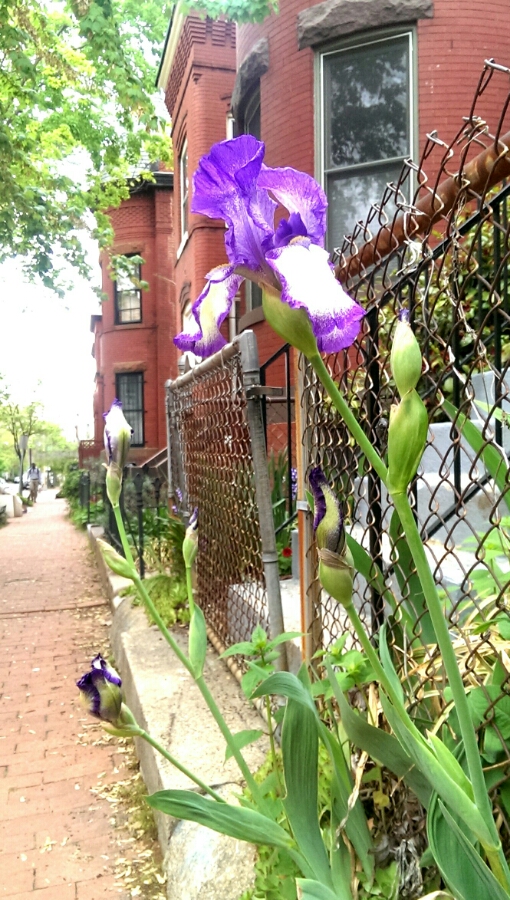
On the way to Willow Street Yoga in Takoma Park for Joe and Natalie Miller’s yoga practice to benefit Nepal.
I came out briefly to sit and contemplate and write in my journal before a staff meeting at lunch time (no lunch provided).
The Scott Burton chairs in the National Sculpture Garden are one of the more delightful places to sit outside near my office.
First, I was joined by several birds. Then some tourists came along. The one with all the jewels sat down at the direction of her friend in orange for a photo. “We’re not allowed to sit here,” the sitter said with a little glee in her voice.
I directed her to the sign near the seats giving permission. This led the photographer both to sit down with her friend, but also to lose any real interest in taking the photograph.
What was it about the loss of transgressiveness that made the photo less desirable? The chairs are the same whether permitted or not. In fact, with sitting permitted, there is more time to explore fully their function as chair as well as their form as art.
This set me wondering about how much our desires are driven by social ideas, rather than needs and comforts.
A father and his son approach the chairs fro the other direction. After reading the sign giving permission to sit, they promptly sat down. The bare statement “granite chairs,” was all that was said before they got back up and went on they’re way.

Peace and light, E — Posted with WordPress for BlackBerry.
What do you see when you look at this picture? What would you have thought if you had come upon a mass of seaweed and jelly fish, having dressed in a bathing suit for a morning plunge into the ocean while on vacation?
Both my yoga teacher John Friend and my meditation and philosophy teacher Paul Muller-Ortega teach that we want to respond in the highest, to seek always to see the good and to respond from that seeing.
I found myself thinking about this morning when I saw dozens of jelly fish on the shore and contemplating a conversation I had yesterday about the topic with a fellow student.
For some, the t-shirt adage “it’s all good” may really ring true. Most every day is naturally bubbly and bright and difficulties or a need to shift or change to find better alignment is not of much importance. I am not naturally effervescent with bliss, though I find a deep and abiding and growing joy in life that comes from a combination of discrimination (viveka) and appreciation for the wonder and complexity of life.
Some may just not notice the jelly fish and just see the sun glinting on the waves, plunging in to swim with delight, not caring much that it resulted in itching or stinging from the jelly fish. The itching and stinging are just minor irritations that wouldn’t change the joy of the day. That’s a great way to live, but not all of us are by nature that care free.
For those of us who see the jelly fish and know that swimming with them can cause potentially significant discomfort, we have two choices: we can get all bummed out that a care free swim in the ocean is not going to happen. That is not responding in the highest. We can also look at what beautiful and amazing creatures are jelly fish, look down at our feet as well as up at the ocean and the sky so that we don’t step on any (walk with discrimination), and then choose to swim in the pool.
Responding in the highest and looking for the good is not the same as being blind to pain and difficulties. It is how we choose to react and our align ourselves within a world that presents both opportunities for delight and for challenge and pain. Responding in the highest is not being oblivious to pain, but rather, choosing not to suffer or cling to disappointment in the face of inevitable pain or difficulty.