Art and Culture | Asana, Pranayama, and Yoga Practice | Food for the Mind (Yoga Philosophy, etc) | Gardening | Meditation | Photos
Statuary Around Town
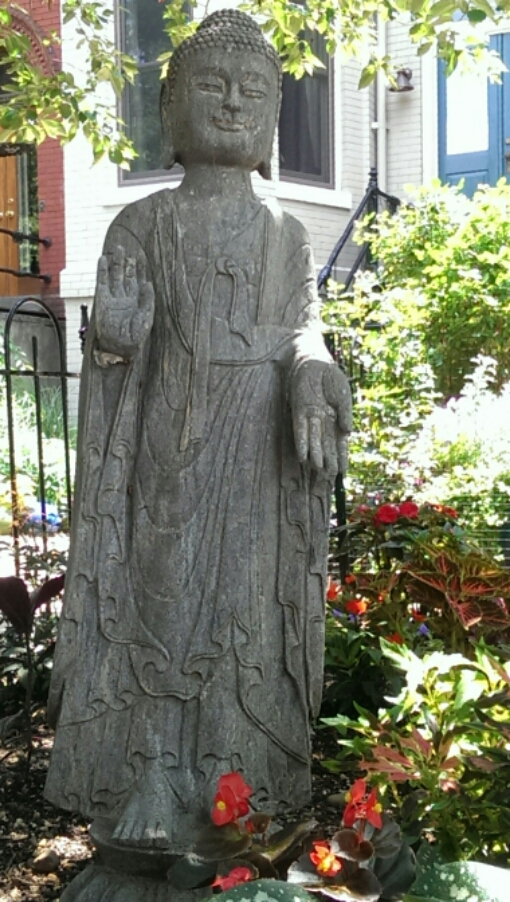
With a stop at the Tuesday Fresh Farm Market where I bought an egg carton full of figs and some white nectarines.

Peace and light, E — Posted with WordPress for BlackBerry.
I have a set of cards that I keep on my altar that are designed to be used for contemplation. There are about fifty cards, each of which has a sanskrit word and its meaning. Just as one gets a fortune cookie randomly or picks a tarot card from a deck, but the message often seems right on point, the word that arises from the card picked from the stack often seems uncannily timely. Early Saturday morning, after not having used the cards in a few months, I picked a card from the middle of the stack to see if it would help guide my contemplation and meditations as I was getting ready to say good-bye to Becky. The word on the card I picked blind from the middle of the stack was “moksha” or liberation. In classical yoga, moksha does carry with it the implication of being liberated by transcending body and mind.
Later on Saturday, when I was on my way home from teaching for the appointment with the vet, I stopped at the metaphysical supply shop for a piece of rose quartz (to use in a ritual to assist with the transition and loss that a friend taught me). At the check out were “dolphin saying cards.” There was a sign next to the cards inviting customers to take one for free. The sign also said that it was not necessary to take the one at the top. The cards were face down; I did not look for a particular saying. I dug a few cards down, and the one I selected read: “freedom has its roots within yourself.” In other words, “moksha” for the second time on this day, when I was facing with Becky her transition of the spirit from the body.
Was it a message? Was it a coincidence? I do know that I knew when it was time, as I did with Henrietta. Becky just did not want to be embodied anymore. When I held her in her arms after she stopped breathing, she was released and relaxed in a way she had not been in months. That the signs were saying “moksha” resonated with Becky’s power and connectedness. I hope that when I am ready to go, I will truly understand moksha, that I will be released. It is so resonant of Becky’s life, for all her quirks, that she was still teaching me even as she was dying.
When I was eight or nine, a teacher asked everyone in my class to say what they wanted to be when they grew up. The other children named the various jobs or professions that appealed to them at the time. I responded that I wanted to be independently wealthy. At that age, I was expressing something I already knew from family issues. Though I did not have the words for it or a clear understanding, what I was saying was not just false precocity. I knew at a basic level what is taught in yoga: I would need enough material support (ardha) to follow my heart in love (kama) and work (dharma); then my life could be free (moksha).
When I was 22 and visiting my friend Dan, he asked me what I really wanted to do with my life. We had just graduated from college. Dan was working for a sculptor who was a professor in the art department; I had just moved back to New York, had just gotten over a failed attempt to serve as an office manager for an off-off Broadway theater, was in a place of deep emotional and financial struggle, and was trying to determine what work and corresponding further education I wanted. “I want to be content,” I said. “That’s too passive,” he replied. “No, that’s not what I mean,” I tried to explain. “For me being content being satisfied and engaged with my work and life, but still working hard and having goals. It’s not just hanging out.” I had all sorts of things that I found interesting and possibilities for a life path, but I didn’t have one specific career or life plan that I was certain would be more fulfilling than any of the others. They just would have satisfied me in different ways. Because of the dilemma of too many choices, I wanted to be able happy with whatever choice I made, even if it seemed like a compromise. I was conscious that once I picked, because of the inherent limitations of time and space, that I would either have to be content with my choice or be unhappy. I have since learned to think of contentment (samtosha), which is one of the niyamas of the path of yoga expounded by Patanjali, as a practice rather than a goal (and it is a very important and continuing practice for me). Contentment is not an end, as I had thought when I was 22; it is just one part of the path to a goal of living liberated (jivanmukti), experiencing self as spirit in all that one does.
On a recent telephone seminar, Paul Muller-Ortega, my meditation and philosophy teacher, in the midst of a broad dialogue regarding various studies and practices, spoke a little of ecstatic serenity. Memories of the discussions I had had long ago about what I wanted welled up in the forefront of my thoughts. In thinking about what is my intention now, especially with regard to my practice (sadhana), I witnessed my previously stated intentions as just stages on the path to this discovery. As soon as I heard Paul say the phrase, I thought, “that’s what I want; I want to be ecstatically serene.” I seek to be always in some part of my conscious being still and peaceful, while simultaneously being passionately engaged in what life brings to me and I bring to life.