Spelt Bread Just Out of the Oven
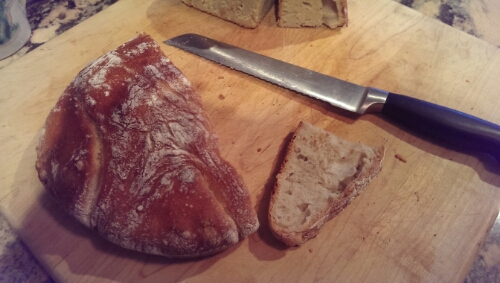
Had I not been paying attention to coming weather, I would not have been able to predict that I would likely work from home today. I then wouldn’t have had, to go with bean soup, bread that needs 24 hours to develop.
Had I not been paying attention to coming weather, I would not have been able to predict that I would likely work from home today. I then wouldn’t have had, to go with bean soup, bread that needs 24 hours to develop.
I go out when I can to be present, to let those, like the Congresspeople trying to get into the Treasury Department to ask oversight questions, who are putting their safety on the line and dedicating more energy and talent than I am capable of to saving all of us, know that they have support, are appreciated, and are not alone. And I give them money and try to amplify their voices.
Every day, I invite myself to do one more thing.
Every day presents a new challenge and opportunity to be in and for community.


The sky emptiest of moonlight, the darkness of the absent moon of mahashivratri lets the stars reveal themselves and illuminate the fullness of possibility. That it is also the first day of meteorological Spring and was the State of the Union feels like quite a confluence.
At lunchtime, I walked out to go to the bank and to pick up some pre-ordered kitchen supplies. Every time I go out, things have changed.
A regular reader of this blog commented on the consistency of my practice of taking photographs. Thinking about this practice, reminded of something I recall John Friend having said. We have a steady hatha yoga practice (asana, pranayama, meditation), for two reasons. When we’re feeling full of joy and gratitude, we practice to make offering in thanks. When we are feeling disconnected or off-balance or sad, we practice to remind ourselves of our connection in spirit. This pretty much means there is always a reason to practice.
With the photographs, sometimes the sweetest moment of my day was noticing a flower or a cloud. I practice doing so, especially when I’m feeling too caught up in the tumult. In the moment (and on reflection later when I review, select, and edit an image to share, I remember, as I do when I do my hatha yoga practice, my current well-being. Sometimes there is more about yoga practice I can say with a photograph than I could with a paragraph.
I love the tree sculptures by Roxy Paine. This one is in the Sculpture Garden on the National Mall. They are exquisitely beautiful and beautifully crafted. In addition to just appreciating their form, though, they make me think of the perils of society preferring the shiny, the seemingly permanent and indestructible, and the constructed over the breathing, shading, nourishing, life-sharing presence of real trees.

Peace and light, E — Posted with WordPress for BlackBerry.
This site uses Akismet to reduce spam. Learn how your comment data is processed.

Your spelt bread looks fantastic! I’ve been thinking about it all morning, and looked up some recipes on the internet. None look as good as yours. Yours looks like a kind of sour dough. Do you have time to give us the recipe?
My go to bread recipe is the “no knead” bread from the New York Times: http://www.nytimes.com/2006/11/08/dining/081mrex.html?_r=0. I used all spelt flour instead of bread flour. Next time I’d use a little less water or a little more flour or do a mix of what and spelt to make up for difference between spelt and wheat flours. The recipe also stands up to one third whole wheat or rye instead of all bread flour. I did an extra rise for a couple of hours, which contributed to its sourdough like characteristics.
I remember trying this recipe a few years ago. Mine turned out to be a really runny mess. Yours looks so good! I’ll add your comments to the recipe I just printed out and give it a try. First to find the flour. Maybe I’ll just order it from King Arthur Flour.