Art and Culture | Asana, Pranayama, and Yoga Practice | Community and Family | Food for the Mind (Yoga Philosophy, etc)
Found Quotation (and Seva)
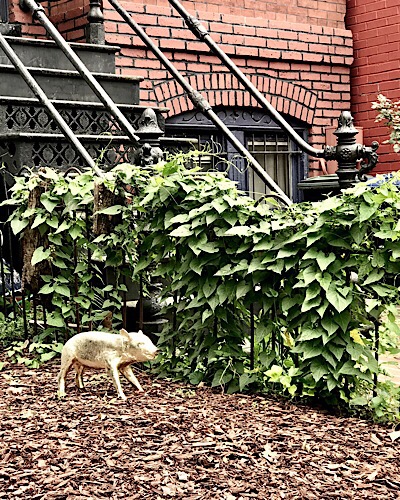
I think it highly unlikely that the neighbor who chose to decorate a front yard with a silver-painted pig and wood chips intended in any way to reference Vishnu in his incarnation as a boar. But as I’m caught up in learning about the animal chariots and incarnations of the 330 million these days, that is what came to mind for me.
There’s a story that Vishnu incarnated as a boar to kill a demon who could not be killed by man or god (similar to the story about Durga slaying Mahisha, the buffalo demon).
When in anthropomorphic form, Varaha is often seen with Bhudevi (Earth goddess) and sometimes also Lakshmi. There she is again–Lakshmi–calling to me to remind me to act from my abundance (from there comes my capacity to slay demons).
I practiced japa on my walk home from work past the Capitol. It was sweet to smell mud and the snow melting.
After sitting with Uma, I put in a load of laundry and went into the kitchen. I decided to decant (not quite the right word — perhaps uncrock?) the fennel and red cabbage sauerkraut while it still was somewhat crunchy.
Shown with the kraut is the second jar from the batch of kimchee I started right after I came back from India.
Isn’t food fun? Anyone have pairing ideas?

It still does not seem right to have daylight savings time start before the equinox. I remember it used to be the first night I cooked outside. Now it is always too cool and not quite light enough, and my morning meditation goes back to finishing before it is light. Whether it matches with the weather or my mood, though, it is here this weekend. I’ve had a much more intense work week than usual, which is resulting only partly from having been out of town for the previous week. The coming weekend promises to be very full (assuming all goes as anticipated) with teaching my own class and studying with Ross Rayburn up at Willow Street both Saturday and Sunday, trying to go out to see some friends dance Saturday night, going to the contact improv jam on Sunday, and then having dinner with neighbors.
To try and not get too off cycle by getting a socially induced equivalent of jet lag, I am starting to get ready for bed an hour early tonight and planning to get to the office before 8 tomorrow morning. Try doing the same things you would do if changing time zones. Get plenty of rest, drink lots of fluids, keep down the caffeine intake and if you really want to have caffeine, make sure you stop drinking it earlier in the day than usual; have any protein in the morning and then dine lightly on grains and vegetables in the late afternoon or early evening. Don’t eat anything heavy at night. That way you will have energy when you wake up too early and be sleepy when it is time to go to bed way before you think it is.
And most important, use the change in time as an opportunity to celebrate the respective joys of shadow and light by having extra attention brought to them whether you will it or not. It is always exciting the first night, particularly if it is warmish and bright as is in the forecast, that it stays light unnaturally late.

I was reminded the other day of a principle of reading the great Hindu philosophical work: all of the meaning of the text can be understood from not only the first sutra, but the first word. The first sutra of The Yoga Sutrasof Patanjali’s is “atha yoga anusasanam” — now begins an exposition of the practices of yoga. Implicit in the “atha,” the now, is that something else has come before. The translations I have speak of previous study and preparation; the studies offered by Patanjali are not for the novice, but for one who has already been practicing. If we read Patanjali’s first sutra with the implicit understanding that the first word contains all of the exposition to follow and that we do not need the rest of the explanation and practice if we truly understand the first word and sutra, then I think more must be meant here by “atha” than just this exposition now comes after previous study.
In this latest contemplation of mine what the word “atha” must hold within it for the practitioner, I thought about the Anusara axiom of practice “the breath leads the way,” which has been the alignment focus in my classes for the past week. What does it mean to have the breath lead the way? At its highest level, it serves to bring us back to “first principle” of “opening to grace.” (As an aside, I note that I believe can apply to the Anusara principles of alignment the same method of understanding: the principle “open to grace,” and even the first word “open” holds all of the other Anusara principles. All the other principles and axioms are explanations and methods for living “open to grace.”)
When we let the breath lead the way, we start each pose by a deep listening, an openness to something greater, an openness to the pulsation between the universal energies and our individual self. We invite the subtle energies to support us and lead us like a great dance partner. We actively surrender to the dance, while still bringing our own skill to our part of the dance, the way the partner being led in a waltz is skilled both in the dance and in being led. In letting the breath lead the way in our yoga practice, we come to the very fullness of the present moment even as we move through a sequence of asanas in time and space. Being open to grace in each moment, in each part of the pose, and allowing our self to be led by the pulsation of the breath even as we move with it, brings us to a recognition that in each moment, we are both part of the sequence of time and space and more than time and space (akrama krama). We come to the atha of samadhi. We use the practice of letting the breath lead the way to teach us to open to grace, to find the exquisite timeless fullness of being itself in order to illuminate all of our practice. If we are already in that atha, that now, then we do not need any of the other practices or explanations, but if we cannot find it on our own, then again and again, the study and practice begins now — atha — so that we can experience in our very heart the fullness (purna) of our selves and better illuminate everything we do on and off the mat with the blissfulness of that fullness.
The other day I was telling one of my regulars that I’d described the group house practice as starting with receiving darshan — receiving sacred knowledge, sitting in the presence of the divine embodied in a great being — from Uma and Sully, who wait downstairs for the students to arrive and expect a petting before everyone goes upstairs to practice.
” Is it darshan or puja [performance of ritual worship]?” my student asked. The two are intertwined. We naturally offer our gratitude and worship for those in whom we recognize the divine and from whom we learn to know the sacred.
What would our lives be like if we treated all our encounters and relationships as both darshan and puja, if we came to each person and being open to receiving a glimpse of the divine and the knowledge the divine imparts and approached each encounter as an opportunity to make puja, to formally act with reverence? The cats certainly expect it.