Untitled

The other day I was telling one of my regulars that I’d described the group house practice as starting with receiving darshan — receiving sacred knowledge, sitting in the presence of the divine embodied in a great being — from Uma and Sully, who wait downstairs for the students to arrive and expect a petting before everyone goes upstairs to practice.
” Is it darshan or puja [performance of ritual worship]?” my student asked. The two are intertwined. We naturally offer our gratitude and worship for those in whom we recognize the divine and from whom we learn to know the sacred.
What would our lives be like if we treated all our encounters and relationships as both darshan and puja, if we came to each person and being open to receiving a glimpse of the divine and the knowledge the divine imparts and approached each encounter as an opportunity to make puja, to formally act with reverence? The cats certainly expect it.


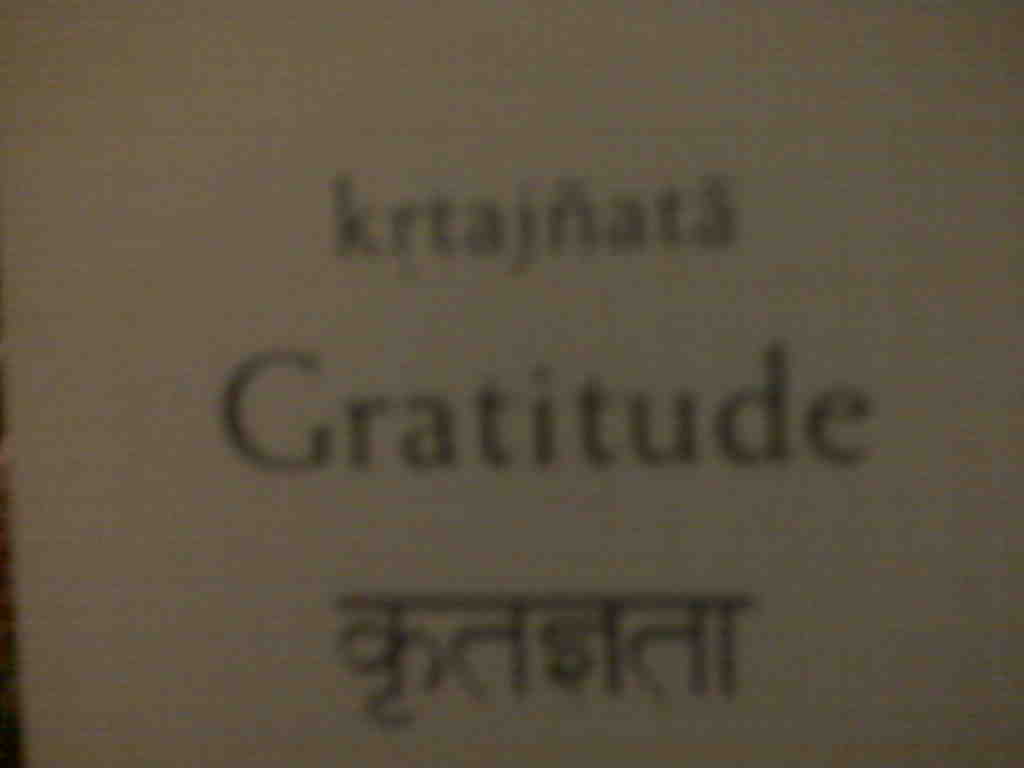
When I get the studio ready for Wednesday night yoga class, I pick a puja card. I shuffle the cards and then pick a card from somewhere in the middle of the stack. More often than not, the card is aligned in some way with the activity, thought, or emotion that is most present in body-mind. Tonight, the card that came first out of the shuffled pack was krtajnata — gratitude.
I am deeply grateful for my teachers, friends, and family–extensively overlapping categories–and wish a happy thanksgiving to all.
Peace and light, E — Posted with WordPress for BlackBerry.
This bumper sticker (on an enormous black SUV with suburban plates) is likely intended to have only a message about the current wars in which the US is engaged. I wholeheartedly support the sentiment at that level.
What if we took it at other levels? What if we applied it to spiritual-religious practices? We could interpret this as suggesting that we honor the great teachers who have gone before us, invite religious observance and spiritual practice to heal ourselves and others, and dissolve notions of differences among religions and spiritual practices as bases for conflict. How many wars between countries or civil wars would end if saw unity while still honoring difference in this regard?
Perhaps most cogent for the yogi: what if we thought of the exhortation in terms of our own personal practice? It would be an invocation to honor our ancestors, heal the wounds of our family and upbringing (samskaras), and release inner conflict. This is, I think the point of practicing (whatever the style of practice) so that true peace can abound.

Peace and light, E — Posted with WordPress for BlackBerry.