Walk to William Penn House for Tuesday Night Practice

When I was waiting for the metro to go to Willow Street Yoga this Saturday morning to offer a free gentle/therapeutics class (new session starts for the class next Saturday, January 15th–all welcome), I heard a very disturbing announcement on Metro. I only take Metro once or twice a week. I am pretty certain I would have noticed it if I had heard it before; in rush hour, of course, it is hard to hear the announcements when the platforms are full. What I heard was this: “Metro police have advised that all passengers are subject to random searches of their carry ons.” A reasonable person might want to know what is a “carry on” for these purposes. My first question to myself was “don’t random searches of this type violate the Constitution?” (Yes, the American Civil Liberties Union is actively engaged in the issue).
I find random searches just for boarding the metro with a carry on an unfortunately not particularly shocking example of how far we have allowed the “war on terror” to be waged against all of us. Perhaps there are readers of this blog who are not shocked or perhaps believe that these searches are warranted; I am open to listening to why. I know that it was not front page news, and my friends have not been talking about it. This was just another one of those awful things we have started taking for granted, which is something that I hope is getting progressively harder to do.
My biggest question for myself was what I would do if the police asked to search my handbag. The odds are slim to none that “random” would in practice include a reasonably well-dressed, clean, small, middle-aged, middle class, fairly evidently American-born, white woman. But what if random was really random and I happened to be in the wrong place at the wrong time? Would I refuse to let my bag be searched on principle? Would I be willing to lose my job and possibly go to jail for my conviction that such a practice misses the mark completely for its intended purposes and tears at the very fabric of a free society and our individual liberties? I find that I do not know the answer. Partly it is attachment to my own security. Partly it is that I do not know whether it would be better just to allow my bag to be searched and not engender conflict than to engage in conflict that will certainly harm me, severely limit my ability to give financial support for important fights and causes, and potentially could harm others around me, even if ultimately, with the help of many I am sure, I were to be a participant in reason prevailing and the practice ceasing.
In thinking about how unsure I was of my ability to act if I were to be put to the test, I was reminded of the situation at the beginning of the Bhagavad Gita, where Arjuna is paralyzed by inability to act in the face of the hideous spector of violent death and destruction that would result from going to battle even to rectify an injustice. Arjuna looks out on the battlefield where battle is enjoined because of the injustices that have been done (we’ll leave it for another day as to whether the violations of law in the Mahabharata are ones that a modern thinker might agree should give rise to the epic battle in the Bhagavad Gita.) Krishna explains to Arjuna that it is his dharma to go to battle; he is a warrior and these wrongs must be rectified. The general day to day principle that governs the life of a yogi — ahimsa or non-harming — is trumped by the greater need to rectify the societal injustice. Arjuna must join in battle because leaving the injustice uncorrected will in result in greater harm to the order of society, even the cosmological order itself. See Stephen Phillips, “Yoga, Karma, and Rebirth” (discussing the interrelationship between the individual practice of ahimsa and the need for cosmological order in Indian philosophy).
I am not likely to be put to the test here, but that is part of the evil of the practice. What can I do? What should I be doing in the face of a direction in society that gives rise to policies like these and the gunning in Arizona yesterday? It takes great discrimination (viveka), more perhaps than I have, to know how and when to act. I do know that it is not right for me as a citizen or a yogi to stand aside. I offer this very public statement of my beliefs and I gave a generous donation to the ACLU yesterday. I am sure that is not enough, but it is a start. As our society moves in the direction it is moving, more and more of us must contemplate, evaluate, and begin to expand how we act and participate to see a world where ahimsa is not just personal, but all persons and beings have the possibility of being free from suffering.
Last week I attended a work-place training entitled “Conflict Management–Dealing with Difficult Conversations in the Workplace.” I do not do much training at work; the several hours a week I spend doing professional reading generally satisfies the needs of my position. When the offer for this two-day training came into my inbox, I decided that it might be useful. I am responsible for a project that involves several different offices in multiple government agencies all of which have perceived differences in agendas and jurisdiction and real differences in expertise and personality. I am also about to get another new supervisor, and people in my division have been edgy.
The training, which had about 15 attendees even though it was the Tuesday and Wednesday before Thanksgiving started simply enough. We all identified ourselves by name and job function and where in the agency we worked and then took the Thomas-Kilmann Conflict Mode Instrument, which helps give a broad general idea of how one typically reacts in situations that involve conflict. All pretty straightforward workplace training stuff. Then the facilitator suggested that most conflict between people (and within ourselves) arises when our feelings of worthiness are or are perceived to be threatened. My ears perked up. “Anavamala,” I thought. It’s just like what the tantric philosophers teach us, that the unreal cloak of unworthiness is what leads to suffering and discord.
The workshop continued. We did some roleplaying and engaged in discussion to consider how we can better lead the best out of each other and ourselves, whatever type of negotiator we are. It was interesting to see how this fairly diverse group of workers — young, old, experienced, brand new workers of varying levels of seniority in the agency — were able to be engaged and brought together in exploring these issues, but nothing was particularly surprising. It was almost time to break for lunch on the first day, when the facilitator asked, and then let drop the question, without discussion or seeking a response, “what about love?”
“What about love, indeed?” I thought. That’s a word we do not hear in the workplace unless it is in an interview and someone claims to love their work, or it’s idle conversation and someone declares that he or she loves a sports team or a restaurant. The next morning I commented privately to the facilitator that I thought it a great question, but was not surprised, given the context, that he had not discussed it further. He said that he would bring it up more, and he did. He suggested that when we love, we are more willing to allow, respect, and listen to differences of opinion; when we love, we are also more motivated to resolve conflict in a way that serves best those with whom we are in conflict. This teaching made sense for most of the participants with regard to conflicts with friends and family, but it was harder for them to see in the context of the workplace because they did not think of love (as this society has come to classify it) as something that is part of the workplace.
How can we bring love into our non-intimate relationships (although I would argue that in some ways, the workplace is very much an intimate relationship as it so deeply relates both to our sense of purpose and to our survival)? The tantric teachings suggest that there is a universal ground to all being, one aspect of which is, in essence, love (prem). When we recognize that we are all made of the same stuff and that an aspect of the universal is love itself, then we are invited to see the unity in diversity and to respond in the highest in the face of difficulty or challenge. (Quakers similarly teach us to recognize the light or good in every being and to treat all as divine). Truly loving universally does not necessarily come naturally and can be a challenging and advanced practice , but it has been my experience that it is a practice that is worthy of all our relationships, including those in the workplace. It may be too much to ask us to like our co-workers, but seeking to recognize that they are worthy of love can go a long way to making our work day a brighter, more productive, more effective, and more compassionate place.

There are thousands of little temples — some hardly more than altars — scattered throughout both the countryside and cities here. I marvel at the artistry of some and the garishness of others.
I think, on witnessing this effulgence of creativity, of what helps me remember the everyday sacred. Mostly, I am inclined to look inward.
Needing a brightly decorated space that tells a story is so different from my Quaker upbringing.
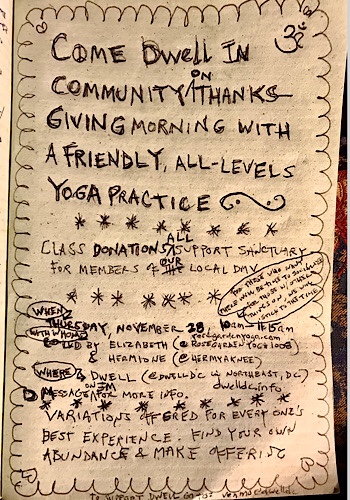
I’m delighted to advise that there will be Thanksgiving morning yoga practice. All donations will support those in need of sanctuary (sanctuarydmv.org).
Send a private message for more directions or questions about the practice.