| | |

Found Exhortation (and “Opening to Grace”)

I was contemplating today the Anusara yoga principle of “opening to grace,” one aspect of which I always understood to be seeking to pause and listen in and from a place of luminous spaciousness before acting or responding to what one does or encounters. Ideally, the intentional practice of yoga opens the possibility of doing all this simultaneously and immediately, but most of us need to reduce the speed at which we approach or take in things if we are to experience and engage the fullest and most nuanced relationship with the wild extraordinariness of what is in and around us.

If we move too quickly or push effortfully or immoderately past our limitations, we are at risk, as I have recently reminded myself in a rather clumsy way. When through our own actions or happenstance we are pushed past our healthy capacity, it is time to slow down, to pause, to reflect, to reinvite and reexplore the basics and seek a deeper level of understanding and capability if we are to expand our capacity to live with grace.

Peace and light, E — Posted with WordPress for BlackBerry.

Similar Posts

  • | | |

    What is “really” yoga?

    Gopi Krishna, in this book The Awakening of Kundalini, writes:  “Yoga exercises can also be directed toward worldly objectives.  There are exercises that are conducive to the health and efficiency of the mind, others that lead to psychic gifts, and still others that strengthen the will and improve the ability to deal with problems.  However, no single achievement of this kind — or even several of them taken together — is Yoga.”  He continues to state that “Yoga is a transhuman state of mind attained by means of the cumulative effect of all practices combined, carried on for years, and supplemented by grace.”  Other texts say enlightenment comes to some just by “grace” with no need for the yoga practices.  Others need various amounts and types of practices.

    Me, I have no idea what is a “transhuman state of mind” but I want for myself and those around me being healthier and stronger, with an improved ability to deal with problems.  (Imagine, for example, those gifts applied in the context of providing universal health care, while simultaneously educated and shifting our society to a healthier way of living).  I don’t think anyone can judge or determine whether one’s self or someone else is truly enlightened or can lead others to enlightenment (whatever that means).  But I am certain from my own experience that yoga helps me to be more grounded, more centered, more intentional, stronger, and healthier.  Thus served by steady practice, I am more content and find it easier to be kind.  I’ll take that for now.

  • | |

    The Virtues of Romaine Lettuce (and embracing our place in the web of being)

    This year, along with a mesclun mix, arugula, mache, and the tender green and red leaf lettuces, I planted several heads of romaine.  It is not my favorite lettuce for salad; I have become spoiled by having baby arugula, spinach, and assorted greens and lettuces.  As a replacement for bread, though, it is far and away the best lettuce.  It’s flavor is green enough, but unobtrusive.  It’s shape and sturdiness make it easy to use as an alternative for tortillas, pancakes (think mushu tofu), or pita or other flat bread.  Tonight, I picked several leaves of romaine, which I rolled around sprouts, avocado, and sweet and spicy tofu (saute onions until golden; crumble and saute firm, silken tofu; stir in until just hot and thickened, a bar-b-que-like sauce of tomato paste, molasses, apple cider vinegar, garlic, Bragg’s amino liquid or soy sauce, chili sauce–proportioned to taste).

    Which lettuce works when depends on all the other elements of the meal.  One is not better than the other in the abstract, though you might have a taste for one more than another.  One type might be better for a particular meal.  So too, we each have our place in the web, and will be better aligned when we offer certain aspects of ourselves at particular places and times.  Part of the discrimination (viveka) we learn in yoga to serve us in this life is developing an understanding of how best we can serve and where and when.

  • | | |

    State of the Garden

    I think during World War II, backyard gardens supplied something on the order of 40 percent (don’t quote me on this) of the nation’s produce. Were we to do that, how much it might contribute to alleviating any shortages–with so much of our food from beyond closing borders.

    How might it help shift our growing climate imbalance and social inequality and the hideous chaos it unleashes? Wouldn’t growing some of your own food be a healthy strategy?

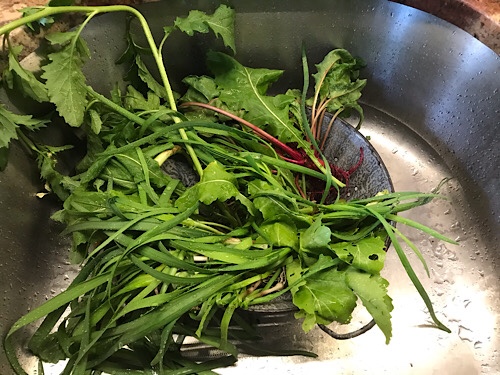
    The generous harvest from today’s garden all came up from prior year plantings. I may joke about how many variations of greens and grains and pulses I can come up with, but the greens are from my back garden, bursting with nutrients, and everything else is a long storage pantry item (including in recent years, dried beans, for having grown enough of them). Most anything else is a luxury. I can go a long time between trips to the grocery store and still have well-flavored, healthy, and inexpensive meals.

Leave a Reply

Your email address will not be published. Required fields are marked *

This site uses Akismet to reduce spam. Learn how your comment data is processed.